
Sem título
Slides do conjunto (3)
-
- There are more than 100 different elements. The periodic table is a chart showing all the elements arranged in a particular way. A Russian scientist called Dmitri
- Mendeleev produced one of the first practical periodic tables in the
- 19th century. The modern periodic table is based closely on the ideas he
- used:
- the elements are arranged in order of increasing atomic number
- the horizontal rows are called periods
- the vertical columns are called groups
- elements in the same group have similar properties/are similar to each other.
-
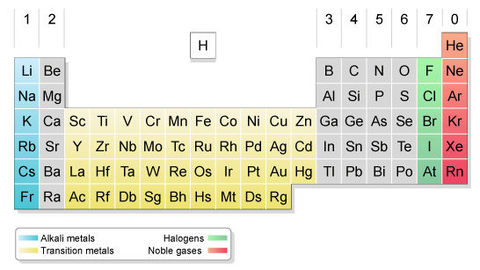
A Picture Of The Periodic Table
- Legenda: The Modern Periodic Table
-
Description Of The Periodic Table
- The main groups are numbered from 1 to 7 going from left to right, and
- the last group on the right is group 0.
- Each element has its own chemical symbol, made from letters.
- Note
- that you will never find a compound in the periodic table, because
- these consist of two or more different elements joined together by
- chemical bonds.
- So you won’t find substances like water or copper sulfate in the periodic table.
- The section in the middle of the
- table is called the Transition Metals. You may also see all
- the groups numbered (including the transition metals), this time from 1
- to 18. If you know what one of the elements in a group is like, you can
- make predictions about the other elements in a group. For example, all
- the elements in group 1 are reactive metals, and all the elements in group 0 are non-reactive non-metals.
- Hydrogen is a non-metal but it is often put in the middle.
- Notice that most elements are metals, rather than non-metals.
Informações
- Descrição
- GCSE Chemistry - (Term 1 Topics) Slides sobre Sem título, criado por Amanda Tabansi em 06-12-2016.
- Criado por
- Amanda Tabansi
- Visualizações
- 0
- Avaliação