
Flashcards
Chapter 1: Chemical Foundations
Flashcards do conjunto (22)
- 1Atoms vs MoleculesMatter is composed of tiny particles called atoms.
Atom: smallest part of an element that is still that element.
Molecule: Two or more atoms joined and acting as a unit. - 2SubscriptsUsed when more than one atom is in the molecule.
- 3Uncertainty in MeasurementA digit that must be estimated is called uncertain.
A measurement always has some degree of uncertainty.
Record the certain digits and the first uncertain digit (the estimated number). - 4Accuracy vs PrecisionPrecision:Degree of agreement among several measurements of the same quantity.
Accuracy: Agreement of a particular value with the true value. - 5Sig Fig Rules For Zeroes1. Nonzero integers always count as significant figures.
2. Leading zeros are zeros that precede all the nonzero digits. These do not count as significant figures.
3.Captive zeros are zeros between nonzero digits. These always count as significant figures.
4. Trailing zeros are zeros at the right end of the number. They are significant only if the number contains a decimal point. - 6sig figs for exact numbersExact numbers have an infinite number of significant figures.
- 7Exponential or Scientific Notation1. c (10^y) 10>c >1
2. Sig figs shown in number easily: 3.00 x 10^2
has two sig figs
3. Advantages: Number of significant figures can be easily indicated and there are fewer zeros are needed to write a very large or very small number. - 8Sig figs in Multiplication/ DivisionFor multiplication or division, the number of significant figures in the result is the same as the number in the least precise measurement used in the calculation.
1.342 × 5.5 = 7.381 --> 7.4
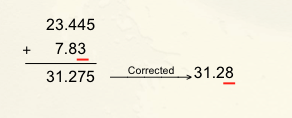
5.5= least precise so answer should have 2 sig figs - 9Sig figs in Subtraction/ Additionanswer has same number of decimal places as the least precise measurement used in the calculation
- 10Dimensional AnalysisUse when converting a given result from one system of units to another.
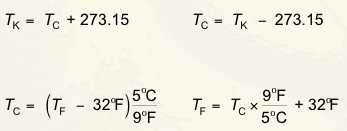
Used in stoichiometry (Chapter 3) - 11Three Systems of Measuring TempFahrenheit, Celsius, and Kelvin
- 12Density1. Mass of substance per unit volume of the substance. (open heart calculation.....m/v)
2. Common units are g/cm3 or g/mL. - 13Matter1. Anything occupying space and having mass.
2. Matter exists in three states: Solid, Liquid, and Gas. - 14Solids, Liquids, Gasses1. S: molecules have strong bonds that remain tightly structured
2. L: molecules are more spread out than liquids
3. G: Really spread part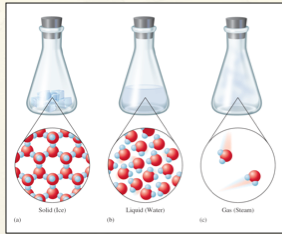
- 15LiquidHas definite volume but no specific shape.
Assumes shape of container. - 16GasHas no fixed volume or shape.
Takes on the shape and volume of its container. - 17SolidRigid
Has fixed volume and shape. - 18Mixtureshomogenous: Having visibly indistinguishable parts; solution.
heterogeneous: Having visibly distinguishable parts. - 19Compound vs MixtureCompound: substance made up of more than one atom and bound together chemically
Mixture: pure substances combined together physically, has no definite composition, ratios of substance can vary - 20Chemical ChangeA given substance becomes a new substance or substances with different properties and different composition.
- 21Physical ChangeChange in the form of a substance, not in its chemical composition.
- 22moleUnit of counting atoms.
Avagadro's number
1mole= 6.02 x 10^23 Molecules
Informações
- Descrição
- Advanced placement AP/SAT/ACT (APCHEM) FlashCards sobre Chapter 1: Chemical Foundations, criado por Ayren Mcg em 03-04-2015.
- Criado por
- Ayren Mcg
- Visualizações
- 40
- Tags
- Avaliação