
Flashcards
Structure of leaves
Flashcards do conjunto (20)
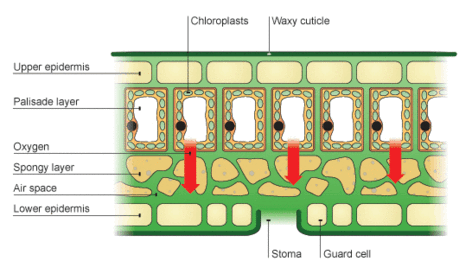
- 1How is a leaf structured?
- 2What does the waxy cuticle do?It is a thin waxy layer that is transparent to allow light through to the chloroplasts in the cells of a leaf, it also acts as a barrier to water loss through evaporation and entry of disease by microorganisms - like bacteria
- 3How are palisade cells structured?
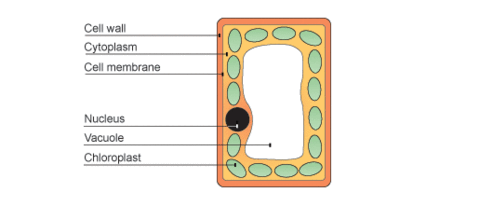
- 4What is the purpose of palisade cells?This is the main site of photosynthesis because this the the uppermost layer that contains chloroplasts and is the layer which has the most number of chlroplasts
- 5What are the advantages of palisade cells being long and closely packed?There is more chlorophyll in a small space
- 6Where are chloroplasts found?Found in palisade, spongy and guard cells.
- 7What is the mesophyll layer?It is the middle of the leaf - contains the palisade and spongy layer.
- 8Describe the spongy layer.It is more rounded and less closely packed than the palisade layer. It can photosynthesise but has fewer chloroplasts than the palisade layer. Main site of gas exchange in the leaf.
- 9What is the lower epidermis?It contains the guard cells and stomata
- 10Why do leaves have stomata?To allow the exchange of gases depending on the condition
- 11Purpose of guard cells.Help the stomata to regulate the rate of transpiration by opening or closing.
- 12What are the veins in a leaf and why do leaves have them?They are the xylem and phloem and transport food and water within the plant.
- 13Explain the function of xylem.Water and mineral ions are supplied to the leaf by the xylem, it is part of a continuous transport system.
- 14Explain the function of the phloem.Carries the products of photosynthesis - sugars, from the mesophyll cells to parts of the plant that cannot produce their own food, such as the roots.
- 15Which gases are involved in diffusion?Mainly carbon dioxide and oxygen.
- 16How do the cuticle and stomata reduce water loss?The shiny surface on the cuticle reflects heat and stomata open at night when it is less humid, so less water will evaporate.
- 17What are the different parts of a leaf?
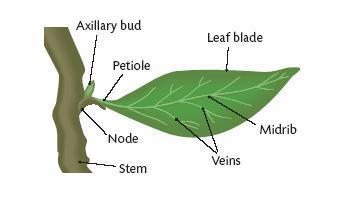
- 18What are the purposes for each part of a leaf?Network of veins - transport system for the plant
Petiole - holds the leaf so it can face the sun
Lamina (leaf surface) - absorbs light to create nutrients
Midrib - supports the leaf and is the main part of the transport system
Stem - keeps the leaves in the light - 19How are leaves adapted for efficient photosynthesis?They are:
Broad -to absorb as much light as possible
Thin - to speed uo diffusion - \(CO_2\) can easily reach the mesophyll
Light - so they are able to grow in a certain angle to recieve as much light possible
They have veins to transport water and food
Upper epidermis - prevent water loss - 20How does water from the soil reach the leaf?It is absorbed by the roots and carried upwards by the xylem into the midrib, then into the network of veins
Informações
- Descrição
- Flashcards on parts of a leaf and their use
- Criado por
- Fatima K
- Visualizações
- 379
- Tags
- Avaliação