
Flashcards
IGCSE Flashcards Higher

Flashcards do conjunto (59)
- 1What is the correct terminology for the angles below and what is their relationship?Alternate angles - they are equal
- 2What is the correct terminology for these angles and what is their relationship?Corresponding angles - they are equal

- 3What is the correct terminology for the angles below and what is their relationship?Supplementary/Co-interior/Allied angles - they add up to 180°

- 4What is the correct terminology for these angles and what is their relationship?Vertically opposite angles - they are equal

- 5How do you find the volume of a prism?Volume = Area of cross-section x height

- 6How do you find the sum of the interior angles of a polygon?Sum of interior angles = (n - 2) x 180°
n = no. of sides
- 7What is the sum of one interior angle and its exterior angle?180°

- 8What is the sum of exterior angles?360°
(To find one do 360 ÷ no. of sides)
- 9How do you calculate frequency density?Frequency density = Frequency ÷ class width

- 10When drawing a cumulative frequency diagram, which values should you plot with?Upper class boundaries (x) and cumulative frequency (y)


- 11What does congruent mean?Same shape and same size - identical in form

- 12What does similar mean?Having corresponding sides proportional and corresponding angles equal (same shape, different size)

- 13How do you calculate the area of a sector?


- 14How would you calculate arc length?


- 15Which equation would you write down to describe 'y is proportional to x'y = kx
- 16Which equation would you write down to represent 'y varies directly proportional to the square of x'

- 17Which equation would you write down for 'y is indirectly proportional to the cube root of x'?

- 18If I'm working out the area of a similar shape, what do I need to remember to do with the scale factor?Square it
- 19If I'm finding the volume of a similar shape, what do I need to remember to do with the scale factor?Cube it

- 20How do I calculate interquartile range?UQ - LQ

- 21If I'm increasing something by 8%, what would I multiply by?1.08
- 22If I'm decreasing something by 5%, what would I multiply by?0.95
- 23If I multiply something by 1.025, what have I increased it by?2.5%
- 24What calculation would you carry out if you wanted to work out how much money you would have in the bank if you saved £100 for 5 years at an interest rate of 0.2%?

- 25Which of these graphs show direct proportion?I and II (directly proportionate graphs always go through (0,0)

- 26Which of these graphs show indirect proportion?IV only
(reciprocal graph of the form y = k/x)
- 27What type of graph is this?Quadratic

- 28Does the graph below have a maximum or minimum turning point and how do you know?Maximum because the coefficient of x^2 is negative

- 29Differentiate


- 30What do you get when you differentiate displacement?Velocity
- 31What do you get when you differentiate velocity?Acceleration
- 32If asked to ESTIMATE the gradient of a point on a curve, what should you do first?Draw a tangent

- 33If asked to find the gradient of a point on a curve, what should you do?Differentiate and then substitute the x-value in
- 34If asked to find which point on a curve has a specific gradient, what should you do? Eg:Differentiate, put this equal to the given gradient and solve to find x coordinate (then find y coordinate)


- 35What is the gradient (dy/dx) at a max or min turning point equal to?0
- 36If a turning point of a quadratic graph is at (3, -4), what is the equation of the axis of symmetry?

- 37How do you calculate the gradient of the line on which (x1, y1) and (x2, y2) lie?

- 38Gradients of parallel lines are......Equal

- 39Gradient of perpendicular lines multiply to make...- 1

- 40What is the midpoint of (x1, y1) and (x2, y2)?

- 41What is the distance between (x1, y1) and (x2, y2)?

- 42What would you use to find the area below?


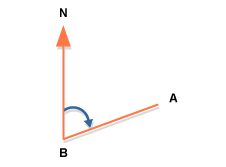
- 43If you're asked to find the bearing of A from B, where should you draw the North line and how many figures should the answer have?At B, 3 figures
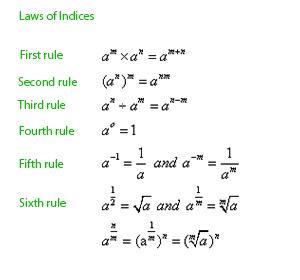
- 44Name as many laws of indices as you can
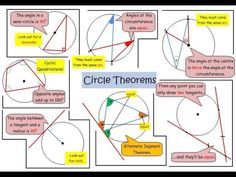
- 45Name as many circle theorems as you can
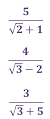
- 46How do you rationalise these?
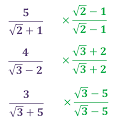
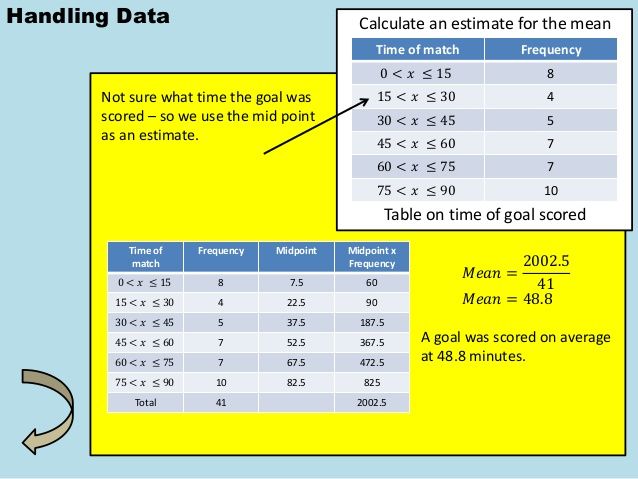
- 47If asked to estimate the mean from a grouped frequency table, what should you do first?Find the mid-points
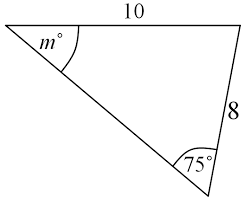
- 48What would you use to find the angle m?Sine rule
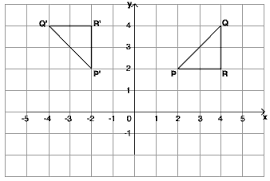
- 49When describing this transformation, which things do you need to include?Rotation, state the centre of rotation, clockwise or anticlockwise and how many degrees
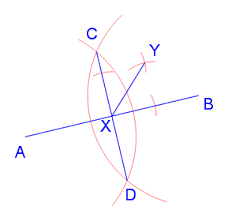
- 50How do you construct a 45 degree angle with a compass?Perpendicular bisector to get 90 degree angle followed by angle bisector
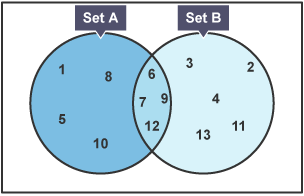
- 51What is n(A U B)?13
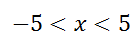
- 52—

- 53When carrying out fg(2), which function do you substitute 2 into first?The g function
- 54Describe the transformationEnlargement, scale factor 2, centre of enlargement (2, 2)
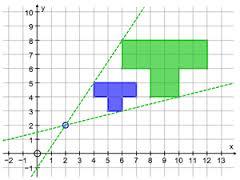
- 55Describe the transformationReflection in the line y = -1
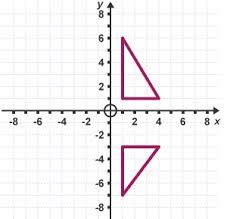
- 56Describe the transformation
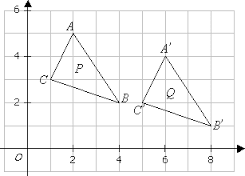
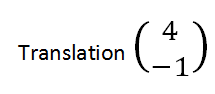
- 57What would you use to find angle A?Cosine rule
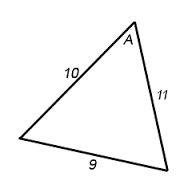
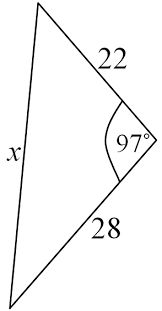
- 58What would you use to find x?Cosine rule
- 59State the elements in A'2, 3, 4, 11, 13
Informações
- Descrição
- Year 7 Maths FlashCards sobre IGCSE Flashcards Higher, criado por Iva Na em 20-03-2017.
- Criado por
- Iva Na
- Visualizações
- 75
- Avaliação