
Quiz
Learning by Doing
This quiz has question types that open in the usual player.
Questions in this quiz (25)
1Learning by doing is a learning concept that allows for humans to understand new knowledge by applying it effectively through their actions
- ATrue
- BFalse
2Learning by doing is one of [blank_start]Pratt’s[blank_end] five teaching approaches.
- APratt’s
3What are the different approaches to learning by doing?
- Aco-operative learning
- Badventure learning
- Capprenticeship
- Dall of the above
4Is apprenticeship the most common method used to train post-secondary education?
- ATrue
- BFalse
5What skills would a master practitioner have in an apprenticeship relationship?
- APossess great amounts of knowledge in their area of expertise, and are able to apply that knowledge in difficult practice settings
- BHave well-organized, readily accessible schemas (cognitive maps) which facilitate the acquisition of new information
- CHave well-developed repertoires of strategies for acquiring new knowledge, integrating and organizing their schemas, and applying their knowledge and skills in a variety of contexts
- DMotivated to learn as part of the process of developing their identities in their communities of practice. They are not motivated to learn simply to reach some external performance goal or reward
- ESituations of practice that…are frequently ill-defined and problematic, and characterized by vagueness, uncertainty and disorder‘.
6Who is the person in the back evaluating?

- AApprentice
7What must the master and learner do to enhance the learning of the apprentice?
- Asay what they are thinking during application of their knowledge and skill
- Bread textbooks
- Cjust do the work
- Dyell out every single action they are doing
8What are the main advantages of the apprenticeship model of teaching?
- Ateaching and learning are deeply embedded within complex and highly variable contexts, allowing rapid adaptations to real-world conditions
- Ballows the students to understand and experience the knowledge by self-mimicking the actions at home
- Cmakes efficient use of time and experts, who can integrate teaching within their regular routine
- Dprovides learners with clear models or goals to attribute to
9Can an apprentice determine how long it will take them to be an expert in their field through the apprenticeship model?
- ATrue
- BFalse
10In trades or occupations undergoing rapid change in the workplace, the [blank_start]apprenticeship model[blank_end] can slow adaptation or change in [blank_start]working methods[blank_end], because of the prevalence of traditional values and norms being passed down by the ‘[blank_start]master[blank_end]’ that may no longer be as relevant in the new conditions facing workers. This limitation of the apprenticeship model can be clearly seen in the [blank_start]post-secondary education[blank_end] sector, where traditional values and norms around teaching are increasingly in conflict with [blank_start]external forces[blank_end] such as new [blank_start]technology[blank_end] and the massification of higher education
- Aapprenticeship model
- Bexperiential learning model
- Cmaster
- Dapprentice
- Eworking methods
- Fteaching methods
- Glearning methods
- Hexternal forces
- Iinternal forces
- Joutside forces
- Kinside forces
- Ltechnology
- Mclothes
- Nwork
- Opost-secondary education
- Phigh school education
- Qelementary school education
11What is experiential learning?
- Alearners reflecting on their experience of doing something
- Blearners reflecting on the knowledge they have learned
- Clearners being enticed to work for cooperative education
- Dlearners relying on their knowledge and experience to perform tasks
12What are the four stages in Kolb's experiential learning model?
- Aactive experimentation
- Bconcrete experience
- Creflective observation
- Dabstract conceptualization
- Eall of the above
13What are some of the design models aimed to embed real world context learning?
- Alaboratory, workshop or studio
- Bapprenticeship
- Clearning by doing
- Dexperiential learning
- Ecase-based learning
14Do students gain hand on experience in choosing and using common scientific, engineering or trades equipment?
- ATrue
- BFalse
15What is the value of laboratory classes?
- Amove from experiencing the knowledge to observing it
- Bmove from observing the knowledge to experiencing the knowledge
- Cmove from not doing anything about it
- Dlearning by doing
16Are laboratories limited in the education they provide?
- ATrue
- BFalse
17What type of learning based steps is this based upon?
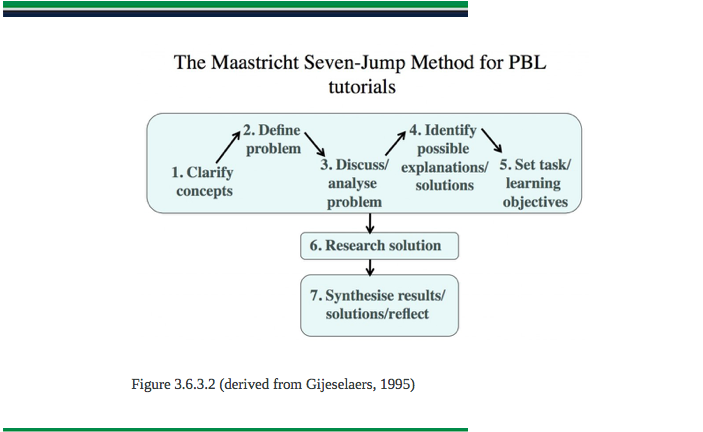
- Aproblem-based learning
18Is problem-based learning not a better approach for long-term retention of material and developing skills?
- ATrue
- BFalse
19What is a variation of problem-based learning?
- Abehaviorism
- Bapprenticeship model
- Ctheory learning
- Dcase-based learning
20[blank_start]Case-based[blank_end] learning uses a guided inquiry method, but usually requires the students to have a degree of prior [blank_start]knowledge[blank_end] that can assist in analysing the [blank_start]case[blank_end].
- ACase-based
- Bknowledge
- Ccase
21Is case based learning not valuable for dealing with complex, interdisciplinary topics or issues?
- ATrue
- BFalse
22What are some of the subjects used in for case-based learning approaches?
- Abusiness and economics
- Bclinical practice in medicine
- Claw
- Dart
- Eall of the above
23[blank_start]Project-based[blank_end] learning is similar to [blank_start]case-based[blank_end] learning, but tends to be longer and broader in scope, and with even more student autonomy/responsibility in the sense of choosing sub-topics, organising their work, and deciding on what methods to use to conduct the [blank_start]project[blank_end].
- AProject-based
- BCase-based
- CProblem-based
- Dcase-based
- Eexperiential
- Fapprenticeship
- Gproject
- Hproblem
- Isolution
24What is a problem with project-based learning?
- Ainstructors focusing too much on students
- Binstructor losing focus on the key objectives
- Cinstructor not performing projects
- Dinstructor providing solutions to students and not provide any learning opportunities
25[blank_start]Inquiry-based[blank_end] learning (IBL) is similar to [blank_start]project-based[blank_end] learning, but the role of the teacher/instructor is somewhat different. In [blank_start]project-based[blank_end] learning, the instructor decides the ‘driving question’ and plays a more active role in guiding the students through the process. In [blank_start]inquiry-based[blank_end] learning, the learner explores a theme and chooses a topic for research, develops a plan of research and comes to conclusions, although an instructor is usually available to provide help and guidance when needed.
- AInquiry-based
- Bproject-based
- Cproject-based
- Dinquiry-based
Information
- Description
- Learning by doing - How do you learn assignment EM203
- Author
- Syed Hasani
- Language
- English
- Views
- 39
- Rating
- No ratings yet Rate this quiz