
Quiz
partial derivtive test
This quiz has question types that open in the usual player.
Questions in this quiz (5)
1use +, -, +/- 0, 0/+, 0/-. and any to make the statement true for the max point. If two symbols are the same, use the 2 and then the symbol for the in the order you read it. 0 is only
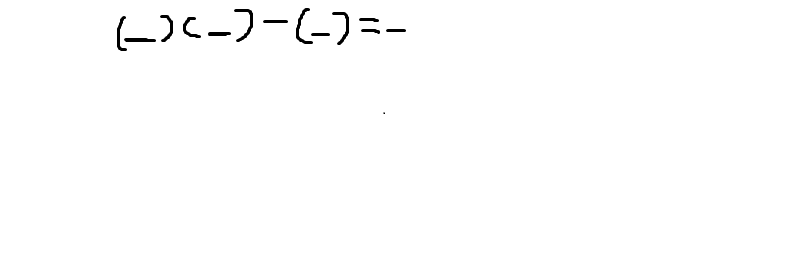
- A4 (+)
- B-
- C0
- D+/-
- E0/-
- F0/+
- G3 (any)
- H2 (+)
- I2 (-)
- J2 (0)
- K2 (+/-)
- L2 (0/+)
- M2 (0/-)
- N2 (any)
- O3 (+)
- P3 (-)
- Q3 (0)
- R3 (+/-)
- S3 (0/+)
- T3 (0/-)
- Uany
- V+
- W4 (-)
- X4 (0)
- Y4 (+/-)
- Z4 (0/+)
- AA4 (0/-)
- AB4 (any)
2Use +, -. 0, +/-, 0/+. 0/-, and any to make the statement true for the min point. If two symbols are the same put the number in front in the order that you will read it. for example if the first blank and the third blank are both 0, then for the third blank use 2(0)
- A+
- B-
- C0
- D+/-
- E0/+
- F0/-
- G3 (any)
- H2 (+)
- I2 (-)
- J2 (0)
- K2 (+/-)
- L2 (0/+)
- M2 (0/-)
- N2 (any)
- O4 (+)
- P3 (-)
- Q3 (0)
- R3 (+/-)
- S3 (0/+)
- T3 (0/-)
- U(any)
- V3 (+)
- W4 (-)
- X4 (0)
- Y4 (+/-)
- Z4 (0/+)
- AA4 (0/-)
- AB4 (any)
3Use +, -, 0, +/-, 0/+, 0/-, and any to make the statement true for the saddle point. Use numbers when two symbols are the same in this maner. For example the first equation blank 1 is - along with first equation blank 2 is -, and equation 2 blank 2 is -. For the first one you will use -, for the second on 2 (-) the third one 1.5 (-) Start with -.

- A+
- B-
- C0
- D+/-
- E2 (+/0)
- F-/0
- G3 (any)
- H2 (+)
- I4 (-)
- J2 (0)
- K2 (+/-)
- L0/+
- M2 (0/-)
- N2 (any)
- O3 (+)
- P3 (-)
- Q3 (0)
- R3 (+/-)
- S3 (0/+)
- T3 (0/-)
- Uany
- V4 (+)
- W2 (-)
- X4 (0)
- Y4 (+/-)
- Z4 (+/0)
- AA4 (-/0)
- AB4 (any)
- AC1.5 (+)
- AD3.5 (-)
- AE1.5 (0)
- AF1.5 (+/-)
- AG1.5 (0/+)
- AH1.5 (0/-)
- AI3.5 (any)
- AJ2.5 (+)
- AK1.5 (-)
- AL2.5 (0)
- AM2.5 (+/-)
- AN2.5 (+/0)
- AO2.5 (-/0)
- AP2.5 (any)
- AQ3.5 (+)
- AR4.5 (-)
- AS3.5 (0)
- AT3.5 (+/-)
- AU3.5 (0/+)
- AV3.5 (0/-)
- AW1.5 (any)
- AX4.5 (+)
- AY2.5 (-)
- AZ4.5 (0)
- BA4.5 (+/-)
- BB4.5 (0/+)
- BC4.5 (0/-)
- BD4.5 (any)
4Use +, -, 0, +/-, 0/+, 0/-, and any to make the statement true for an unknown point. Use numbers when two symbols are the same.
- A+
- B-
- C4 (0)
- D+/-
- E+/0
- F-/0
- Gany
- H2 (+)
- I2 (-)
- J2 (0)
- K2 (+/-)
- L2 (0/+)
- M2 (0/-)
- N2 (any)
- O3 (+)
- P3 (-)
- Q3 (0)
- R3 (+/-)
- S3 (0/+)
- T3 (0/-)
- U3 (any)
- V4 (+)
- W4 (-)
- X0
- Y4 (+/-)
- Z4 (0/+)
- AA4 (0/-)
- AB4 (any)
5The point (2, -1, -6) is a [blank_start]local minimum[blank_end] in the function f(x,y) = 2x2 + 2xy + 2y^2 - 6x. The point (0,0,2) is a [blank_start]saddle point[blank_end] in the function f(x,y) = 2x2 - 4xy + y^2 + 2. The point (-1,-1,2) is a [blank_start]local maximum[blank_end] in the function f(x,y) = - x^4 - y^2 + 4xy. The point (0,0,0) is a [blank_start]unknown[blank_end] when f(x,y) = x^2 + y^2 + 2xy.
- Alocal minimum
- Bsaddle point
- Clocal maximum
- Dunknown
Information
- Description
- multaviarible calculus (week 17) Quiz on partial derivtive test, created by jason wheeler on 23/10/2017.
- Author
- jason wheeler
- Language
- English
- Views
- 0
- Tags
- Rating
- No ratings yet Rate this quiz