
Quiz
Chapter 06
Create a free account to finish this quiz
Save your progress and see your final score.
Already have an account? Sign in
Questions in this quiz (48)
1With respect to light production in stars, select all of the correct statements from the following list.
- AHotter stars have a longer maximum intensity wavelength.
- BHeat flows from hot to cool regions.
- CBlack body radiators are generally cool.
- DStars emit light mostly from their surfaces.
- EHotter stars radiate more energy at higher frequencies.
- FThe temperature of a star can be roughly estimated from its color.
- GTemperature is a measure of the heat produced by a star.
2With respect to atoms, select all of the correct statements from the following list.
- AGaining or losing protons produces different ions.
- BElectrons surround the nucleus.
- CThe nucleus is completely composed of neutrons.
- DNeutral atoms have the same number of protons as electrons.
- EProtons are positively charged.
- FThe number of neutrons determines the isotope of an atom.
- GElectrons can be found anywhere outside a nucleus.
3Based on the interactions of light and matter, select all of the correct statements from the following list.
- AHot gases produce emission spectra.
- BHot solids emit continuous spectra.
- CThe size of an electron's orbit depends on its energy.
- DBright-line spectra are created by emission.
- EAbsorption spectra have dark lines.
- FElectrons will move to higher orbits when an atom absorbs enough energy.
- GAtoms absorb energy by emitting photons.
4With resepct to stellar spectra, select all of the correct statements from the following list.
- AThe Lyman and Paschen series of the hydrogen spectrum are not visible.
- BStellar spectra are absorption spectra.
- CBalmer lines tend to be strong in all stellar spectra.
- DEvery single star has a unique spectrum.
- EDoppler shifts in spectral lines give clues to the motions of stars.
- FAtoms can absorb or emit any amount of energy.
- GSpectra can reveal the chemical composition of stars.
5What kind of radiation do we (the human body) emit?
- Aultraviolet
- BX-rays
- Cgamma rays
- Dvisible
- Einfrared
6If you quadruple the temperature of a black body, by what factor will the total energy radiated per second per square meter increase?
- A16
- B64
- C256
- D1,024
- E4
7Which of the following statements is true about the Celsius and Kelvin (absolute) temperature scales?
- AZero degrees Celsius is the same temperature as –273 K.
- BThe size of one degree is the same on both scales.
- CZero is at the same temperature on both scales.
- DThe size of one Kelvin is 5/9 that of a Celsius degree.
- EThe size of one Celsius degree is 5/9 that of a Kelvin.
8The temperature of a gas is a measure of which of the following?
- Atotal number of atoms in the gas
- Bamount of heat that flows out of the gas
- Cdensity of the gas
- Dtotal amount of internal energy in the gas
- Eaverage motion of its atoms
9When the sun is high above the horizon in a clear sky, it has a yellowish color. According to the black body radiation curves shown here, the sun's surface temperature is most nearly which of the following?
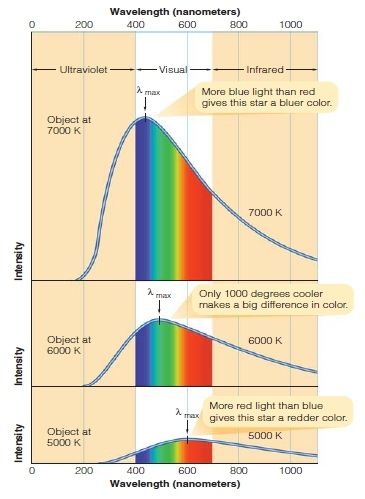
- A6,000 K
- B7,000 K
- C> 7,000 K
- D< 5,000 K
- E5,000 K
10If the temperature of star B is twice the temperature of star A, what can we say about the energy emitted by the surface of star B compared to the energy emitted by star A?
- AEach square meter emits eight times as much energy per second.
- BEach square meter emits four times as much energy per second.
- CEach square meter emits sixteen times as much energy per second.
- DThis cannot be determined without knowing the size of each star.
- EEach square meter emits twice as much energy per second.
11Which subatomic particle has a negative charge?
- Aelectron and neutron
- Belectron
- Celectron and proton
- Dproton
- Eneutron
12The wavelength of maximum intensity that is emitted by a black body is which of the following?
- Aproportional to temperature to the fourth power
- Bproportional to temperature
- Cinversely proportional to temperature to the fourth power
- Dinversely proportional to temperature
- Eproportional to temperature and proportional to temperature to the fourth power
13Of the following, which color represents the lowest surface temperature for a star?
- Ared
- Byellow
- Corange
- Dwhite
- Eblue
14The amount of electromagnetic energy radiated from every square meter of the surface of a black body each second is which of the following?
- Ainversely proportional to temperature
- Bproportional to temperature and proportional to temperature to the fourth power
- Cproportional to temperature
- Dproportional to temperature to the fourth power
- Einversely proportional to temperature to the fourth power
15An atom that is ionized must have which of the following?
- Amore protons than electrons
- Beither more electrons than protons or more protons than electrons
- Cmore electrons than protons
- Dmore protons than neutrons
- Emore neutrons than protons
16Which of the following is true of an atomic nucleus?
- AAll of these choices are correct.
- BIt contains more than 99.9% of an atom's mass.
- CIt contains all of an atom's positive charge.
- DIt contains no electrons.
- EIt contains more than 99.9% of an atom's mass and all of an atom's positive charge.
17A hot hydrogen gas emits which of the following?
- Ano light in the visible spectrum
- Bonly three spectral lines in the visible spectrum: red, blue, and violet
- Ca continuous visible spectrum (like a rainbow)
- Donly one spectral line in the visible spectrum, of red color
- Eonly two spectral lines in the visible spectrum: red and blue
18What conditions produce a dark (absorption line) spectrum?
- Alight from a continuous spectrum source passing through a cooler low-density gas
- Ba hot solid, liquid, or high-density gas
- Ca hot low-density gas
- Da hot solid, liquid, or high-density gas and hot low-density gas
- EAll of these choices are correct.
19Which electron energy level transition corresponds to a hydrogen atom absorbing a visible light photon that has a wavelength of 656 nanometers?
- AThe electron makes the transition from energy level 3 to energy level 2.
- BThe electron makes the transition from energy level 1 to energy level 2.
- CThe electron makes the transition from energy level 2 to energy level 1.
- DThe electron makes the transition from energy level 3 to energy level 4.
- EThe electron makes the transition from energy level 2 to energy level 3.
20All stars are composed of mostly hydrogen and helium, yet many stars have no lines for hydrogen or helium in their spectra. What causes this apparent contradiction?
- ASpectral lines are created in the lower atmospheres of stars, and for many stars hydrogen and helium are hidden below the atmosphere.
- BThe resolution of many spectrographs is too poor to show the extremely thin spectral lines for hydrogen and helium.
- CThe upper layers of a star contain hot, low-density gases that produce bright lines at precisely the same wavelengths as the dark lines, thus making them invisible.
- DHot hydrogen and helium gas in the interstellar medium produces bright lines to fill in the dark lines.
- EThe surface temperature is such that the electrons are not at the proper energy levels to produce spectral lines at visible wavelengths.
21You research the star Sirius and find that its spectral lines are blue-shifted. What does this tell you about Sirius?
- AIt has a transverse velocity that is toward us.
- BIt has a radial velocity that is away from us.
- CIts surface temperature is higher than that of the sun.
- DIt has a radial velocity that is toward us.
- EIt has a transverse velocity that is away from us.
22Suppose that you take the spectra of several stars and identify the 656 nm line of hydrogen. You then measure against the reference spectrum on the same image and find that some of the 656 nm lines are shifted due to the Doppler effect. Of the following shifted locations of this line, which one is that of a star that is moving away from us at the highest speed?
- Astar B at 657 nm
- Bstar C at 658 nm
- Cstar A at 655 nm
- Dstar E at 659 nm
- Estar D at 654 nm
23How did ancient blacksmiths judge the temperature of a heated piece of iron?
- Aby how long it has been heating up
- Bby its color
- Cby its smell
- Dwith a thermometer
24Which piece of iron is hottest?
- Ayellow
- Bblue
- Cwhite
- Dred
25What is the color of the hottest stars?
- Ared
- Bblue
- Cwhite
- Dyellow
26What controls the color of a star?
- Aits brightness
- Bits rotation rate
- Cits temperature
- Dits composition
27Which is a difference between a red star and blue star?
- AThe blue star's emissions peak at longer wavelengths.
- BThe red star's emissions peak at higher frequencies.
- CThe blue star's emissions peak at shorter wavelengths.
- DThe red star is hotter.
28If a match and a bonfire can both be considered a black body of about the same temperature, the bonfire gives off more energy. What is the reason for this?
- AThe match is more concentrated than the bonfire.
- BThe bonfire has a larger surface area.
- CThey are both at the same temperature, so they must give off the same amount of energy.
- DNot enough information is given to answer.
29What is true of a neutral atom?
- AIt has extra neutrons.
- BIt has the same number of protons and electrons.
- CIt has gained or lost electrons.
- DIt has an electron at a higher energy level.
30What is true of an ion?
- AIt has the same number of protons and electrons.
- BIt has gained or lost electrons.
- CIt has an electron at a higher energy level.
- DIt has extra neutrons.
31What is true of an excited atom?
- AIt has extra neutrons.
- BIt has an electron at a higher energy level.
- CIt has the same number of protons and electrons.
- DIt has gained or lost electrons.
32What determines the wavelengths of the photons an atom will absorb or emit?
- Athe number of electrons
- Bthe ionization energy of the nucleus
- Cthe difference in energy between electron energy levels
- Dthe number of extra neutrons
33What kind of spectrum would be observed when observing radiation from a hot solid or gas under high pressure?
- Acontinuous
- Babsorption
- CIt depends on the temperature.
- Demission
34What kind of spectrum would be observed when observing radiation through a cool gas?
- Aabsorption
- Bcontinuous
- CIt depends on the temperature.
- Demission
35What kind of spectrum would be observed when observing radiation from a compressed (thick) hot gas?
- Aabsorption
- Bemission
- Ccontinuous
- DIt depends on the temperature.
36What kind of spectrum would you observe from molten lava?
- Acontinuous
- Bemission
- CIt depends on the temperature.
- Dabsorption
37What kind of spectrum would you observe if you looked through gases boiling out of molten lava?
- AIt depends on the temperature.
- Babsorption
- Cemission
- Dcontinuous
38What are the Balmer lines?
- Athe visible lines of the helium spectrum
- Bthe ultraviolet lines of the hydrogen spectrum
- Cthe visible lines of the hydrogen spectrum
- Dthe infrared lines of the hydrogen spectrum
39Doppler shifts in the wavelengths of stellar spectra can tell us about the motions of a star.
If the lines in a stellar spectrum are blueshifted, which of the following is true?- AThe star could be moving perpendicular to a line between Earth and the star.
- BThe star is moving away from us.
- CThe star is moving toward us.
- DThe star is not moving at all.
40Doppler shifts in the wavelengths of stellar spectra can tell us about the motions of a star.
If the lines in a stellar spectrum are redshifted, which of the following is true?- AThe star is moving away from us.
- BThe star is moving toward us.
- CThe star is not moving at all.
- DThe star could be moving perpendicular to a line between Earth and the star.
41Doppler shifts in the wavelengths of stellar spectra can tell us about the motions of a star.
If the lines in a stellar spectrum show no Doppler shift, which of the following is true?- AThe star is moving away from us.
- BThe star is not moving at all.
- CThe star is moving toward us.
- DThe star could be moving perpendicular to a line between Earth and the star.
42The nebula shown in the figure above will produce a(n) __________ spectrum.
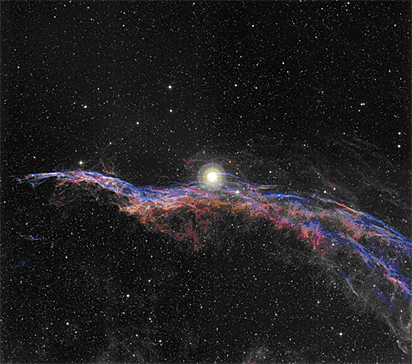
- Acontinuous
- BDoppler
- Cemission
- Dabsorption
43Which list below has the following types of stellar spectra in order of increasing temperature from left to right:
- Atypes B0; F5; G0; K5; M0; A1
- Btypes G0; K5; M0; A1; B0; F5
- Ctypes K5; M0; A1; B0; F5; G0
- Dtypes M0; K5, G0, F5, A1, B0
- Etypes F5; G0; K5; M0; A1; B0
44Which of the following colors or wavelength ranges is most intense in an M0 type star:
- Ayellow
- Bred
- Cviolet
- Dblue
45Which of the following colors (or wavelength ranges) is most intense in an A1 type star:
- Ared
- Byellow
- Cblue
- Dinfrared
46Which of the following types of stellar spectra has its intensity peak at the longest wavelength?
- Atype O2
- Btype B3
- Ctype A2
- Dtype G4
47A Model Atom. What is the mass of a hydrogen atom in grams?
- AA gram
- BA trillionth of a trillionth of a gram
- CA millionth of a millionth of a gram
- DA millionth of a trillionth of a gram
48Molecules and Atoms. Which is more massive: an atom, a molecule, an isotope, or an ion?
- AIon
- BMolecule
- CAtom
- DIsotope
Information
- Description
- Quiz on Chapter 06, created by Lisa Ye on 16/02/2018.
- Author
- Lisa Ye
- Language
- English
- Views
- 5
- Rating
- No ratings yet Rate this quiz