
Quiz
TEST 1
This quiz has question types that open in the usual player.
Questions in this quiz (16)
1Which of the following processes is NOT involved in polymer formation?
- AThe generation of ATP
- BThe generation of water molecule
- CAnabolism
- DIncrease in system entropy
- EActivated Carrier
2An oligomeric protein complex is composed of 4 identical subunits arranged in a symmetric way. It performs the conversion of Chemical-X to Chemical-Y. The protein complex has an allosteric binding sites for Chemical-Z, which upon binding, destabilizes the binding of Chemical-X and -Y. Which of the following trends best predicts the concentration of Chemical-Y over time?
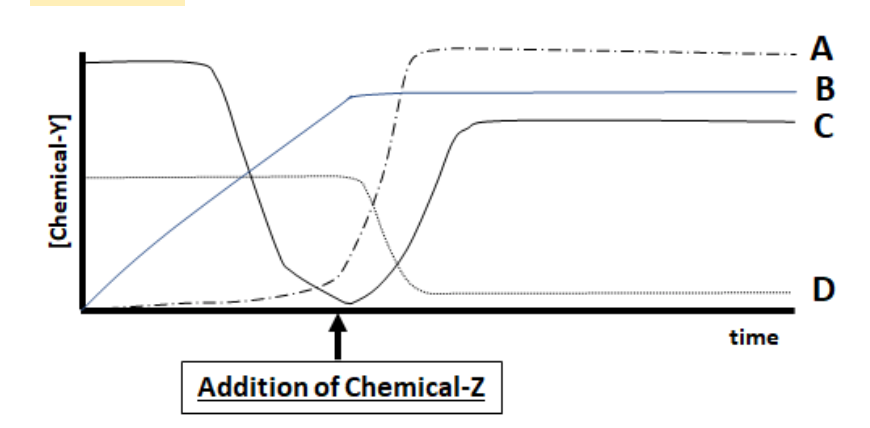
- AA
- BB
- CC
- DD
3You want to study how fast a protein molecule can diffuse inside of a cell. Which of the following methods fit best for your goal?
- AFRET =energy
- BFRAP
- CElectron microscope
- DRNAi
- EWestern blot analysis
4Proline is referred as to the “alpha helix breaker” because
- AIt's only found in the L form, which is incompatible with helical protein structure
- BIt lacks the hydrogen atom needed for hydrogen bonding
- CIt lacks a charged functional group for ionic bonding
- DIt is hydrophobic
- EIt has a polar functional group
5Carbon is a major chemical element in life. Which of the following examples is the most likely reason for that?
- ACarbon can generate four covalent bonds
- BCarbon dating can be used to age
- CCarbon mediates hydrogen bonding
- DCarbon-Carbon bond can be broken by UV light
- ECarbon is lighter than Oxygen
6While synthesizing a new blue pigment a chemist notices that the new compound accumulates between an aqueous environment and a hydrophobic environment. When added a mixture of oil, the pigment creates a blue ring around the droplets of oil. Which of the following statements best describes this new pigment?
- AThe pigment is a polar molecule and is forming hydrogen bonds with water and oil molecules
- BThe pigment is hydrophilic and will not form hydrophobic bonds with the oil
- CThe pigment is amphipathic, having a polar and nonpolar regions
- DThe pigment is neither polar nor nonpolar, its apolar
- EThe pigment is probably hydrophobic and is attempting to bond with the oil
7Which of the following statements is (are) false? (can be multiple)
- AThe total entropy in a system increases over time
- BProtein kinase performs the transfer of phosphate from ATP to the side Valine, ALanine, and Phenylalanine
- CEnzymes catalysis lowers entropy to speed up chemical reaction
- DHydrogen bonding between water molecules are the main force that drives hydrophobic interactions in aqueous solution
- EPolypeptide “MHAGSSYV” and “VYSSGAHM” fold into the identical second structure
8Ras small G protein can have two distinct protein conformations. Conformation-H forms GTP binding site while Conformation-W stabilize….
- AMutated Ras protein will have enhanced GTPase activity
- BProtein-X forms disulfide bond with mutated Ras
- CThe mutated Ras will promote Cancer formation
- DMutated RAs will stay inactive
- EMutated Ras will have faster GTP- GDP exchange rate
9A phosphorylation of Ser-155 on “protein A” exposes the Lys-300 to the surface of Protein -A which follows the destruction of protein-A. Which of the following is NOT likely the case for the process?
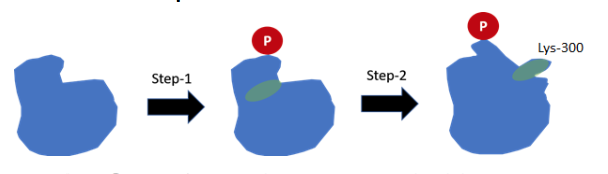
- AStep-1 requires a protein kinase
- BThe side chain from Lys-300 is used to generate a peptide bond
- CStep-2 is energetically favorable
- DRibosome and a charged tRNA are required for the peptide bond formation.
- EProtein-A be degraded by proteasome
10You are trying to generate a fusion protein of Protein-H and GFP. Which restriction enzymes would you use to generate such DNA construct? The shaded three nucleotides indicate the codons for the last amino acid in Protein-Z and the start codon for GFP.
The following is the DNA sequence that are recognized by different restriction enzymes and where each restriction enzyme makes cut. All sequences are written from 5’ to 3’.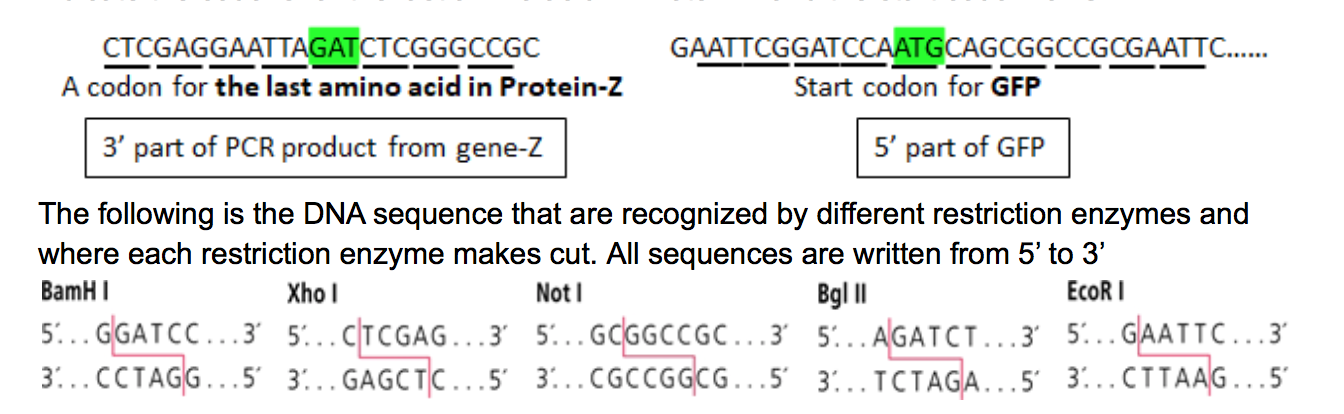
- ABamH I
- BBamH I and Not I
- CBgl II and BamH I
- DEcoR I
- EXho I and Not I
11You have successfully generated a DNA construct for a GFP-tagged protein H. You have a gut feeling that Protein-H makes multiprotein complex with Protein-J. Therefore, you made a red fluorescent protein (RFP)-tagged version of protein-J. You expressed both GFP-protein H and RFP protein J in a cell and found both green and red fluorescence overlap significantly inside the nucleus. What conclusion can you make from the observation?
- AProtein-H directly interact with Protein-J.
- BProtein-H requires additional factors to generate a protein complex with Protein-J.
- CProtein H does not form a protein complex with Protein-J.
- DProtein-H-J complex performs DNA replication.
- ENone of the above
12 In a parallel experiment, you generated a highly specific antibody for Protein-H and performed immunostaining in a cell. You found that the antibody staining result was very different from that of Question 11. You observe a staining pattern in the cytosol, but not in the nucleus. What conclusion do you make from the experiment?
- AProtein-J does not interact with Protein-H.
- BThe antibody apparently is not recognizing Protein-H.
- CAntibody staining dissolved Protein-H from the nucleus.
- DProtein-H is a cytoplasmic protein, not a nuclear protein.
- ENone of the above
13You decided to extract cell lysate and performed Western blot analysis on Protein-H with your highly specific antibody. You made a cell lysate from gene-H knockout cells as well. You expect seeing a band at 100 kDa for Protein-H based on its primary sequence. However, you didn’t see a band at 100 kDa. You just realized you forgot to add Beta-mercaptoethanol during the SDS-PAGE. Which of the following conclusions is most likely?
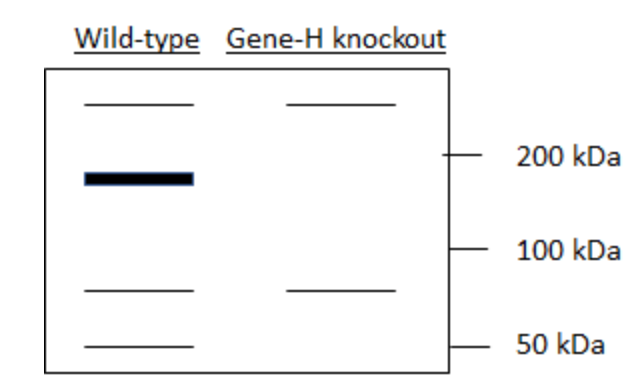
- AProtein-H never existed
- BMost of Protein-H undergoes ubiquitination
- CProtein-J directly interacts with Protein-H
- DProtein-H may form disulfide bond with other protein
- EForget about it. Nothing can be learned from a failed experiment. Do it again!
14After studying Protein-H and -J interaction, you decided to study where Protein-H is synthesized from. You expressed GFP-tagged Protein-H in cells. You photobleached the whole cell and performed a live imaging. You suspect that Protein-H is synthesized inside the nucleus. The green florescence started showing up from the nucleus 50 min after the photobleaching. Which of the followings is correct?
- AProtein-H requires 50 min to be synthesized.
- BThe Protein-H is being synthesized from the nucleus.
- CProtein-H interacts with Protein-J, definitely.
- DProtein-H is synthesized from the cytosol and imported into nucleus.
- EYour question cannot be answered with the experiment.
155'-ATAGGGCTT-3' is a short sequence of a strand of DNA. What will be the complementary sequence of the other strand? Be sure to indicate the 5' or 3' ends of each sequence.
[blank_start]5’ - AAGCCCTAT - 3’[blank_end]- A5’-AAGCCCTAT-3’
16Name each chemical bonds for 4 shaded interactions in protein folding
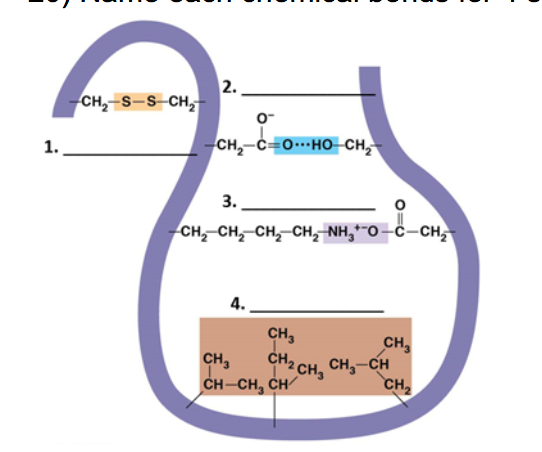
- Adisulfide bond
- BHydrogen bond
- CIonic bond
- Dhydrophobic interaction
Information
- Description
- Quiz on TEST 1, created by Hh Hhhh on 10/05/2018.
- Author
- Hh Hhhh
- Language
- English
- Views
- 8
- Rating
- No ratings yet Rate this quiz