
Quiz
ISTQB Foundation Software Testing C
This quiz has a time limit, so it opens in the usual player.
Questions in this quiz (40)
1Which approaches can help increase the quantity of software? (K2)
I. Incorporating rigorous testing
II. Preventing change requests
III. Establishing defects metrics
IV. Allocating schedule contigencies- AI and II are true; III and IV are false
- BIII and IV are true; I and II are false
- CI and IV are true; II and III are false
- DI and III are true; II and IV are false
2Which of the following can help testers understand the root causes of defects from previous projects? (K1)
- AIshikawa diagram
- BCause-and-effect diagram
- CLessons learned
- DFishbone diagram
3What would USUALLY have a set of input values and execution conditions? (K1)
- ATest basis
- BTest case
- CTest objective
- DTest control
4Which of the following general testing principles are true? (K2)
I. Testing shows the presence of defects but not the absence of defects
II. Testing of combinations of inputs and outputs will find all defects
III. Testing should start after the completion of key development tasks
IV. Testing of safety-critical software is similar to testing web applications- AI is true; II, III and IV are false
- BII is true; I, III, and IV are false
- CI and II are true; III and IV are false
- DII and III are true; I and IV are false
5Which of the following is a MAJOR test planning task? (K1)
- ADetermining the exit criteria
- BMeasuring and analysing results
- CImplementing corrective actions
- DMonitoring and documenting progress
6Which of the following is a KEY test closure task? (K1)
- AEnsuring proper environment setup
- BWriting a test summary report
- CAssessing the need for additional tests
- DFinalising and archiving testware
7Which statements BEST demonstrate the various degrees of independent testing? (K2)
- ATests are designed using exhaustive test design techniques
Tests are designed using exploratory test design techniques - BTests are designed to generate most fundamental errors early
Test are designed to uncover errors with the highest risk - CTests are designed by the person who wrote the code
Test s are designed by a person from another department - DTests are designed based on the documentation requirements
Tests are designed based on the experience of the testers
- ATests are designed using exhaustive test design techniques
8Which of the following software work products can be used as a basis for testing? (K1)
- AIncremental scenarios
- BDesign documents
- CUndocumented features
- DV-model specifications
9Which tests are BEST described by the following characteristics? (K2)
W. Component testing
X. Integration testing
Y. Alpha testing
Z. Robustness testing
1. Testing the interaction between components
2. Fixing defects as soon as they are found
3. Automating test cases before coding
4. Testing separately testable components.- AW1, X4, Y3, and Z2
- BW2, W4, X1, and Z1
- CW2, W3, W4, and X1
- DW3, X1, X2, and X4
10Which test is OFTEN the responsibility of the customers or users of the system? (K1)
- AUsability testing
- BFunctional testing
- CMaintenance testing
- DAcceptance testing
11Which acceptance test is USUALLY performed by system administrators? (K1)
- AOperational
- BCustomer
- CContractual
- DRegulatory
12Which test can be performed at all test levels? (K1)
- ASystem testing
- BOperational testing
- CStructural testing
- DIntegration testing
13Regression testing can be applied to which of the following? (K2)
I. Functional testing
II. Non-functional testing
III. Structural testing- AI and II only
- BI and III only
- CII and III only
- DI, II, and III
14Which test requires the execution of the software component? (K1)
- AFormal Inspection
- BDynamic testing
- CCode walkthrough
- DExecution testing
15As a moderator in a typical formal review, what can be one of your responsibilities? (K1)
- ADeciding on the execution of reviews
- BDocumenting all the issues and problems
- CLeading the review of the documents
- DIdentifying and describing the findings
16What is the KEY difference in the usage of static analysis tools? (K2)
- ADevelopers use static analysis tools before and during component testing
Designers use static analysis tools during software modeling - BDevelopers use static analysis tools to check the syntax of their codes
Designers use static analysis tools to ensure adherence to programming standards - CDevelopers use static analysis tools before and after integration testing
Designers use static analysis tools to guarantee regulatory compliance - DDevelopers use static analysis tools to check the syntax of their codes
Designers use static analysis tools after software modeling
- ADevelopers use static analysis tools before and during component testing
17Features to be tested, approach refinements, and feature pass/fail criteria BUT not environmental needs should be specified in which document? (K3)
- ATest case specification
- BTest Plan
- CTest procedure specification
- DTest design specification
18Which document specifies the execution order of test cases? (K1)
- ATest design specification
- BTest item
- CTest procedure specification
- DTest plan
19Match the test design techniques to the correct descriptions. (K2)
S. Black-box technique
T. White-box technique
U. Structural-based technique
V. Specification-based technique
1. Selecting test cases based on documentation
2. Ignoring the internal structure of the system- AS1, S2, U1, and U2
- BT1, T2, U1, and U2
- CS1, S2, V1, and V2
- DT1, T2, V1, and V2
20What techniques would be MOST appropriate if the specifications are outdated? (K3)
- AStructure-based and experienced-based techniques
- BBlack-box and specification-based techniques
- CSpecification-based and structure-based techniques
- DStructure-based technique and exhaustive testing
21To test an input field that accepts a two-digit day based on a particular month, which data set demonstrates boundary value analysis? (K3)
- A0, 1, 16, 31, and 100
- B1, 27, 28, 30, and 31
- C2, 26, 27, 29, and 30
- D-1, 0, 15, 32, and 99
22Which technique is OFTEN considered as an extension of equivalence partitioning? (K1)
- ADecision table testing
- BState transition testing
- CUse case testing
- DBoundary value analysis
23Without testing all possible transitions, which test suite will test all marital statuses? (K3)
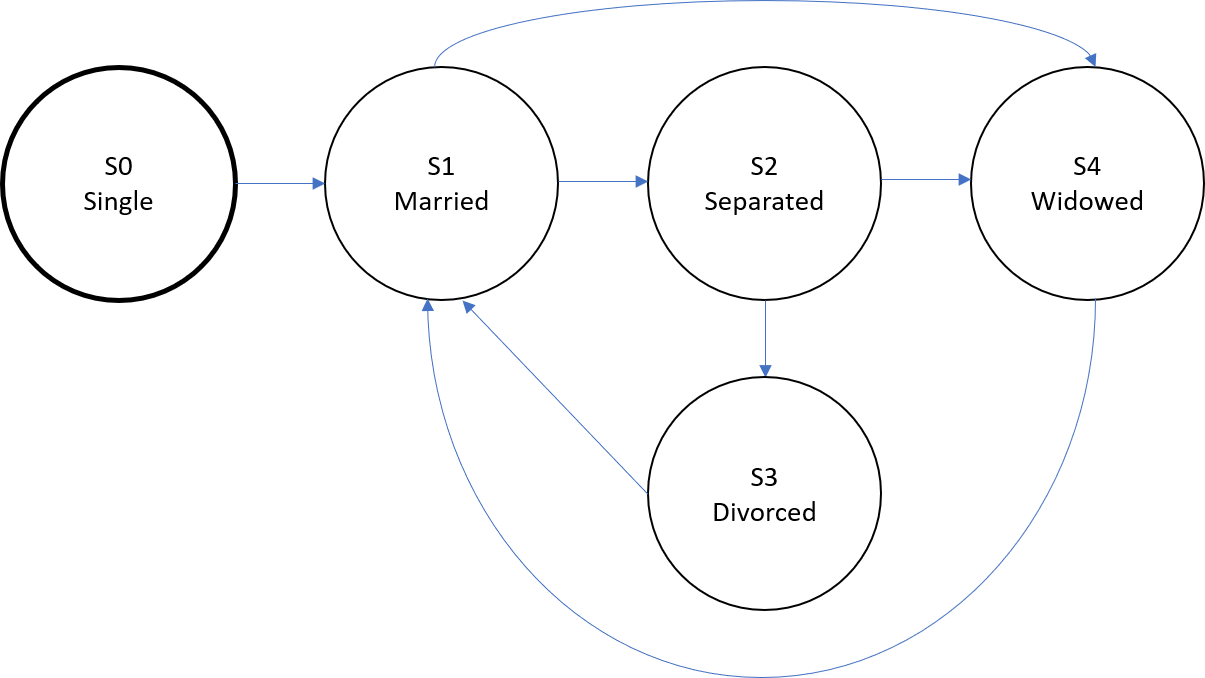
- AS0-S1-S2-S4-S1-S4
- BS0-S1-S2-S3-S1-S2
- CS0-S1-S4-S1-S2-S3
- DS0-S1-S2-S3-S4-S1
24Which technique describes process flows through a system based on its likely usage? (K1)
- AData driven testing
- BState transition testing
- CDecision table testing
- DUse case testing
25Which combination of p, q, and r values will ensure 100% statement coverage? (K3)
if (p = q) {
r = r + 1;
if (r < 5) {
s = 10;
}
} else if (p > q) {
s = 5;
}- Ap = 5, q = 5, r = 5
p = 5, q = 4, r = -1 - Bp = 5, q = 1, r = 3
p = 4, q = 4, r = 5 - Cp = 3, q = 3, r = 3
p = -1, q = -2, r = 3 - Dp = -1, q = -1, r = 0
p = -2, q = -1, r = 0
- Ap = 5, q = 5, r = 5
26How many test cases are needed to achieve 100% condition coverage? (K3)
if ((temperature < 0) or
(temperature > 100)) {
alert ("DANGER");
if ((speed > 100) and (load <= 50)) {
speed = 50;
}
} else {
check = false;
}- A5
- B4
- C2
- D3
27What is an informal test design technique where a tester uses information gained while testing to design new and better tests? (K1)
- AError guessing
- BExploratory testing
- CUse case testing
- DDecision table testing
28How are error guessing and exploratory testing similar? (K2)
- ABoth are widely used formal techniques
- BBoth are white-box test design techniques
- CBoth are experience-based testing
- DBoth are effective at all testing levels
29Who should be responsible for coordinating the test strategy with the project manager and others? (K1)
- ATester
- BDeveloper
- CCustomer
- DTest leader
30Which of the following are KEY tasks of a test leader? (K2)
i. Understanding the project risks
ii. Measuring performance of components
iii. Scheduling tests and other activities
iv. Using monitoring tools as needed- Ai and iii
- Bi and ii
- Ciii and iv
- Dii and iii
31What is a group of test activities that are organised and manager together? (K1)
- ATest procedure specification
- BTest level
- CTest case specification
- DTest plan
32Which test approaches or strategies are characterised by the descriptions below? (K2)
S. Process-compliant approaches
T. Heuristic approaches
U. Consultative approaches
V. Regression-averse approaches
1. Includes reuse of existing test material
2. Listens to suggestions from technology experts
3. Adheres to industry-specific standards
4. Runs test execution and evaluation concurrently- AS4, T3, U2, V1
- BS1, T2, U3, V4
- CS2, T3, U1, V4
- DS3, T4, U2, V1
33What is the ratio of the number of failures relative to a category and a unit of measure? (K3)
- AFailure rate
- BDefect density
- CFailure mode
- DFault tolerance
34What are the main objectives of software project risk management? (K2)
- AIncrease focus on preventive processes and improve tester job satisfaction
- BReduce the probability of occurrence and decrease the potential impact
- CControl contractor problems and minimise the impact of corporate politics.
- DIncrease the probability of project success regardless of the cost involved.
35Based on the IEEE Standard for software test documentation (IEEEStd 829-1998), in which sections of the test incident report should the following details be recorded? (K1)
a) Test incident report identifier
b) Summary
c) Incident description
d) impact
1. Expected results
2. Actual results
3. Procedure step
4. Environment
5. Revision level
6. Date and time- Aa:3; b:5; c:1,2,4, and 6
- Bb:5; c:1,2,3,4, and 6
- Cb:5 and 6; c: 1,2,3, and 4
- Da:5,c:1,2,3,4, and 6
36Based on the IEEE Standard for Software Test Documentation (IEEE Std 829-1998), which of the following sections are part of the test summary report? (K3)
a) Summary
b) Test incident report identifier
c) Test deliverables
d) Risks and contingencies
e) Variances
f) Approvals
g) Output specifications- Aa, e, and f
- Ba, c, and d
- Ca, b, and f
- Da, d, and e
37Which tool can be used to support and control part of the test management process? (K1)
- ACoverage management tool
- BTest management tool
- CData preparation tool
- DPerformance testing tool
38What is a scripting technique that uses data files to contain not only test data and expected results, but also keywords related to the application being tester? (K1)
- AAutomation technique
- BScripting language
- CProcess-driven testing
- DKeyword-driven testing
39Which tool needs to interface with other office automation software in order to generate reports in the format required by the organisation? (K1)
- AProgress tracking tools
- BTest management tools
- CMetrics management tools
- DTest execution tools
40Which of the following can be considered as success factors when deploying a new tool in an organisation? (K2)
- AProviding coaching to users and defining usage guidelines
- BMonitoring tool usage and reducing the need for risk analysis
- CImproving processes and focusing more on component testing
- DAssessing testing completion and minimising code reviews
Information
- Description
- ISTQB - Foundation Level Foundation - Certified Tester Quiz on ISTQB Foundation Software Testing C, created by Robyn Babbage on 09/07/2018.
- Author
- Robyn Babbage
- Language
- English
- Views
- 30
- History
- Created on 9 Jul 2018 · updated on 21 Aug 2018
- Tags
- Rating
- No ratings yet Rate this quiz