
14535132
Description

Quiz by Catherine Oh, updated more than 1 year ago

|
Created by Catherine Oh
over 7 years ago
|
|
Question 1
Question
This portion protects and anchors the hearts, preventing overstretching. It is made from dense irregular connective tissue.
Answer
-
mediastinum
-
epicardium
-
fibrous pericardium
-
endocardium
Question 2
Question
The [blank_start]serous[blank_end] pericardium consists of the parietal layer which is fused with fibrous [blank_start]pericardium[blank_end] and a [blank_start]visceral[blank_end] layer which is the epicardium that holds direct contact with the heart.
Answer
-
serous
-
pericardium
-
visceral
Question 3
Question
Serous fluid is found outside of the parietal and visceral pericardia in the pericardial cavity.
Answer
- True
- False
Question 4
Question
Grooves on the outside of the heart that separate the chambers called [blank_start]sulci[blank_end]. They contain blood vessels and [blank_start]fat[blank_end].
Answer
-
sulci
-
fat
Question 5
Question
What are all the correct characteristics about the auricle?
Answer
-
Is a pouch-like structure on the anterior surface of atrium.
-
Is found between the parietal and visceral pericardia in the pericardial cavity.
-
Helps holds atria hold a greater volume of blood.
-
Are found on the left and right side of the heart.
Question 6
Question
Which chambers are the receiving chambers of the heart?
Answer
-
ventricles
-
atria
-
superior and inferior vena cava
-
tricuspid (AV) valve
Question 7
Question
What right atrium receives blood from what 3 sources?
Answer
-
superior vena cava
-
inferior vena cava
-
coronary sinus
-
left ventricle
Question 8
Question
What is another name for the aortic valve?
Answer
-
semilunar valve
-
atrioventricular valve
Question 9
Question
These valves prevent backflow from the ventricles to the atria.
Answer
-
left and right atrioventricular valves
-
left and right semilunar valves
Question 10
Question
These valves prevent backflow from the arteries into the ventricles.
Answer
-
Atrioventricular valve
-
Semilunar valve
Question 11
Question
The right AV valve is also known as the:
Answer
-
bicuspid
-
mitra
-
tricuspid
Question 12
Question
What portion of the heart supplies heart cells with fresh oxygen and nutrients?
Answer
-
coronary veins
-
coronary arteries
-
semilunar valves
-
atrioventricular valves
Question 13
Question
These structures collect waste from cardiac muscle and drain into a large vein (coronary sinus) which then empties into the right atrium.
Answer
-
coronary veins
-
coronary arteries
-
sinoatrial node
-
purkinje fibers
Question 14
Question
What are some characteristics of cardiac muscle?
Answer
-
branched
-
intercalated discs
-
gap junctions
-
desmosomes
-
voluntary
-
multi-nucleated
Question 15
Question
The presence of [blank_start]creatine[blank_end] kinase in the blood indicates injury of skeletal or cardiac muscle cells. This is often an indicator of a myocardial [blank_start]infarction[blank_end].
Answer
-
creatine
-
infarction
Question 16
Question
Name the correct structures. (singular)
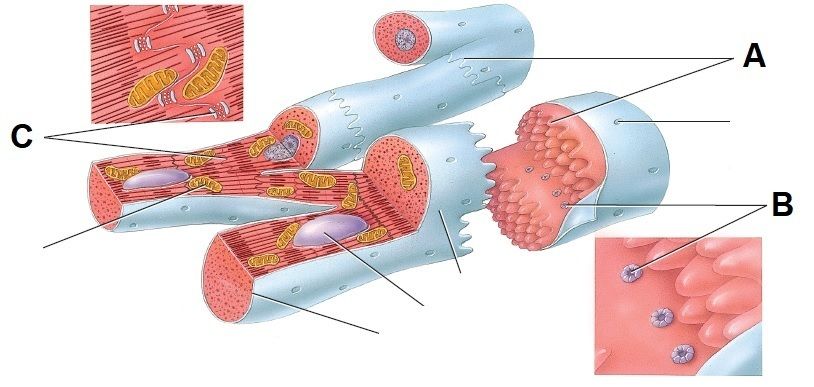
Answer
-
intercalated disc
-
gap junction
-
desmosome
Question 17
Question
What are these structures? Give the actual names, not the kind of filament.
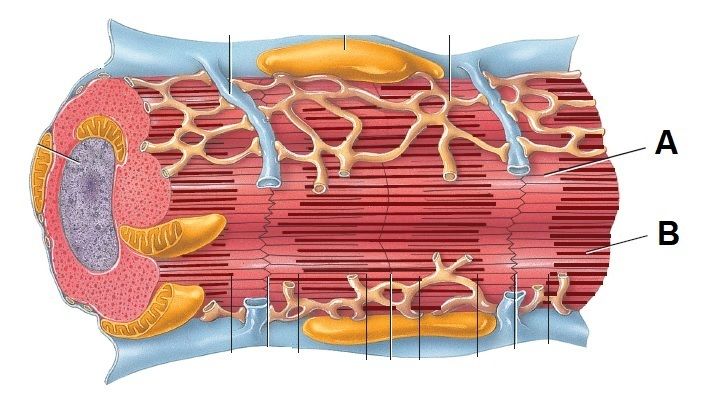
Answer
-
actin
-
myosin
Question 18
Question
What type of contraction does each colour indicate?
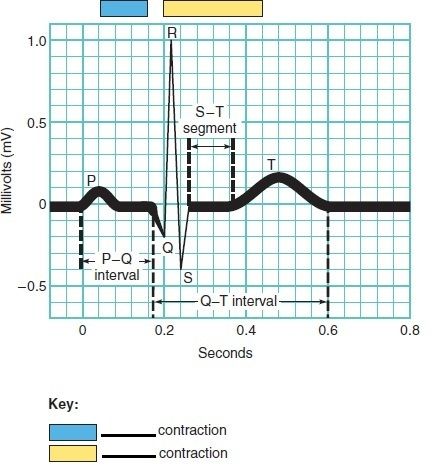
Answer
-
atrial
-
ventricular
Question 19
Question
Auto-rhythmic fibers repeatedly generate spontaneous action potentials that then trigger heart [blank_start]contractions[blank_end]. First, they act as [blank_start]pacemakers[blank_end], and second they form the conduction system which [blank_start]propagates[blank_end] actions potentials through the heart muscle.
Answer
-
contractions
-
excitations
-
depolarizations
-
propagates
-
instigates
-
implicates
-
stimuli
-
controllers
-
pacemakers
Question 20
Question
What channels open for depolarization?
Answer
-
Ca2+
-
Na2+
-
K+
Question 21
Question
During the plateau phase, _______ channels opens and let ______ions enter from outside cell and from storage in SR.
Answer
-
Ca2+, Ca2+
-
Na2+, Ca2+
-
K+, K+
-
K+, Ca2+
Question 22
Question
After Ca2+ ions are open to enter the outside cells, Ca2+ binds to ________ to allow for actin-myosin cross-bridge formation and tension development. This is the beginning of muscle contraction.
Answer
-
troponin
-
epinephrine
-
myosin
-
actin
Question 23
Question
The refractory period is a period of time that a cell cannot be stimulated by another action potential.
Answer
- True
- False
Question 24
Question
Cardiac muscles rely on [blank_start]aerobic[blank_end] cellular respiration for [blank_start]ATP[blank_end] production. They have many [blank_start]mitochondria[blank_end] and use lactic acid produced by [blank_start]skeletal[blank_end] muscles.
Answer
-
ATP
-
aerobic
-
mitochondria
-
skeletal
Question 25
Question
One cardiac cycle consists of a systole and diastole of both atria, rapidly followed by the systole and diastole of both ventricles.
Answer
- True
- False
Question 26
Question
What is the sound of the first "lubb" in a heartbeat?
Answer
-
Blood turbulence during rapid ventricular filling.
-
Blood turbulence associated with closing of the AV valves after ventricular systole.
-
Blood turbulence associated with closing of the semilunar valves near the beginning of the ventricular diastole
-
Blood turbulence during atrial systole.
Question 27
Question
Blood turbulence associated with closing of the semilunar valves near the beginning of the ventricular diastole makes the second heart sound. ("dupp" of the lupp-dupp)
Answer
- True
- False
Question 28
Question
Blood turbulence during rapid ventricular filling makes the third heart sound during a cardiac cycle.
Answer
- True
- False
Question 29
Question
Blood turbulence during atrial systole is the fourth sound and is loud enough to hear after the first 2 closures of the heart.
Answer
- True
- False
Question 30
Question
Atrial systole is when blood is ejected and completely fills the ventricles.
Answer
- True
- False
Question 31
Question
What is the correct relationship between cardiac output, stroke volume and heart rate?
Answer
-
CO = HR X SV
-
HR = SV / CO
-
CO = SV / HR
-
SV = HR X CO
Question 32
Question
[blank_start]Stroke[blank_end] volume is the volume of blood ejected by the [blank_start]ventricle[blank_end] with EACH contraction.
Answer
-
Stroke
-
ventricle
Question 33
Question
Increased [blank_start]K+[blank_end] blocks generation of action potentials. Increased [blank_start]Na+[blank_end] blocks Ca2+ inflow. Increased [blank_start]Ca2+[blank_end] speeds heart rate and force of contraction.
Answer
-
K+
-
Na+
-
Na+
-
Ca2+
-
Ca2+
-
K+
-
Na+
-
K+
Question 34
Question
Elastic arteries include:
Answer
-
Pulmonary trunk
-
aorta
-
brachiocephalic subclavian
-
common carotid
-
common iliac
-
basilar arteries
Question 35
Question
What is an anatomses?
Answer
-
A division of a vein along a body part.
-
Very small artery that lowers pressure.
-
Union of two or more arteries supplying the same body region.
-
Connects arterioles and venules.
Question 36
Question
Capillaries only consist of what two structures?
Answer
-
endothelium and basement membrane
-
smooth muscle and endothelium
-
connective tissue and basement membrane
-
smooth muscle and basement membrane
Question 37
Question
Capillaries function of exchange of nutrients an wastes between blood and tissue fluid.
Answer
- True
- False
Question 38
Question
What two structures create a bloodflow called the microcirculation?
Answer
-
metarteriole
-
intercellular cleft
-
postcapillary venule
-
sinusoid
Question 39
Question
The myocardium consists of mostly [blank_start]cardiac[blank_end] muscle.
Answer
-
cardiac
Want to create your own Quizzes for free with GoConqr? Learn more.