
Quiz
Physiology VII: Spinal Reflexes, Upper Motor Neurones and the Control of Movement
This quiz has question types that open in the usual player.
Questions in this quiz (6)
1Lets say you want to perform flexion of the thigh. Doing so would stretch the extensors of the thigh, which would initiate the myotatic (stretch) reflex, rendering you unable to flex your thigh. This is obviously not how things work. When alpha motor neurons to the flexor muscles are excited, the extensor muscles that should act against it are inhibited by means of inhibitory [blank_start]interneurons[blank_end] that branch off of said alpha motor neuron, thus allowing flexion to occur.
- Ainterneurons
- Balpha motor neurons
- Cgamma motor neurons
- Ddelta alpha neurons
2The Flexor Reflex and the Crossed Extensor Reflex are reflexes that cause a limb to flex/extend (respectively) in response to harmful stimuli. Such reflexes are mediated by [blank_start]excitatory[blank_end] interneurones.
- Aexcitatory
- Binhibitory
3In terms of the Corticospinal tract, most fibres decussate at the decussation of the pyramids in the [blank_start]medulla[blank_end], to form the [blank_start]lateral[blank_end] corticospinal tract.
- Amedulla
- Bpons
- Cmidbrain
- Dlateral
- Emedial
- Fdorsal
- Gventral
4The below labelled motor tract controls flexion or muscles mainly in the upper body. What is it called?
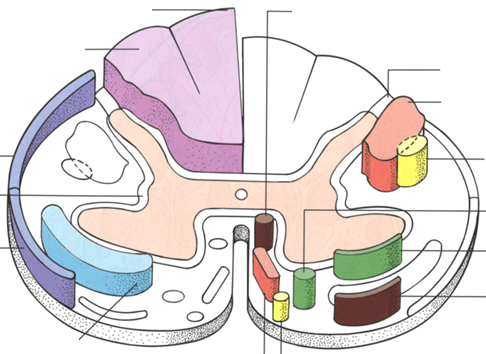
- ARubrospinal Tract
5Which vestibular tract is responsible for the vestibulo-ocular reflex?
- ATectospinal Tract
- BLateral Vestibulospinal Tract
- CMedial Vestibulospinal Tract
6The Tectospinal Tract utilises the Superior Colliculus to perform its functions (e.g. orientation of the head and eyes to an important, new visual stimulus)
- ATrue
- BFalse
Information
- Description
- Physiology VII: Spinal Reflexes, Upper Motor Neurones and the Control of Movement given by Prof John Peters
- Author
- Matthew Coulson
- Language
- English
- Views
- 26
- Tags
- Rating
- No ratings yet Rate this quiz