
Quiz
AMS588 - Ch. 14 Prototyping
This quiz has a time limit, so it opens in the usual player.
Questions in this quiz (30)
1An approximation of a product along one or more dimensions of interest is known as a _______:
- APrototype
- BProduct architecture
- CConcept generation
- DForecasting model
2Which of the following is NOT an example of prototypes?
- AConcept sketches and Mathematical models
- BSimulations and Test components
- CFully-functional preproduction models
- DArchitecture drawing
3Which of the following are types of prototypes?
- APhysical (physically built)
- BAnalytical (nontangible)
- CComprehensive (most attributes included)
- DFocused (one or two aspects)
- EAll of the choices are correct
4Which of the following are purposes of prototyping
- ALearning (“Will it work?”)
- BCommunication
- CIntegration (components working well together)
- DMilestones (checkpoints)
- EAll of the choices are correct
5True or False: Looks-like prototype is more concerned with functionality than appearance.
- ATrue
- BFalse
6Which of the following is NOT a principle of prototyping:
- AAnalytical prototypes are more flexible than physical
- BPhysical prototypes help detect unanticipated phenomena
- CPrototypes may increase risks associated with costly iterations
- DPrototypes may expedite other development steps
- EPrototypes may restructure task dependencies
7After defining the purpose of the prototype, the next step in planning for prototypes is to:
- AEstablish the level of approximation of the prototype
- BOutline an experimental plan
- CCreate a schedule
- DPlan milestone prototypes
8In planning milestone prototypes, ______ prototypes are typically used to assess whether the product works as intended, while _____ prototypes are used to assess reliability and to identify remaining bugs in the product.
- ABeta, alpha
- BPreproduction, alpha
- CPreproduction, beta
- DAlpha, beta
9According to Norman’s design principles, when in doubt ________.
- AConsider visibility or affordances
- BAsk for feedback
- CThink of constraints
- DStandardize
- EUse natural mappings
10Which of the following is an example of “Communication” as a use of prototypes:
- A3D physical models of style or function
- BAlpha or beta test models
- CFirst testable hardware
- DProof-of-concept model
11Which of the following is an example of “Integration” as a use of prototypes:
- AProof-of-concept model
- BAlpha or beta test models
- C3D physical models of style or function
- DFirst testable hardware
12
Which of the following is an example of “Milestones” as a use of prototypes:- A3D physical models of style or function
- BProof-of-concept model
- CFirst testable hardware
- DAlpha or beta test models
13According to the textbook _________ prototypes are required to detect unanticipated phenomena.
- AAnalytical
- BPhysical
- CBoth
14According to the textbook ______ prototypes are generally more flexible than _____ prototypes:
- AAnalytical, physical
- BPhysical, analytical
- CNeither choice is correct
15Which of the following is NOT one of the Four Types of Prototypes:
- AFocused
- BIndividual
- CPhysical
- DAnalytical
16Using the diagram above, which of the following type of prototype is note generally feasible?
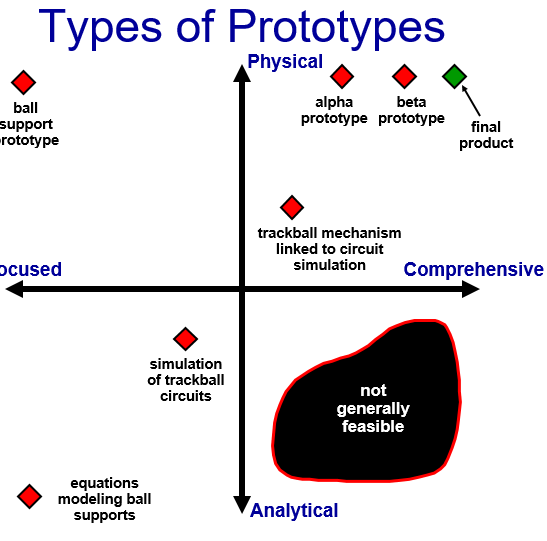
- AComprehensive-Analytical
- BComprehensive-Physical
- CFocused-Physical
- DFocused-Analytical
17Which of the following is NOT an example of a Prototype Type and Purpose(s):
- AFocused-Analytical: Learning
- BFocused-Physical: Learning and communication
- CComprehensive-Physical: Learning, communication, integration, milestones
- DComprehensive-Analytical: Milestones
18Which of the following is NOT true considering a prototype decision (technical risk vs. prototype cost):
- ANo need for comprehensive prototypes for Low risk-low cost decisions (printed stuff)
- BCan afford comprehensive prototypes for low risk-high cost decisions (ships, buildings)
- CMany comprehensive prototypes used for High risk-low cost decisions (software)
- DMany comprehensive prototypes used for High risk-high cost decisions (airplanes, satellites)
19Which of the following examples requires carefully planned comprehensive prototypes to sell the first unit?
- ASoftware
- BBuildings
- CShips
- DAirplanes
- ESatellites
20
Which of the following is NOT a characteristic of Physical prototypes:- Aintangible approximation of the product
- BMay exhibit un-modeled behavior
- CSome behavior may be an artifact of the approximation
- DOften best for communication
21Which of the following is NOT a characteristic of Analytical Prototypes:
- AMathematical model of the product
- BCan only exhibit behavior arising from explicitly modeled phenomena (However, behavior is not always anticipated)
- CSome behavior may be an artifact of the analytical method
- DOften allow less experimental freedom than physical models
22Which of the following are characteristics of Focused Prototypes:
- AImplement one or a few attributes of the product
- BAnswer specific questions about the product design
- CGenerally several are required
- DAll of the choices are correct
23Which of the following is NOT a characteristic of Comprehensive Prototypes:
- AImplement only one attribute of the product
- BOffer opportunities for rigorous testing
- COften best for milestones and integration
24Which of the following are NOT a Prototyping Strategies:
- AUse prototypes to increase uncertainty
- BMake models with a defined purpose
- CConsider only one form of prototype
- DChoose the timing of prototype cycles
25Which of the following are Prototype technologies:
- A3D CAD Modeling and Analysis
- BFree-Form Fabrication
- CBoth choices are correct
26Which of the following is NOT true considering Prototyping Methods:
- ACNC machining can be used to create prototypes
- BRubber molding and urethane casting are traditional methods
- CPrototypes can be made from materials such as wood, foam, or plastics
- DModel making requires little to no skill
27True or false: Rapid Prototyping Methods are mostly subtractive processes:
- ATrue
- BFalse
28Which of the following are rapid prototyping methods:
- ASLA (Stereolithogrpahy Apparatus)
- BSLS (Selective Laser Sintering)
- C3D Printing
- DLOM (Laminated Object Manufacturing)
- EAll of the choices are correct
29With Virtual Prototyping, 3D CAD models enable many kinds of analysis including:
- AFit and assembly
- BManufacturability
- CForm and style
- DKinematics
- EFinite element analysis (stress, thermal)
- FCrash testing
- GAll of the choices are correct
30Which of the following is an example of “Learning” as a use of prototypes:
- A3D physical models of style or function
- BProof-of-concept model
- CFirst testable hardware
- DAlpha or beta test models
Information
- Description
- AMS 588 - Chapter 14 Prototyping practice quiz
- Author
- Jenna Williams
- Language
- English
- Views
- 33
- Tags
- Rating
- No ratings yet Rate this quiz