
Quiz
Week 2: Controlling Microbial Growth
This quiz has question types that open in the usual player.
Questions in this quiz (18)
1[blank_start]Obligate (strict) aerobes[blank_end]: require [blank_start]O2[blank_end]
[blank_start]Facultative anaerobes[blank_end]: don’t require O2, [blank_start]but will use if present[blank_end]
[blank_start]Aerotolerant anaerobes[blank_end]: tolerate O2 , [blank_start]will not use[blank_end]
[blank_start]Microaerophiles[blank_end]: require [blank_start]reduced levels of O2[blank_end]
[blank_start]Obligate (strict) anaerobes[blank_end]: [blank_start]cannot[blank_end] survive in presence of O2- AObligate (strict) aerobes
- BFacultative anaerobes
- Cbut will use if present
- DAerotolerant anaerobes
- Ewill not use
- FMicroaerophiles
- Greduced levels of O2
- HO2
- IObligate (strict) anaerobes
- Jcannot
- Kcan
- LCO2
2• [blank_start]Fastidious[blank_end]: rely heavily on the environment to supply specific organic nutrients
• [blank_start]Non-Fastidious[blank_end]: less “needy” or “picky”. Can survive on a broader range of supplied nutrients- AFastidious
- BNon-Fastidious
3Label the type of organism for its optimum temperatures.
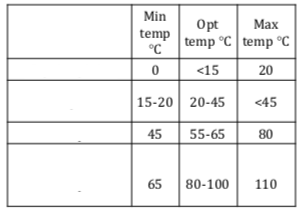
- APsychrophile
- BMesophile
- CThermophile
- DExtreme Thermophile
4Label the type of organism for its optimum pH levels
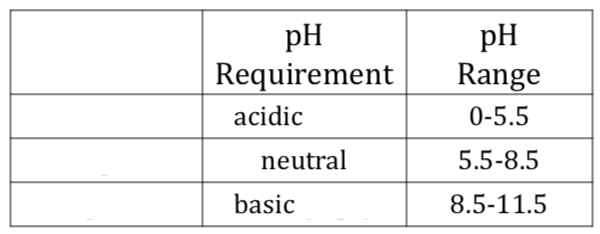
- Aacidophile
- Bneutrophile
- Calkaliphile
5You married a mormon and took all eight of your kids under 6 years old to the lake when you moved to Salt Lake City. The lake has a salinity range of 5-27% NaCl (according to wikipedia), but its the end of the summer so the lake is pretty shallow so it is probably on the higher end of the range currently. Your daughters brought back a mason jar full of lake water to give you for your 24th birthday but by the time you opened it, there was a large amount of bacteria growing in this closed jar. How would you classify this organism?
- Aextreme halophile; anaerobic
- Bosmolerant; aerobic
- Chalophile; aerobic
6[blank_start]Halobacterium[blank_end] [blank_start]salinarium[blank_end] is an example of an extreme halophile.
- AHalobacterium
- Bsalinarium
7What can you learn from the Fluid thioglycollate medium test?
- Aoxygen requirements
- Bfermentation
- CGram stain
- Dtemperature requirements
8[blank_start]Resazurin[blank_end] is the oxygen indicator in the fluid thioglycollate medium.
- AResazurin
9If there is low osmotic pressure inside the cell, but high osmotic pressure in its environment, where will water flow?
- ANet flow into the cell
- BNo net flow
- CNet flow out of the cell
10[blank_start]Defined medium[blank_end]: amount of every ingredient is known
[blank_start]Undefined medium[blank_end]: also known as complex- ADefined medium
- BUndefined medium
11Label each tube with the type organism that would have that growth pattern.
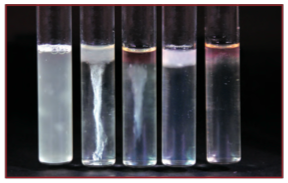
- Aaerotolerant anaerobe
- Bfacultative anaerobe
- Cstrict anaerobe
- Dstrict aerobe
- Emicroaerophile
12[blank_start]Decontamination[blank_end]
• Lowest level of control
• Reduction of pathogenic organisms to level safe to handle
without protective attire
• Physical cleaning with soap or detergent- ADecontamination
- BDisinfection
- CSanitization
- DAutoclaving
13[blank_start]Disinfection[blank_end]
• Intermediate level of protection
• Kill large numbers if not all of pathogens
• Does not kill large numbers of spores- ADisinfection
14[blank_start]Disinfectants[blank_end] - used on surfaces
• Bleach, Lysol
• Ultraviolet (UV) radiation
[blank_start]Antiseptics[blank_end] - reduce pathogens on or in living tissue
• Iodine, chlorhexadine, alcohols- ADisinfectants
- BAntiseptics
15How does UV impact DNA?
- Athymine dimers
- Bdistorts DNA, impacting replication and transcription
- Cdenatures completely
- Dturns it into RNA
16How do organisms repair damage from UV?
[blank_start]Light repair[blank_end] – [blank_start]photoreactivation[blank_end]
• Requires visible light
• [blank_start]Uses enzyme photolyase to reverse damage[blank_end]
[blank_start]Dark repair[blank_end] – [blank_start]excision repair[blank_end]
• Remove damaged bases and some surrounding
• [blank_start]Refill gap with correct bases[blank_end]- ALight repair
- BUses enzyme photolyase to reverse damage
- CDark repair
- DRefill gap with correct bases
- Ephotoreactivation
- Fexcision repair
17[blank_start]Sterilization[blank_end]
• Highest control level
• Complete elimination of [blank_start]all viable organisms, including spores[blank_end]
• Physical: Autoclave, filter sterilize liquids, flame loop
• Gas: Ethylene oxide, formaldehyde
• Irradiation: Gamma, X-ray
• Electromagnetic radiation: UV- ASterilization
- BDisinfection
- CDecontamination
- Dall viable organisms, including spores
- E80% of organisms
- Fspores only
- Gpathogens
18Which is the highest level of control?
- ASterilization
- BDisinfection
- CDecontamination
Information
- Description
- Environmental factors affecting microbial growth; germicides Questions made from slides
- Author
- Amanda A
- Language
- English
- Views
- 3
- Tags
- Rating
- No ratings yet Rate this quiz