
17131877


Question 1
Question
Chemoreception is utilized by the gustatory and olfactory receptors, which correlate with one's sense of _____________ and _______________.
Answer
-
taste, smell
-
smell, taste
-
sight, smell
-
sight, taste
Question 2
Question
Chemoreception evolved independently in many groups
Answer
- True
- False
Question 3
Question
Which kind of neurons are most prominent in olfactory receptors?
Answer
-
bipolar neurons
-
unipolar neurons
-
multipolar neurons
-
pseudounipolar neurons
Question 4
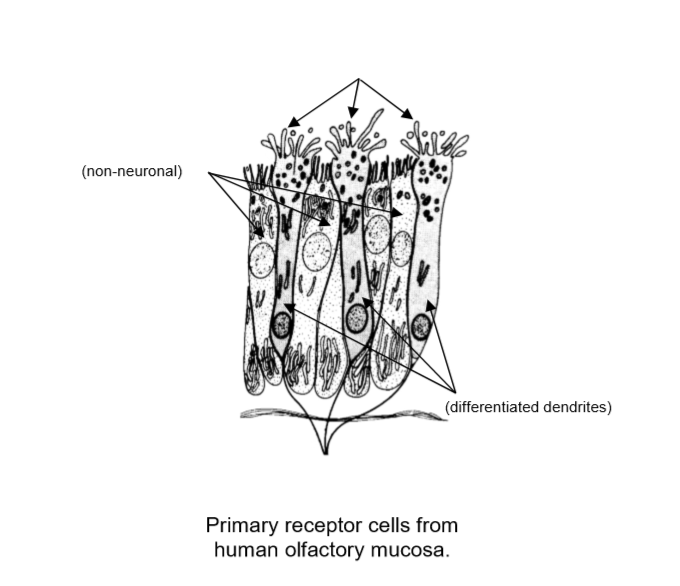
Answer
-
Sustentacular cells
-
Cilia
-
Receptor cells
Question 5
Question
Gustatory responses are only found in a few major phyla
Answer
- True
- False
Question 6
Question
Which of these is the MAJOR vertebrate gustatory adaptation?
Answer
-
taste buds
-
mouth
-
nasal hairs
-
tongue
Question 7
Question
The only part of the nervous system exposed to the environment is part of the ______________
Answer
-
olfactory
-
tactile
-
gustatory
Question 8
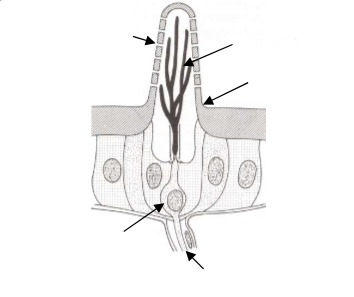
Answer
-
pore
-
dendrites
-
cuticle
-
receptor cell
-
axon
Question 9
Question
Gustation and olfaction are the [blank_start]most[blank_end] universal sensory modality because they are the [blank_start]simplest[blank_end] to pick up.
Answer
-
most
-
least
-
simplest
-
most complex
Question 10
Question
Process of olfaction:
1. A smell is [blank_start]picked up from the environment[blank_end]
2. [blank_start]The smell overcomes the threshold[blank_end] to be sensed
3. cilia [blank_start]pass dissolved smell to receptor cells[blank_end]
4. receptor cells [blank_start]send signals to olfactory nerve[blank_end]
Answer
-
picked up from the environment
-
The smell overcomes the threshold
-
pass dissolved smell to receptor cells
-
send signals to olfactory nerve
Question 11
Question
How do we differentiate between smells?
Answer
-
some receptors can bind to many smells
-
a smell can bind to many receptors
-
groups of receptors produce unique signals
-
there are specific receptors designed to bind to each smell individually
Question 12
Question
Substentacular cells...
Answer
-
are non-neuronal cells
-
capture odor molecules to send to bipolar neurons
-
add more surface area
-
are taste buds
-
send signals from the nose to the brain
Question 13
Question
What are the 7 primary odors?
Answer
-
musky
-
floral
-
pepperminty
-
camphoraceous
-
ethereal
-
pungent
-
putrid
-
sweet
-
sour
-
delicious
Question 14
Question
Vertebrate taste buds are [blank_start]secondary[blank_end] sense cells that are made of [blank_start]epithelial[blank_end] tissue.
Answer
-
secondary
-
primary
-
epithelial
-
nervous
-
muscle
Question 15
Question
Process of gustation:
1. [blank_start]food molecules dissolve in fluid[blank_end]
2. [blank_start]molecules picked up by taste buds[blank_end]
3. [blank_start]taste hairs (microvilli)[blank_end] send molecules to [blank_start]receptor cells[blank_end]
4. [blank_start]recetor cells send signal to neurons[blank_end]
Answer
-
food molecules dissolve in fluid
-
molecules picked up by taste buds
-
taste hairs (microvilli)
-
receptor cells
-
receptor cells send signal to neurons
Question 16
Question
How long do taste buds last before they have to be replaced?
Answer
-
12-14 days
-
12-14 hours
-
2-4 days
-
2-4 hours
Question 17
Question
How many taste hairs are on each taste bud?
Answer
-
30-40
-
3-4
-
40-50
-
4-5
Question 18
Question
What are the 4 main taste sensations?
Answer
-
sour
-
sweet
-
salty
-
bitter
-
delicious
-
savory
-
pungent
Question 19
Question
The sweet sensation is not found in __________ animals.
Answer
-
marine
-
invertebrate
-
equestrian
-
reptilian
Question 20
Question
What are the two non-traditional taste sensations?
Answer
-
water
-
umami
-
savory
-
sweet
-
sour
Question 21
Question
Umami detects...
Answer
-
amino acids
-
carbohydrates
-
fats
Question 22
Question
Humans do not taste water, it is an internal sense for dehydration
Answer
- True
- False
Question 23
Question
Vomoronasal organ (Jacobson's organ) is found in...
Answer
-
reptiles
-
amphibians
-
mammals
-
mollusks
-
birds
Question 24
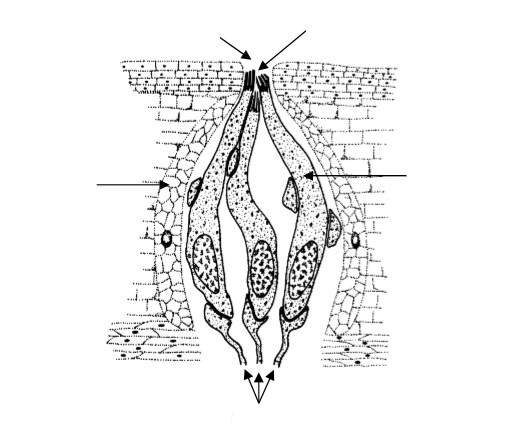
Answer
-
taste pore
-
microvilli
-
receptor cells
-
capsule
-
neurons
Question 25
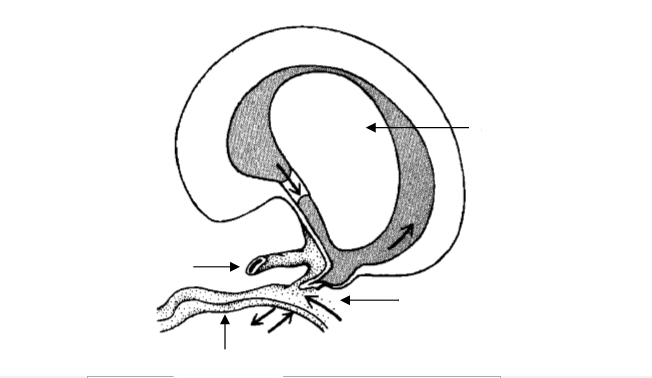
Answer
-
mushroom body
-
jacobson organ duct
-
upper palate
-
lachrymal duct
Question 26
Question
What is the role of a snake's forked tongue?
Answer
-
Jacobson's organ senses molecules on the tongue picked up from the air for detecting pheromones
-
olfactory nerves on the tongue sense pheromones in the air
-
snakes can taste pheromones in the air, allowing them to find prey
-
to boop your snoot when they like you
Question 27
Question
Vision is the [blank_start]most[blank_end] important sense
Answer
-
most
-
least
Question 28
Question
Photoreceptors are modified, [blank_start]secondary[blank_end] sense [blank_start]hair[blank_end] cells that sense [blank_start]photic energy[blank_end]
Answer
-
secondary
-
primary
-
hair
-
nerve
-
photic energy
-
radiation
Question 29
Question
What are the 3 types of information that photoreceptors receive?
Answer
-
intensity
-
wavelength
-
plane of polarization
-
absorption
Question 30
Question
Plane of polarization detects...
Answer
-
what plane you are in
-
polarized light to navigate
-
wavelength
-
intensity
Question 31
Question
What is the major advantage of vision?
Answer
-
it's instantaneous
-
seeing the pretty colors
-
reading
-
it's more accurate than other senses
Question 32
Question
Dermal light sense/diffuse photosensitivity uses photosensitive nerve endings to...
Answer
-
tell day from night
-
sense shadows
-
detect time/seasonal events
-
see better underwater
Question 33
Question
Eyespots form vivid images
Answer
- True
- False
Question 34
Question
Which groups have eye spots?
Answer
-
flatworms
-
annelids
-
arthropods
-
mollusks
-
nematodes
Question 35
Question
Forms of eyespots
[blank_start]Flat sheets[blank_end]: can only sense intensity and light/dark; most ancestral/least sophisticated
[blank_start]Convex[blank_end]: can sense direction; multifaceted/compound eyes
[blank_start]Concave[blank_end]: can sense direction; thought to give rise to vesicular eyes
Answer
-
Flat sheets
-
Convex
-
Concave
Question 36
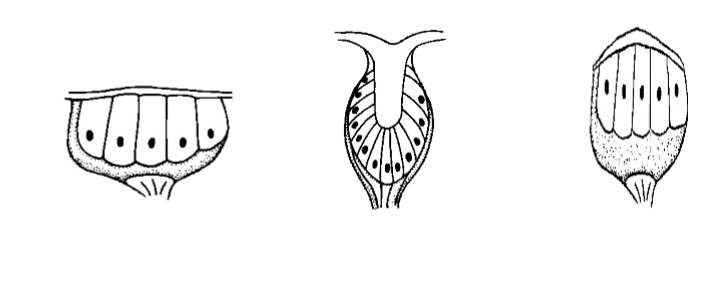
Answer
-
Flat sheet
-
Concave
-
Convex
Question 37
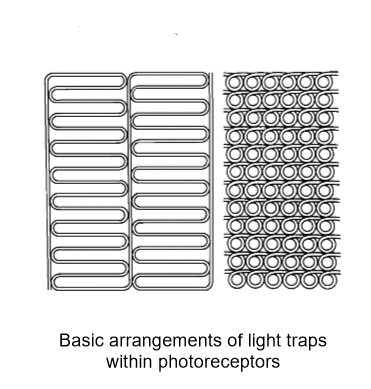
Answer
-
Laminar stacks
-
Rhabdomeric tubes
Question 38
Question
Vesicular eyes [blank_start]independently[blank_end] evolved [blank_start]twice[blank_end], and are found in [blank_start]four[blank_end] different groups.
Answer
-
independently
-
dependently
-
twice
-
once
-
three times
-
four
-
three
-
two
Question 39
Question
Convex eyes are made up of omatidia, which are...
Answer
-
each of the optical units that make up a compound eye
-
a modification of the cones in a single-lens eye
-
a modification of the rods in a single-lens eye
Question 40
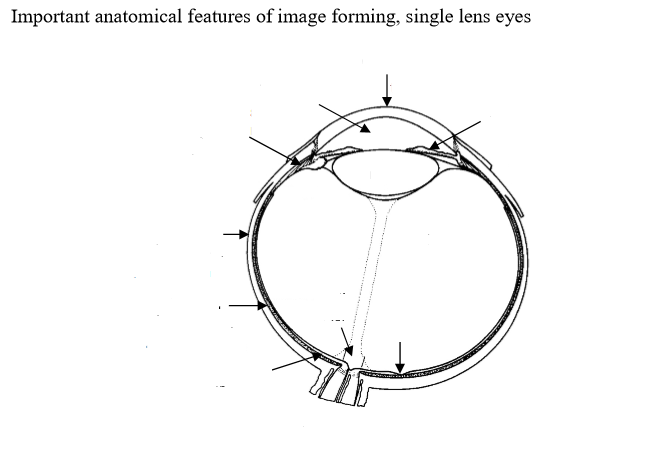
Answer
-
Cornea
-
Iris
-
Fovea
-
Vitreous humor
-
Optic disk
-
Neurons
-
Retina (inner tunic)
-
Choroid (middle tunic)
-
Sclera (outer tunic)
-
Lens
-
Ciliary muscles
-
Aqueous humor
Question 41
Question
80% of the eye's focus power is in the...
Answer
-
aqueous humor
-
lens
-
cornea
-
vitreous humor
Question 42
Question
blood vessels supply oxygen to the eye in the...
Answer
-
choroid
-
retina
-
sclera
-
vitreous humor
Question 43
Question
The ________ is most helpful for light refraction and underwater vision
Answer
-
Cornea
-
Iris
-
Lens
-
Aqueous humor
Question 44
Question
How can the eye focus light?
Answer
-
Move retina
-
Move lens
-
Change lens shape
-
Change eye shape
Want to create your own Quizzes for free with GoConqr? Learn more.