
Quiz
BIOSCI 350 - RK Topic Three
This quiz has question types that open in the usual player.
Questions in this quiz (22)
1In biochemical systems the connection between energy and equilibria is not so obvious, because of the quadrillions of objects to deal with - the behaviour of which is stochastic (temperature and thermal fluctuations cannot be ignored).
- ATrue
- BFalse
2Maximisation of the Gibbs free energy is associated with the attainment of chemical equilibrium.
- ATrue
- BFalse
3The two approaches to thermodynamics:
[blank_start]Classical[blank_end] thermodynamics - defines work, heat, enthalpy and entropy in a way that is mathematically complete, but highly abstract.
[blank_start]Statistical[blank_end] thermodynamics - a forbidding task, but insight into this way of thinking allows 'making sense' of thermodynamics, e.g. the Boltzmann distribution.- AClassical
- BStatistical
4Select all manifestations of KINETIC energy (others will be POTENTIAL energy):
- AHeat / thermal energy
- BRadiant energy
- CElectrical energy (moving charged particles)
- DBond energy
- EChemical energy
- FElectrical energy (charge separation)
5Thermodynamic systems
It is important to define the region of interest - this distinguishes the [blank_start]system, and the surroundings[blank_end]. A complete description of a system requires specified composition, [blank_start]pressure, volume, and temperature[blank_end]. The system can be isolated, closed, or open.
The sum of all energies in a system (or [blank_start]'internal energy'[blank_end]) = U. U is impossible to estimate - however we are more interested in the easily measured [blank_start]change in energy, /\U[blank_end].- Asystem, and the surroundings
- Bpressure, volume, and temperature
- C'internal energy'
- Dchange in energy, /\U
6Energy is an extensive part of the system - i.e., it [blank_start]scales[blank_end] with the size of the system. Thus, it can be normalised by units [blank_start]kJ/mol[blank_end], as opposed to just kJ. In contrast, temperature is an intensive property, and is [blank_start]independent[blank_end] of the size of the system.
- AkJ/mol
- Bscales
- Cindependent
7Which of these is correct?
- AWork (w) = transfer of energy involving concerted/ordered movement of some component in system/surroundings.
Heat (q) = transfer of energy which increases the random motion of molecules. - BHeat (q) = transfer of energy involving concerted/ordered movement of some component in system/surroundings.
Work (w) = transfer of energy which increases the random motion of molecules.
- AWork (w) = transfer of energy involving concerted/ordered movement of some component in system/surroundings.
8Which of these is correct?
- A/\U = q + w
- B/\U = q * w
- C/\U = q - w
- D/\U = q / w
9[blank_start]First[blank_end] law of thermodynamics: energy cannot be created or destroyed, only transformed.
[blank_start]Second[blank_end] law of thermodynamics: no natural process can occur unless it is accompanied by an increase in [blank_start]entropy[blank_end] in the universe.- AFirst
- BSecond
- Centropy
10Which of these statements about entropy is FALSE?
- AEnthalpy of a system includes both the internal energy of a system and the amount of energy required to make room for the system by displacing its environment.
- BThe heat (q) transferred at a constant volume equals change in energy (/\U)
- CThe heat (q) transferred at a constant pressure equals change in enthalpy (/\H)
- DThe importance of enthalpy is that biological process occur at constant pressure, not volume.
- EWhen dealing with gases, or working at high pressures, work associated with expansion/contraction becomes negligible and /\H =(approx)= /\U
11Protein un/folding is an all-or-nothing process that can be treated as a two-species equilibirum F <-> U
- ATrue
- BFalse
12An appropriate explanation into why two blocks of differing temperatures will reach thermal equilibrium, despite /\U = 0, is:
- AThe driving force of any spontaneous change is the tendency of energy and matter to disperse.
- BThe driving force of any spontaneous change is the statistical parameter of v^i, where v = velocity of molecule and i = internal energy.
13Select all valid statements about ENTROPY:
- AEntropy is a measure of the distribution of energy or matter in a system.
- BEntropy is a measure of the capacity to do work.
- CEntropy is a measure of the tendency towards spontaneous change.
- DEntropy is a measure of the height to breadth ratio of a system.
- EStates of entropy are the most probable states - the states of maximum multiplicity.
14It is easy to apply the second law, because in the lab we work with an isolated system, not a closed system.
- ATrue
- BFalse
15Pick da one what Gibbs free energy is
- AG = H - TS
- BG = S - TH
16[blank_start]/\G < 0[blank_end] : forward reaction is energetically favourable / is spontaneous
[blank_start]/\G = 0[blank_end] : system equilibrium
[blank_start]/\G > 0[blank_end] : reverse reaction is energetically favourable / is spontaneous- A/\G < 0
- B/\G = 0
- C/\G > 0
17The Gibbs free energy of a reaction [blank_start](/\rG)[blank_end] is the partial derivative of the Gibbs energy function, with respect to the [blank_start]extent of reaction[blank_end].
/\rG = [blank_start]/\rGo[blank_end] + RT*lnQ; where /\rGo is a [blank_start]constant[blank_end] - the standard Gibbs energy of a reaction, and Q = reaction quotient (in this case, Q = [blank_start][F]/[U][blank_end]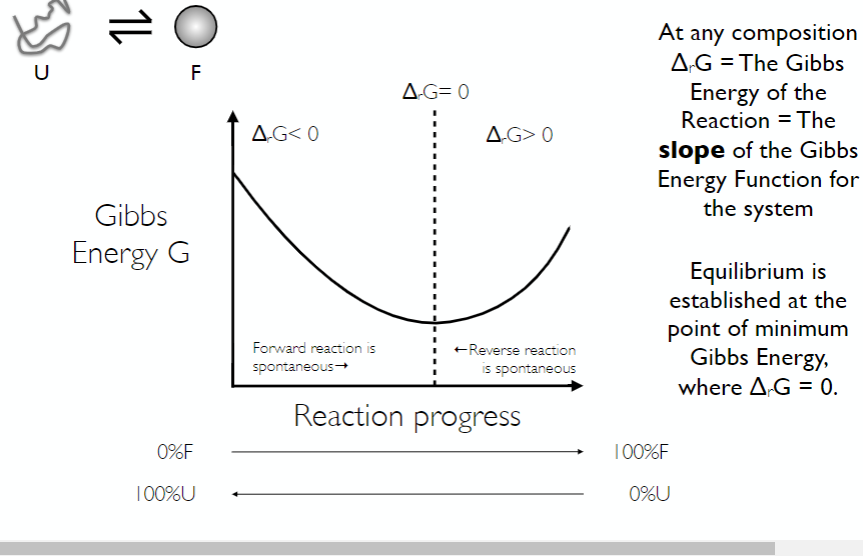
- Aextent of reaction
- B(/\rG)
- C/\rGo
- Dconstant
- E[F]/[U]
18When...
[blank_start]/\rG < 0[blank_end], Q < K, so [blank_start]forward[blank_end] reaction
[blank_start]/\rG > 0[blank_end], Q > K, so [blank_start]backward[blank_end] reaction
[blank_start]/\rG = 0[blank_end], Q = K, so equilibrium- A/\rG < 0
- B/\rG > 0
- C/\rG = 0
- Dforward
- Ebackward
19The Gibbs energy allows us to specify the maximum amount of work (excluding expansion / compression) that can be done by a process at a constant temperature and pressure.
- ATrue
- BFalse
20Protein folding results from a balance between energy and entropy.
When a polypeptide 'folds' into a defined tertiary structure, it becomes conformationally restricted - therefore [blank_start]decreasing[blank_end] entropy upon folding. This [blank_start]opposes[blank_end] protein folding. This can be discussed in terms of phi/psi angles, and [blank_start]multiplicity[blank_end].
However, proteins DO fold. Highly favourable interactions between amino acids occur in the folded state, but also, the [blank_start]solvent[blank_end] (which is part of the system) needs to be considered. The structure of the solvent may be perturbed by folding of the protein. [blank_start]Hydrophobic effects[blank_end] are the main driver for why folding is entropically favoured in terms of the configuration of the solvent: hydrophobic groups and water do not mix (they [blank_start]restrict the motional freedom[blank_end] of water), and van der Waals forces are present in the [blank_start]folded[blank_end] state only. Proteins do not fold in a [blank_start]vacuum[blank_end].- Adecreasing
- Bmultiplicity
- Copposes
- Dsolvent
- EHydrophobic effects
- Frestrict the motional freedom
- Gfolded
- Hvacuum
21In summary, protein folding results in a net [blank_start]release[blank_end] of energy, as a result of van der Waals forces that are [blank_start]absent[blank_end] in the unfolded state. It decreases the [blank_start]configurational entropy[blank_end] of the protein but increases that of the [blank_start]solvent[blank_end]. There is no one single 'dominant effect' of protein folding.
Both the entropy and enthalpy of a reaction are [blank_start]temperature[blank_end] dependent, and as a result both high and low temperatures result in protein [blank_start]unfolding[blank_end].- Arelease
- Babsent
- Cconfigurational entropy
- Dsolvent
- Etemperature
- Funfolding
22Addendum: 'Two-State' Protein Folding
Studying protein folding experimentally requires system perturbation - because normally the population of the unfolded state is so low under normal conditions that [blank_start]denaturing[blank_end] (by heat / chemical / mechanical force) is required to observe the un/folding process.
To follow the process, [blank_start]CD signal at 222nm[blank_end] is followed. This provides a read of protein [blank_start]secondary[blank_end] structure. Addition of urea allows [blank_start]ensemble[blank_end] observations of equilibrium - however if individual CD signals could be followed, a un/folded signal like the open/closed of an ion channel would be observed.
The [blank_start]average time spent[blank_end] in each state represents the equilibrium constant of that reaction.
The two state model can't be easily validated using ensemble measurements - it can't be done by CD but FRET provides one way. [blank_start]Optical traps[blank_end] also allow for the observation of protein folding at the single molecule level.- Adenaturing
- BCD signal at 222nm
- Csecondary
- Densemble
- Eaverage time spent
- FOptical traps
Information
- Description
- BIOSCI 350 Quiz on BIOSCI 350 - RK Topic Three, created by Eilidh Young on 04/05/2019.
- Author
- Eilidh Young
- Language
- English
- Views
- 0
- Tags
- Rating
- No ratings yet Rate this quiz