
Quiz
Untitled
Create a free account to finish this quiz
Save your progress and see your final score.
Already have an account? Sign in
Questions in this quiz (73)
1According to the RECOMMENDED guidelines, respiratory effort should be recorded with:
- APiezo-electric bands
- BInductance plethysmography
- CNasal pressure transducers
- DIntercostal EMG
2What would increase the resolution of EEG spikes and improve definition of the waveforms?
- AUsing a 100 uv input voltage
- BIncreasing sampling rate
- CIncreasing sensitivity
- DApplying 50/60 Hz filter
3One of the MOST important roles of data collection for the recording technologist is to:
- AScore sleep stages prior to applying treatment
- BComplete Epworth Sleepiness Scale
- CRecord interpretation of patient comments and actions
- DDocument any changes in recording parameters
4Which of the following is a physiological artifact?
- ADetached ground electrode
- BElectrode pop
- C50/60 Hz
- DEye movement
5The two inferior chin electrodes are placed on the:
- AMental foramen
- BObicularis oris
- CSubmentalis
- DMastoid
6When performing a PSG on a 5 year-old, the technologist notes the amplitude generated from the EEG and EOG electrode derivations is too high to clarify see the activity and causing waveforms to square off. What sensitivity adjustment would be appropriate?
- A10 uv/mm
- B7 uv/mm
- C5 uv/mm
- D2 uv/mm
7Following RECOMMENDED guidelines, which of the following would be an appropriate time to end a MWT trial?
- A3 consecutive epochs of Stage R
- BA single epoch of N1
- C20 minutes even if sleep occurs earlier
- DNo sleep at 20 minutes of recording
8Which method is recommended for a sleep center of disinfect reusable PAP humidity chambers?
- ARinse with soap and water followed by the 15 minute soak in 1:3 vinegar to water solution
- BSumberge in bleach solution for 10 mins and air dry
- CPasteurization
- DFlush with sterile water
9The electrode array used for recording physiologic activity is referred to as:
- AMontage
- BPolarity
- Cimpedence
- DSensitivity
10What is the correct distance between O1 and O2 electrodes for a patient with a frontopolar-occipital (Fpz-Oz) plane circumference of 58 cm and a nasion-inion distance of 40 cm?
- A7.2 cm
- B10 cm
- C4 cm
- D5.8 cm
11Indirect monitoring of oxygen level by the use of sensors that detect light wave absorption is:
- AEnd tidal CO2
- BPulse oximetry
- CThermal sensor
- DCapnography
12According to RECOMMENDED guidelines the desirable sampling rate for recording EOG is:
- A100 Hz
- B50 Hz
- C500 Hz
- D25 Hz
13What additional parameter would be MOST helpful to monitor when recording a patient with COPD?
- ACapnography
- BPiezo technology
- CIntercostal EMG
- DEsophageal pressure
14Which arrhythmia would require activation of an Emergency Response System?
- ABradycardia
- BSinus tachycardia
- CVentricular fibrillation
- DPremature atrial concentration
15These MSLT results would be compatible with:
Nap 1- 3 minutes
Nap 2- 6 minutes
Nap 3- 4 minutes
Nap 4- 1.5 minutes
Nap 5- 2 minutes- ANarcolepsy
- BHypercapneic response
- CIdiopathic hypersomnia
- DPsychophysiological insomnia
16Which method would BEST aid in distinguishing idiopathic central sleep apnea from Cheyne Stokes respirations?
- ARecord using an esophageal pH monitor
- BUse a snore monitor to correlate respirations
- CMonitor frequency and type of arousals
- DObserve for a crescendo-decrescendo pattern in the respiratory channels
17Which of the following is an example of a bipolar derivation?
- AThermistor
- BLOC- M2
- CC4- M1
- DTibialis- tibialis
18According to RECOMMENDED guidelines, portable monitoring is appropriate to:
- AScreen patients with a low probability of OSA
- BAssess patients with a low baseline oxygen saturation
- CMonitor a patient's response to oral appliance therapy
- DDiagnose Hypoventilation Syndrome
19Which of the following is an appropriate action when a patient has a prosthetic eye?
- AEliminate eye leads on the side of the prosthesis
- BOmit eye movements during physiologic calibrations
- CAdd additional eye lead directly below prosthesis
- DDocument on the record and in the technologist notes
20A primary reason for asking a patient to look up and down, left and right during physiologic calibrations is to:
- AAid in identification of REM sleep
- BDetermine comeal-retinal potential
- CElicit posterior occipital slow transients
- DAssesses for augmentation of alpha
21According to RECOMMENDED guidelines, the minimal recording duration in hours for an adult PSG is:
- A2
- B8
- C4
- D6
22Which of the following is a contraindication for CPAP therapy?
- AVagal nerve stimulator
- BNasal congestion
- CMallampati Class IV
- DPneumothorax
23When a patient calls the Sleep Center complaining that the pressure on their CPAP machine seems too high and is making it difficult to exhale, the first step would be to:
- AAdd heated humidity
- BInitiate relaxation skills and desensitization techniques
- CIncrease ramp or delay features
- DVerify correct PAP pressure with a manometer
24When a patient states they feel like they are suffocating and can't get enough air when on CPAP, they are most likely complaining of:
- ALow oxygenation
- BSymptoms of excessive pressure
- CAir hunger
- DSymptoms of low humidity
25A patient who has been compliant with PAP therapy for two years returns complaining of a persistent mask leak. The best action is to:
- AReassure the patient that minor leaks are not a concern
- BReview current mask options with the patient
- CSchedule a follow-up PSG
- DDecrease the patients CPAP level
26Overcompensation for mask or mouth leaks when using autotitrating CPAP (APAP) is MOST LIKELYto result in:
- AIncreased PAP adherence
- BUnnecessary high pressure
- CComplex sleep apnea
- DPneumothorax
27An adult with goof resolution of obstructive apneas on IPAP of 10 cm H2O and EPAP of 6 cm H2O begins having hypopneas after rolling supine. According to RECOMMENDED guidelines, what bilevel pressures would be appropriate after observing three obstructive hypopneas?
- AIPAP 10 and EPAP 7
- BIPAP 11 and EPAP 6
- CIPAP 10 and EPAP 5
- DIPAP 12 and EPAP 4
28Oral appliances in an alternative option for patients with:
- ARestrictive lung disease
- BCentral apnea
- CHypoventilation
- DMild obstructive sleep apnea
29You are titrating a patient on nasal CPAP when you notice considerable mask leak during stage R, but no SDB is present. Which of the following is the BEST action to take?
- ADocument the mask leak but take no actions until the patient awakens
- BDocument the mask leak the switch to a full face mask
- CDocument the mask leak then lower the CPAP pressure by 1 cm H2O
- DDocument the mask leak then apply a chin strap
30During a PAP titration, signal flattening in the nasal pressure monitor indicates:
- ACentral apnea
- BHypoventilation
- CSnoring
- DFlow limitation
31What is needed to determine a proper mask fit?
- AThe mask must be pressurized
- BThe mask should be tightly secured
- CThe CO2 port should be closed
- DIntentional leak must be high
32According to RECOMMENDED guidelines, when titrating supplemental oxygen the interval required between changes should be no shorter than:
- A5 minutes
- B15 minutes
- C10 minutes
- D3 minutes
33According to RECOMMENDED guidelines for titration of pediatric patients, CPAP should be increased when which of the following is observed?
- A2 hypopneas
- B4 RERAs
- C1 hypopnea
- D3 hypopneas
34According to RECOMMENDED guidelines for a bilevel PAP titration, the maximum IPAP for a patient >12 years should be:
- A30 cm H2O
- B25 cm H2O
- C20 cm H2O
- D15 cm H2O
35What type of calibration is defined as applying a calibration signal of known voltage to all amplifiers simultaneously with the sensitivity and filter controls set to values used at the beginning of a study?
- AMontage
- BAll-channel
- CPhysiologic
- DSignal
36Which of the following BEST describes the RECOMMENDED method to wean down supplemental oxygen during PAP titration?
- ACPAP (IPAP if on bilevel) can be increased to reduce the requirement of supplemental oxygen
- BCPAP (IPAP if on bilevel) should not be increased to reduce the requirement of supplemental oxygen
- Cthe IPAP-EPAP differential can be increased to reduce the requirement of supplemental oxygen
- DThe IPAP-EPAP differential can be decreased to reduce the requirement of supplemental oxygen
37According to RECOMMENDED guidelines the beginning pressure for a PAP titration is:
- A6 cm H2O
- B5 cm H2O
- C7 cm H2O
- D4 cm H2O
38According to RECOMMENDED guidelines for adult patients, CPAP pressure should be increased:
- AAt intervals > 5 minutes after observing two obstructive apneas
- BAfter 2 minutes and observing three RERAs
- CAt intervals of > 10 minutes after observing two hypopneas
- DAfter 2 minutes of loud or ambiguous snoring
39A patient's RDI is reduced from 55 per hour pre-intervention to 8 per hour when on CPAP, with 43 minutes of uninterrupted supine REM observed. According to AASM guidelines this titration would be classified as:
- AUnacceptable
- BOptimal
- CAdequate
- DGood
40When performing a PAP titration on a 10-year old, how many minutes of unambiguous snoring should be observed before increasing CPAP?
- A1
- B4
- C3
- D2
41According to RECOMMENDED guidelines, heated humidification is indicated to:
- AImprove daytime sleepiness
- BMinimize the need for PAP
- CImprove CPAP utilization
- DMinimize worsening of sleep apnea
42According to RECOMMENDED guidelines for patients <12 years, CPAP should be increased after observing at least:
- A3 RERAs
- B5 minutes of ambiguous snoring
- C4 hypopneas
- D2 obstructive apneas
43A systematic process of verifying compliance with specific requirements is:
- APatient assessment
- BSignal-to-noise ratio
- CQuality assurance
- DCommon mode rejection
44When reviewing the medical history the technologist notes that a patient takes Xanax for panic attacks. The technologist should anticipate:
- AIncreased REM
- BIncreased WASO
- CDecreased TST
- DDecreased N3
45The PRIMARY reason for instructing patients to clean masks daily is to:
- AAlleviate mask leaks
- BAvoid the spread of disease
- CPromote PAP adherence
- DMinimize skin irritation
46When reviewing a patient's medical history it is noted that one of the differential diagnosis is hypotension. Which of the following is MOST appropriate?
- AMaintain awareness of the potential for false oximetry values
- BPlace a tongue blade next to the patient's bed
- CUse personal protective equipment when entering the patient room
- DPrepare to awake patient following REM cycles that have fragmentary myoclonus
47When explaining to a patient how CPAP helps eliminate obstructive apnea, the technologist would explain that:
- AThe airway typically collapses at the end of inspiration
- BCPAP splints the obstructed airway open
- CChemoreceptors will reset and eliminate apnea
- DThere are separate pressures for inspiration and expiration
48A patient that intentionally engages in behavioral patterns that are inconsistent with sleeping well is demonstrating:
- AHyperarousal
- BParadoxical Insomnia
- CSundowing
- DInadequate Sleep Hygiene
49The syndrome resulting from prolonged severe episodes of hypoxemia during sleep ad associated with an increase in PaCO2 that worsens during sleep is:
- AGastroesophageal Reflux
- BUpper Airway Resistance
- CPulmonary Hypertension
- DObesity- Hypoventilation
50Obstructive apnea in pediatric patients is MOST often associated with:
- AHyperactivity
- BOverlap syndrome
- CIdiopathic hypersomnolence
- DHypothyroidism
51Review of the patient medical history indicates obesity, hyperlipidemia, hypertension and insulin resistance. What syndrome would this represent?
- AObesity-Hypoventilation
- BOverlap
- CMetabolic
- DCongenital Central Hypoventilation
52The emergence of central respiratory events during PAP titiration for treatment of obstructive sleep apnea is described as:
- AMixed sleep apnea
- BHypoventilation Syndrome
- CCheyne Stokes Breathing
- DComplex sleep apnea
53Actigraphy is MOST useful in the evaluation of:
- AObesity hypoventilation
- BRestless Legs Syndrome
- CCentral apnea
- DInsomnia
54Sleep debt can BEST be described as the:
- AConsequence of fragmented sleep
- BResult of excessive REM sleep
- CCumulative affect of insufficient sleep
- DAmount of sleep an individual needs
55The MOST common cause for insomnia in the general population is:
- AShift work
- BMisperception of sleep state
- CSleep onset association disorder
- DInadequate sleep hygiene
56Sharply contoured waves clearly distinguishable from the background with a duration of < 0.5 seconds occurring maximally over the central regions are:
- ASawtooth waves
- BV waves
- CK complexes
- DPOSTS
57How would the arousal in the middle of this epoch be classified?
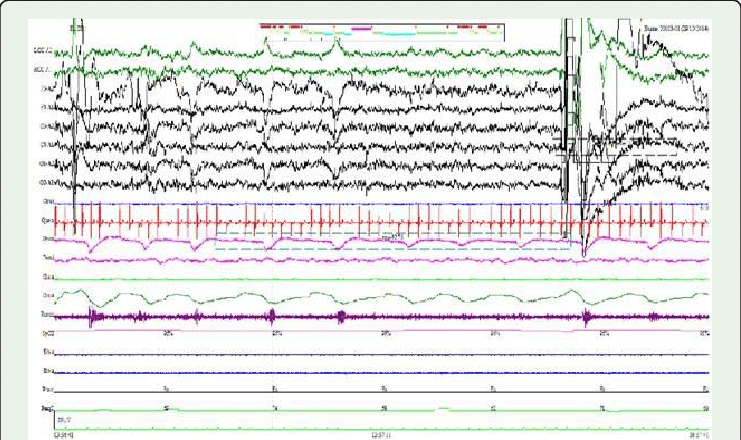
- ASnore
- BPLM
- CRespiratory arousal
- DSpontaneous
58This epoch would be scored as stage:
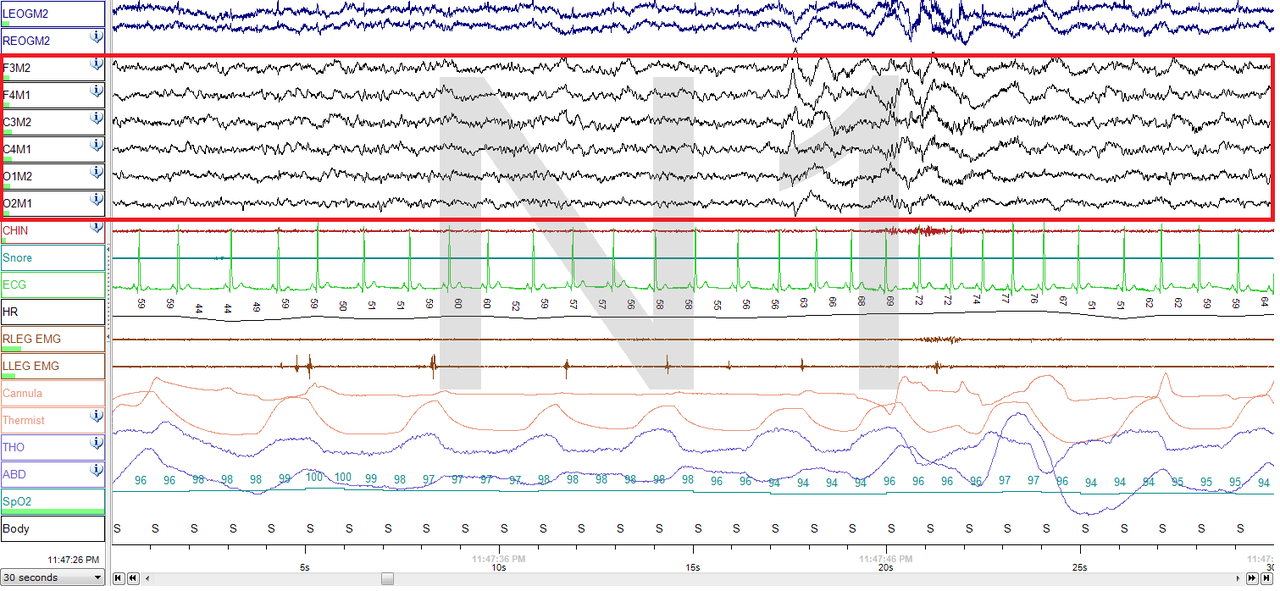
- AWake
- BR
- CN2
- DN1
59A sequence of breaths lasting at least 10 seconds that does not meet the criteria for an apnea or hypopnea, characterized by increasing respiratory effort and ending in an arousal is:
- AALMA
- BCRBD
- CRERA
- DGERD
60Which of the following is the BEST method to aid in the clarification and differentiation of central versus obstructive respiratory events?
- AImpedance pneumography
- BIntercostal EMG
- CStrain gauge
- DPeizo technology
61This epoch would be scored as stage:
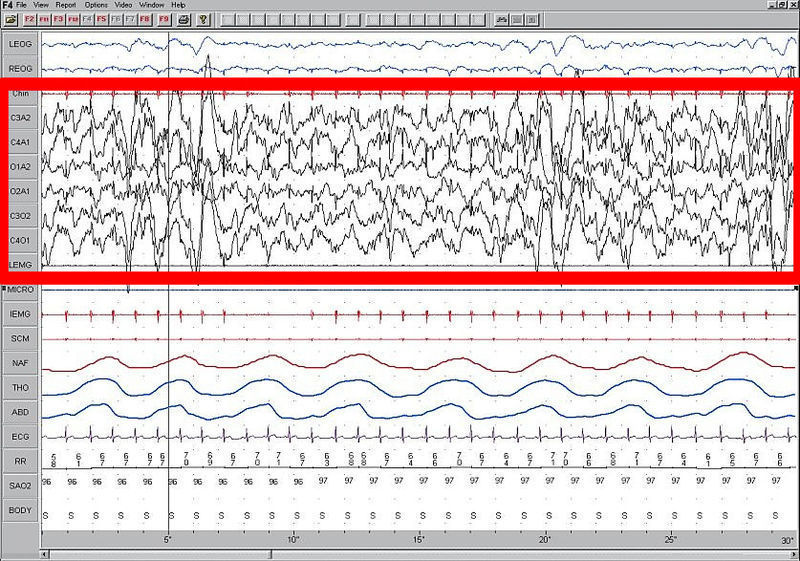
- AR
- BN2
- CN1
- DN3
62TRT: 8.5 hours
TST: 6.0 hours
OSA: 55
Mixed apneas: 27
Hypopneas: 110
Respiratory arousals: 199
Calculate the AHI- A23/hr
- B46/hr
- C32/hr
- D65/hr
63According to RECOMMENDED guidelines, an arousal during stage R must be accompanied by an increase in submental EMG lasting at least:
- A10 seconds
- B3 seconds
- C5 seconds
- D1 second
64The apnea hypopnea index is reported as the:
- AAverage numbers of apneas and hypopneas that occurred during the night
- BPercentage of sleep time demonstrating apneas and hypopneas
- CAverage number of apneas and hypopneas seen per hour of sleep
- DPercentage of sleep time was disrupted by apneas and hypopneas per hour
65When airflow changes do not meet the criteria for obstructive apnea or hypopneas, respiratory effort event related arousals can be estimated by:
- ADetection of vibration by using piezoelectric transducers
- BMeasuring the pressure difference between the mask and the machine outlet
- CSawtooth patterns in the unfiltered airflow or mask pressure tracing
- DFlattening of the inspiratory airflow profile associated with an arousal
66This epoch would be scored as Stage:
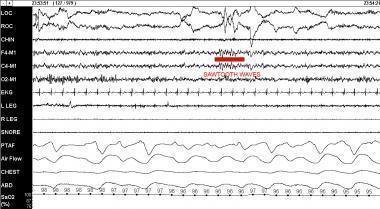
- AN2
- BWake
- CN1
- DR
67According to the RECOMMENDED guidelines for scoring RERAs in children:
- ARespiratory effort should be constant throughout the event
- BThere should be a decrease in end-tidal pCO2 above pre-event baseline
- CThere must be a sequence of >2 breaths that lead to an arousal but do not meet criteria for apnea or hypopnea
- D'There should not be snoring during the event
68According to RECOMMENDED guidelines, in patients who do not generate a dominant posterior alpha rhythm, stage N! should be scored when observing:
- A11-15 Hz background activity
- BHypnopompic hypersynchrony
- CSleep Spindles
- DVertex waves
69Which of the following is true of the posterior dominant rhythm in infants and children?
- AIt attenuates when the infant or child is awake with eyes closed
- BFrequency (hz) increases with age
- CFrequency (Hz) decreases with age
- DIt is analogous to alpha rhythm regardless of age
70Which of the following is the BEST statement regarding the use of non-EEG parameters for distinguishing NREM sleep from REM sleep in infants younger than 6 months?
- ATransient muscle activity is a feature of stage R
- BPreserved muscle tone is a feature of stage R
- CIrregular respirations are typically present in NREM
- DEyes movements are typically present in NREM
71Calculate the mean sleep latency based on the following MSLT sleep latency values
Nap1- 20 mins
Nap2- 15 mins
Nap3- 2 mins
Nap4- 7 mins
Nap5- 20 mins- A4.8 min
- B32 min
- C12.8 min
- D64 min
72Paradoxical breathing is identified by channel deflections that are:
- AIn phase in respiratory effort and out of phase in airflow
- BOut of phase in airflow with respiratory effort remaining flat
- COut of phase in respiratory effort with airflow remaining flat
- Din phase in airflow and in phase in respiration
73Absence of a heartbeat is called:
- ABradycardia
- BAsystole
- CArrythmia
- DTachycardia
Information
- Description
- Quiz on Untitled, created by Yadira Acosta on 17/06/2019.
- Author
- Yadira Acosta
- Language
- English
- Views
- 53
- Rating
- No ratings yet Rate this quiz