
Quiz
Wave behaviour basics
This quiz has question types that open in the usual player.
Questions in this quiz (6)
1Waves are a branch of study in Physics. They are important for understanding things from light and sound to earthquakes and water waves.
Waves come in two main types. In [blank_start]transverse[blank_end] waves, the particles go up and down in place while the wave moves forward. [blank_start]Water[blank_end] waves are an example of this, and you'd know that you can bob up and down in the water without moving as the waves move under you. Light is another transverse wave.
In [blank_start]longitudinal[blank_end] waves, the particles move back and forth, making [blank_start]compressions[blank_end] and rarefactions, while the wave moves forward. [blank_start]Sound[blank_end] waves are an example of this, and you can get an idea of how they work by looking at a cymbal or drum when it is struck and you can see how it vibrates.- Atransverse
- Bbipedal
- CWater
- Dlongitudinal
- Ecompressions
- Fequilibrium
- GSound
2Label the parts with the correct words
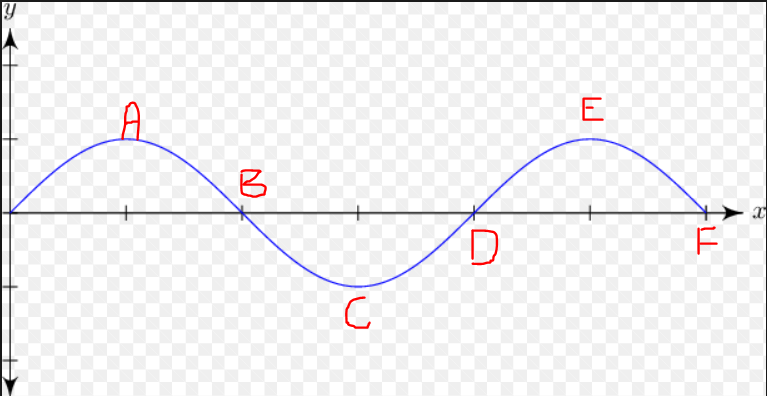
- APeak
- BTrough
- CEquilibrium
3Wavelength is the distance for one complete wave (a complete peak and a complete trough)
- ATrue
- BFalse
4Amplitude is the height from a trough to a peak
- ATrue
- BFalse
5Frequency is the number of waves per second
- ATrue
- BFalse
6A wave carries [blank_start]energy[blank_end]. For example, a sound wave carries the energy of talking from one place to another. As the wave moves [blank_start]forward[blank_end], it slowly loses energy into other forms (like the friction between the vibrating air particles) and so gets weaker - this is why a sound is [blank_start]less[blank_end] strong further away from the source.
Waves can [blank_start]spread[blank_end] out (diffract), [blank_start]bend[blank_end] around corners (refract) and [blank_start]bounce[blank_end] off things (reflect). These explain all sorts of wave behaviour, from how mirrors work, to echoes, to why the water in a harbour is calm compared to the open sea and why earthquakes are felt the way they are.- Aenergy
- Btemperature
- Cforward
- Dless
- Emore
- Fspread
- Gbend
- Hbounce
Information
- Description
- Year 7 Physics Quiz on Wave behaviour basics, created by Gwyneth Cooper on 29/07/2019.
- Author
- Gwyneth Cooper
- Language
- English
- Views
- 177
- Tags
- Rating
- No ratings yet Rate this quiz