
19859496
Description

Quiz by jolene wong, updated more than 1 year ago

|
Created by jolene wong
about 6 years ago
|
|
Question 1
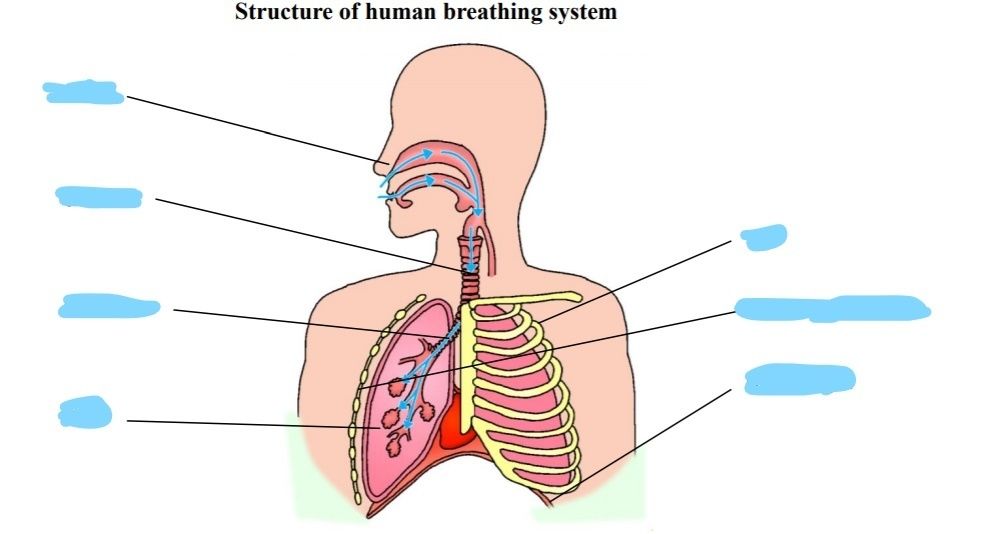
Answer
-
nose
-
trachea
-
bronchus
-
lung
-
ribs
-
intercostal muscle
-
diaphragm
Question 2
Question
During breathing in:
(1) Air enters the breathing system through the nose (or the mouth)
(2) Air travels along the [blank_start]trachea[blank_end] and then the two [blank_start]bronchi[blank_end].
(3) Air travels along smaller and smaller tubes.
(4) Air reaches the [blank_start]air[blank_end] [blank_start]sacs[blank_end] at the end of the smallest tubes.
Answer
-
trachea
-
bronchi
-
air
-
sacs
Question 3
Question
Gaseous exchange inside the lungs
The trachea branched to two [blank_start]bronchi[blank_end] (singular: bronchus).
Each bronchus divides into smaller and smaller tubes, ending in a large number of [blank_start]air[blank_end] [blank_start]sacs[blank_end].
The air sacs are surrounded by tiny blood vessels ([blank_start]blood[blank_end] [blank_start]capillaries[blank_end]).
The blood in the blood vessel flowing from other parts of the body carries higher [blank_start]carbondioxide[blank_end] content and lower [blank_start]oxygen[blank_end] content.
Gaseous exchange occurs between through the thin wall of the air sac and blood vessels.
Carbon dioxide leaves the [blank_start]blood[blank_end] to the [blank_start]air[blank_end] and oxygen enters the blood from the air.
Answer
-
bronchi
-
air
-
sacs
-
blood
-
capillaries
-
carbon dioxide
-
oxygen
-
blood
-
air
Question 4
Question
compare with inhaled air, exhaled air
contains [blank_start]less[blank_end] oxygen,
[blank_start]more[blank_end] carbon dioxide,
[blank_start]more[blank_end] water vapour,
has a [blank_start]higher[blank_end] temperature
Answer
-
less
-
more
-
more
-
less
-
more
-
less
-
higher
-
lower
Want to create your own Quizzes for free with GoConqr? Learn more.