
Quiz
PK mt2
Create a free account to finish this quiz
Save your progress and see your final score.
Already have an account? Sign in
Questions in this quiz (89)
1A protein's tertiary structure is stabilized by...
- Aa. Hydrophobic R Groups
- Bb. Ionic bonds
- Cc. Phosphodiester bonds
- Da, b, and d
2The graph in figure 1 illustrates the results of an experiment in which you measured the initial rate of production (units = micromoles of product generated/minute). If we set up this experiment with exactly Half as much enzyme in our reactions, we expect to see:
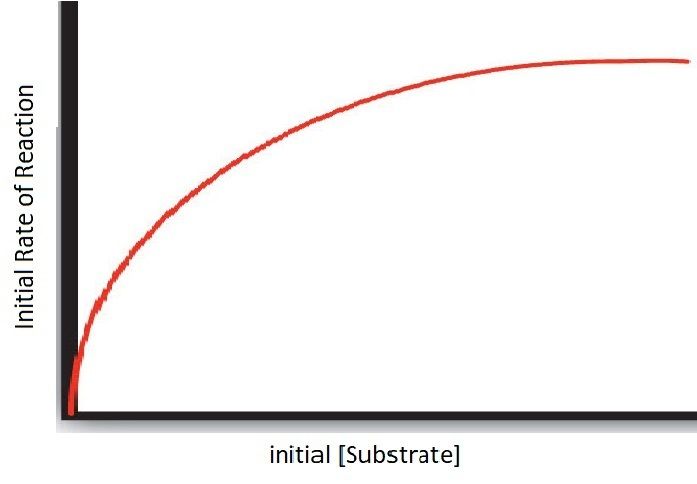
- AThe maximum rate of the catalyzed reaction will drop by half, the initial rate will stay the same
- BThe initial rate of the catalyzed reaction will drop by half, the maximum possible rate will stay the same
- CThe rate of the catalyzed reaction will be cut in half at all concentrations of substrate
- DThere will be no effect of the rate of the reaction
- EThe rate of the catalyzed reaction will double for all concentrations of substrate
3In animals, if the fuel consumed exceeds energy expended, fats are synthesized from carbohydrates in order to store excess energy. Acetyl-coA Carboxylase catalyzes the first dedicated step in fatty acid synthesis. This enzyme responds to a large number of cellular signals. A logical strategy for the regulation of Acetyl-coA Carboxylase might include:
- Aa. Activation when concentration of AMP is high vs. concentration of ATP
- Bb. Activation when concentration of AMP is low vs. concentration of ATP
- Cc. Inhibition when the concentration of AMP is low vs. concentration of ATP
- Dd. Inhibition by high levels of glucose
- EBoth c and d
4Methanogens used to be one of the dominant life forms on Earth. Today their growth is restricted to very specialized environments. This is because they:
- ANeed H2, and O2 is toxic to them
- BNeed methane (CH4), and O2 is toxic to them
- CNeed O2 and H2 is toxic
- DNeed methane, and H2 is toxic
- EAre UV-sensitive
5Many proteins carry cofactors which are involved in the reaction carried out by the enzyme. Which of the compounds described below might as a cofactors for a protein involved in a redox reaction?
- AFADH
- BATP
- CO2
- DCO2
- ERNA
6Which of the following would diffuse through a lipid bilayer the fastest?
- ANa+
- BEthane (C2H6)
- CWater
- DGlucose
- EATP
7"Pumps" push solutes up/against a gradient. Because this activity increases the potential energy stored in the gradient, the cell might "pay" for this through...
- Ahydrolysis of ATP
- Bcounter-flow of another solute down a gradient
- Cthe formation of ATP from AMP + PPi
- Dtwo of the above activities might power a biological "pump"
- Eincreasing potential energy is energetically favorable - it doesn't have to be "paid for"
8Kinetochores play an essential role in mitosis by:
- Aa. Pulling the centromere along microtubules
- Bb. Holding two sister chromatids together
- Cc. Separating the homologs
- Dd. establishing tension and so allowing the cell to know when the sister chromatids are properly aligned
- Ea and d
9Meiosis II resembles mitosis in that __ but differs from mitosis in that __
- Asister chromatids separate, cohesins are not involved in meiosis II
- Bsister chromatids separate, kinetochores are not involved in meiosis II
- Csister chromatids separate, the products of this division of sisters are not identical cells
- Dhomologous chromosomes separate, sister chromatids do not separate in meiosis II
- EDNA replicates before both mitosis and meiosis II, cohesins hold sister chromatids together only in mitosis
10Motor proteins transport vesicles within eukaryotes cells. In contrast, many cytoplasmic proteins arrive at their destinations within the cell through simple diffusion. Why can't vesicles get where they need to be through diffusion?
- Aa. Vesicles are too small to diffuse within the cytoplasm
- Bb. Vesicles are made up largely of lipids, and so cannot diffuse
- Cc. Diffusion of a vesicle would take a much longer time than diffusion of a protein - it would be too slow
- Dd. The cytoplasm is very viscous - this slows the proteins but not vesicles
- EBoth c and d are good reasons to use motor proteins to transport vesicles
11Elephants and mosses differ in many interesting ways. Strangely, the only difference specifically described in this course is the fact that:
- AAfter fertilization but before the meiosis, elephant cells undergo many mitoses but moss cells don't
- BAfter fertilization but before meiosis, moss cells undergo many mitoses but elephant cells don't
- CAfter meiosis but before fertilization, elephant cells undergo many mitosis but moss cells don't
- DAfter meiosis but before fertilization, moss cells undergo many mitoses but elephant cells don't
- EAfter meiosis is complete, moss cells can undergo another round of meiosis, but elephants don't do this
12Sexual reproduction increases genetic diversity in three ways. Which of the mechanisms described below is Not one of these ways?
- ANew combination of alleles on a single chromosome are created by crossing over
- BNew combination of alleles are created via increased mutation rate
- CNew combinations of alleles are created via fertilization
- DNew combinations of alleles are created via segregation of homologs
13Most animal cells are diploid - meaning their G1 nuclei have two copies of every gene. In plants, while the cells of embryos are diploid, many cells in the adult plant are "endoreduplicated". This means their nuclei have many copies of the genome (up tp 64 copies per nucleus, instead of 2). Obviously creating a 64x nucleus from a 2x nucleus requires a new kind of cell cycle. This could be achieved by:
- AMoving from G1 to S and then back to G1. Repeat until you reach 64 copies
- BUndergoing interphase and mitosis, but not cytokinesis. Repeat as needed.
- CUndergoing cytokinesis, but not mitosis. Repeat without interphase.
- DUndergoing mitosis and cytokinesis, but skipping the S phase of the cell cycle
- ERepeatedly failing to separate homologs during mitosis
14In horses, A is a dominant allele of the Agouti gene that results the coat color called "Bay": brown with black mane, tail, and legs. Homozygosity for a, a recessive allele, results in and overall black color. You have a bay male horse and want to determine whether he is heterozygous or homozygous for A, so you cross him to a black female. The resulting single offspring is black. From this you can conclude
- AYour bay male is homozygous (AA)
- BYour bay male horse is heterozygous (Aa)
- CNot enough offspring to be able to conclude anything
- DThe male's horse's phenotype already tells you his genotype - you didn't need to do a cross.
15Avery, MacLoed, and McCarty were able to genetically transform "rough" pneumococcus to "smooth", using an extract from killed pneumococci. They concluded that DNA rather than protein was the genetic material because:
- AThe extract, when treated with RNAse, failed to transform cells
- BThe extract, when treated with protease, failed to transform cells
- CThe extract, when treated with DNase, no longer transformed cells
- DThe extract, when treated with DNAse, still transformed cells
16In Figure 2, the four pieces represent cross sections of spherical structures composed of phospholipids. Which of these structures most resembles the structure of a cell membrane?
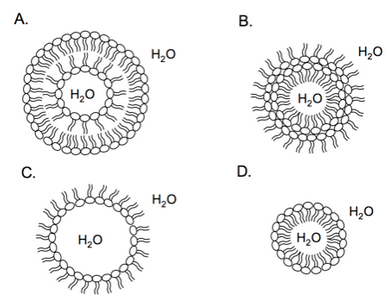
- AA
- BB
- CC
- DD
17The partial sequence of an DNA is 5' CGATCGAT 3'. The sequence of the complementary DNA strand, written (as always) 5' to 3' is:
- A5' CGATCGAT 3'
- B5' TAGCTAGC 3'
- C5' ATCGATCG 3'
- D5' GCTAGCTA 3'
- E5' AUCGAUCG 3'
18The Watson-Crick structure of DNA provided a very significant conceptual advance in our understanding of the role of DNA as the molecule of heredity. What was the critical aspect of this structure that suddenly allowed us to understand how DNA can provide a heritable "plan" for life?
- AIt is a helix
- BThe 2 strands of DNA run anti parallel to each other
- CDNA has a major and minor groove
- DThe 2 strands of DNA carry identical nucleotide sequences
- EThe 2 strands of DNA are base-paired by hydrogen bonds, with A paired with T and C paired with G
19The "Hydrogen hypothesis" suggests that...
- AOur mitochondria can provide us with hydrogen (H2), if needed
- BOur mitochondria allow us to perform a more efficient form of fermentation
- CAn archaen "teamed up" with a bacterium that provided it with hydrogen (H2); this symbiont evolved into present day eukaryotes
- DHydrogen (H2) was toxic to most living organisms once there was significant amount of O2 in the atmosphere
- EThe production of hydrogen in water-splitting kept H2 levels high on our planet
20A protein that forms an ion channel through a membrane is most likely to be...
- AA peripheral protein
- BA transmembrane protein
- CA phospholipid
- DAn enzyme
- EEntirely outside the phospholipid bilayer
21DNA differs from RNA in that it lacks an OH group at the 2' position - thus it's caleld "deoxyribose". Nucleotide 5' triphosphates (NTPs) can also be synthesized in the lab that are "dideoxy"ribose; these are missing the OH group at the 3' , as well as the 2' position. If DNA polymerase was to attempt to add a dideoxyNTP to an otherwise normal primer and template, what would be the consequences for the extension of that primer?
- AThe dideoxyNTP couldn't be added to the chain
- BThe dideoxyNTP could be added, but no additional bases could be added after that
- CThere would be no effect on chain growth; this OH group is not important
- DThe chain would grow normally, but it would be unusually unstable, compared with normal DNA
- EThe chain would grow, but it would have U instead of T
22The DNA found in the mitochondria is of ___ origin and encodes ___.
- AArchean, some of the genes for aerobic respiration
- BBacterial, some of the genes for aerobic respiration
- CNuclear, some of the genes for glycolysis
- DBacterial, some of the genes for carbon fixation
- ECyanobacterial, some of the genes for electron transport
23Cells that lack cell walls are at a disadvantage vs. cells that possess them, because:
- AThey can't engulf other cells
- BThey can swell up and explode in a high-salt environment
- CThey can swell up and explode when placed in pure water
- DThey cannot transport substances across their membrane
- EThey are sensitive to oxygen
24The active site of an enzyme has to fit its substrate. The 3-dimensional shape of the enzyme's active site is formed by:
- Athe folding of a linear chain of nucleic acids
- Bcarving of a protein by a protease
- Cthe fitting of the protein into a template strand
- Dreverse translation
- Ethe folding of a linear chain of amino acids
25Enzymes are used for virtually every chemical reaction in the cell. Enzymes make life possible by:
- Aa. Enhancing reaction rate
- Bb. Enhancing substrate-specificity
- Cc. Enabling the cell to control the rate of a reaction
- DAll of the above
- Ea and b only are correct
26The term "primary structure" of a protein refers to...
- AThe sequence of its nucleotides, joined by phophodiester bonds
- BIts affinity for its substrate
- CThe 3D shape of the protein
- DThe folding of hydrophilic (polar or charged) vs. hydrophobic regions
- EThe sequence of amino acids, joined by peptide bonds
27The maximum rate (Vmax) of the reaction reflects:
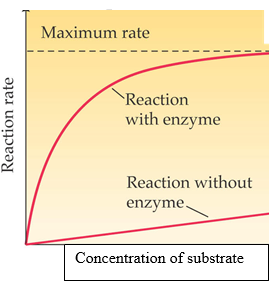
- AThe speed at which the enzyme can perform the reaction
- BThe affinity of the enzyme for the substrate (the east with which it can bind the substrate)
- CThe diffusion constant of the substrate
- DThe activation energy of the uncatalyzed reaction
28The initial slope of the curve (the slope at very low substrate concentrations) reflects
- Aa. The spontaneous (uncatalyzed) reaction rate
- Bb. The affinity of the enzyme for the substrate (the ease with which it can bind the substrate)
- Cc. The diffusion constant of the substrate
- Dd. The activation energy of the uncatalyzed reactions
- EC and D
29The alpha helical and beta sheet structures of proteins are stabilized by
- AHydrogen bonds
- BIonic bonds
- CHydrophobic bonds
- DHydrophilic bonds
- ESecondary structure
30The type of allosteric regulation depicted in the graph for (b) might be used by the cell when:
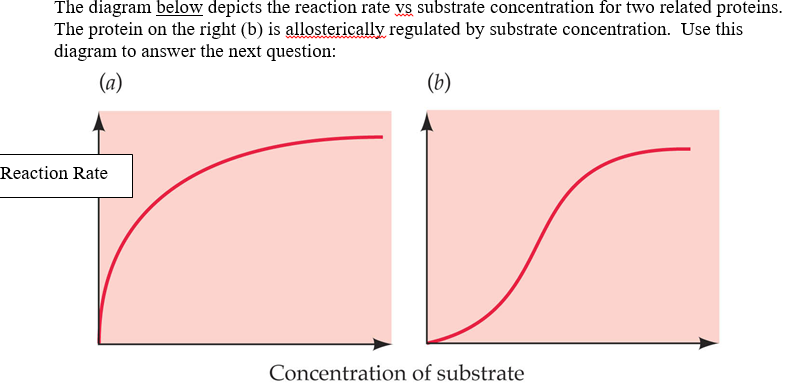
- Aa. the concentration of S must be kept as low as possible (i.e., for detoxification)
- Bb. the enzyme participates in the reaction only when excess S is available
- Cc. High concentrations of S are toxic but low ones are beneficial
- DBoth b and c
- EBoth a and b
31Feedback inhibition of enzyme activity is useful when
- Aan enzyme needs to know when to quit
- Ban enzyme needs to know when it's running out of substrate
- Can enzyme needs to drive a reaction backwards (=positive ∆G)
- Dan enzyme needs to stay active all the time
- Ean enzyme loses its cofactor
32The drop in H2 concentration in the Earth's atmosphere and oceans made life much more difficult for bacteria that specialize in:
- AFermentation
- BAerobic respiration
- COxygenic photosynthesis
- DNonoxygenic photosynthesis
- EMethanogenesis
33The Miller-Urey experiment proved:
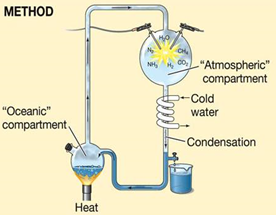
- Aa. that the early Earth's atmosphere was highly reducing
- Bb. that the early earth's atmosphere was highly oxidizing
- Cc. that the formation of complex molecules from simple ones requires enzymes
- Dd. that the formation of complex molecules from simple ones can occur spontaneously
- EBoth a and d are true
34Early, "preinheritance" life used iron sulfur clusters as catalysts. If these compounds can be found in nature, why do we now use proteins carrying iron sulfurs as catalysts?
- Aa. to decrease substrate specificity
- Bb. to increase substrate specificity
- Cc. to prevent spontaneous oxidation of the iron in the cluster
- Da and c
- Eb and c
35Which of the following types of bacteria can fix CO2?
- Aa. Chemoautotrophs
- Bb. Chemoheterotrophs
- Cc. Photoautotrophs
- Dd. Photoheterotrophs
- EA and C
36In the purine nucleotide biosynthetic pathway drawn below, the numbers represent enzymes required for the synthesis of GMP and AMP. The biosynthetic pathway branches at IMP. This pathway is subject to allosteric feedback regulation. If the concentration of AMP is too high, and the concentration of GMP is too low, a good way to fix this problem would be to have:
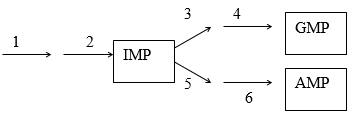
- AAMP act as a negative regulator of enzyme 2
- BGMP act as a positive regulator of enzyme 6
- CAMP act as a negative regulator of enzyme 5
- DGMP act as a negative regulator of enzyme 1
- EGMP act as a negative regulator of enzyme 2
37A cell has an interior concentration of glucose that is quite high, and is placed in an environment in which the concentration of glucose is relatively low. The cell is found to transport glucose from its environment into the cell. Such transport is referred to as ___ and requires ____.
- Adiffusion, swelling
- Bpassive transport, an influx of water
- Cactive transport, and microtubules
- Dactive transport, and a source of energy
- Eosmosis, a solvent
38In increase in the concentration of saturated fatty acids in the membrane is likely to result in the following: (membrane permeability, membrane fluidity)
- Aa. higher, higher
- Bb. same, lower
- Cc. higher, same
- Dd. lower, lower
- Ee. lower, same
39Glucose - starved bacteria were added to a solution of radioactive glucose at varying concentrations, and their initial rate of incorporation of radioactivity was measured. The maximum rate of intake (illustrated by the diagram below) is limited by...
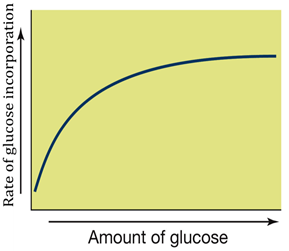
- Aa. the number of glucose transporter molecules
- Bb. the speed at which each transporter moves glucose across the membrane
- Cc. the affinity of the transporter for its substrate
- Dd. none of the above - this is simple diffusion across the membrane itself
- EJust a and b
40All exchange between a cell and its environment happen at the cell's surface. How can a cell increase its volume without substantially decreasing its surface to volume ratio?
- AThis cant be done; the surface to volume ration always increases linearly with volume
- BThis cant be done; the surface to volume ratio always decreases linearly with volume
- CThe cell could stay as spherical as possible to minimize surface area
- DThe cell could get longer, without getting fatter
41Mitochondria perform respiration in eukaryotic cells. The genes required for the mitochondrion's ETC and the Citric Acid cycle are encoded by:
- Aa. the nuclear genome
- Bb. the mitochondrial genome
- Cc. the plastid genome
- Dd. a and b only
- Ee. b and c only
42Which of the following is correct about integral membrane proteins?
- AThey lack tertiary structure
- Bthey are not mobile within the bilayer
- Cthey are usually transmembrane proteins
- Dthey are loosely bound to the surface of the bilayer
- Ethey serve only a structural role in membranes
43According to the fluid mosaic model of the cell membrane, a transporter protein with an extracellular hydrophilic domain and a cytoplasmic hydrophilic domain should be able to:
- Aa. Glide freely within the plane of the membrane, allowing it to react with various other membrane proteins
- Bb. flip across the membrane - allowing the extracellular domain to become cytoplasmic, and the cytoplasmic domain to be located outside the cell (so that transport can reverse direction)
- Cc. both and b
- Dd. neither a nor b
44A eukaryotic chromosome is typically ___ and it is replicated ____.
- Alinear, from a single origin
- Blinear, from multiple origins
- Clinear, from two terminal origins
- Dcircular, from a single origin
- Ecircular, from multiple origins
45Cohesins are proteins that bind sister chromatids together. If a cell is treated with a poison that prevents cohesins from forming a "handcuff" around sister chromatids, we'd expect the cell to be able to correctly complete ___ but not _____.
- Adna replication, chromatid segregation
- Bdna replication, crossing over
- Csegregation, cell division
- Dmitosis, cytokinesis
- EDNA repair, DNA replication
46Which statement about the cell cycle is not true?
- Ait consists of interphase, mitosis, and cytokinesis
- Bthe cell's dna replicated during G1
- Ca cell can remain in G1 for weeks or so much longer
- DDNA is not replicated during G2
- ECells enter the cell cycle as a result of internal or external signals
47When a cell completes mitosis and cytokinesis and enters G1, it should have...
- Aonly half the code (information) it had in G2
- Bhalf the number of chromosomes that it had in G2
- CHalf as much DNA per nucleus as it had in G2
- DTwice as much DNA per nucleus, compared to G2
- ETwice the number of chromatids per chromosome, compared with G2
48Your muscle cells have many nuclei per cell. Given that you started life as a zygote with a single nucleus, how did this change occur?
- Athe muscle cell must have undergone mitosis several times without undergoing cytokinesis
- Bthe muscle cell must have undergone S phase twice, without an intervening mitosis
- Cthe cell must have undergone cytokinesis without first performing mitosis
- Dthe cell must have gone directly from S phase to cytokinesis, without mitosis
49Using the pictures below - which cell is in prophase?
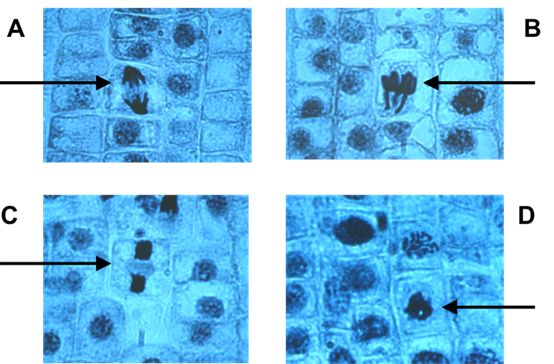
- AA
- BB
- CC
- DD
50The active site of an enzyme has to fit its substrate. The 3d shape of the enzyme's active site is formed by:
- Athe folding of a linear chain of nucleic acids
- Bcarving of a protein by a protease
- Cthe fitting of the protein into a template strand
- Dreverse translation
- Ethe folding of a linear chain of amino acids
51The process by which a small molecule can bind to a protein, altering its shape in order to alter its function, is called...
- Aa. constitutive control
- Bb. repression
- Cc. allosteric regulation
- Dd. activation
- Eboth b and c
52Some methanogens are chemoautotrophs. This means they can:
- Aa. fix carbon from CO2
- Bb. make their own ATP from ADP + Pi without eating other organisms
- Cc. synthesize NADH from NAD+ without eating other organisms
- Dd. all of the above
- Ee. none of the above
53The figure below depicts the effects of increasing O2 concentration on the saturation of oxygen-binding proteins myoglobin (a) and hemoglobin (b). Which of the following statements is false?
- AHemoglobin (Hb) is required to transport O2 from the lungs to the rest of the body
- Bat low [O2], Hb binds O2 relatively poorly (=has low affinity)
- Cat high [O2] Hb binds O2 relatively tightly (=has higher affinity)
- DO2 has a positive regulatory effect on Hb's ability to bind O2, but that's not true for myoglobin
- EMyoglobin is used to transport O2 through the blood of whales
54You have an enzyme that catalyzes the reaction S -> P. You measure the initial rate of the reaction vs. temperature. At temperature above 50 C, you find that the rate of the production of Product suddenly decreases, from 100 micromoles P/minute to 1 micromole P/minute. This is probably because
- Athe activation energy is decreased at higher temperatures
- Bthe enzyme unfolded at 50 C
- Ccovalent bonds are unstable above 50 C
- Dchemical reactions go slower at higher temperatures
- Etoo much product has accumulated
55Which of the following molecules would be expected to most rapidly diffuse across a cell membrane?
- Aglucose
- Bsodium ion
- Cwater
- DCH4
- Ean amino acid
56The evolution of eukaryotes-based on a symbiosis with an aerobically respiring bacterium-required the invention evolution of a new kind of protein. This was:
- Aa. atp synthase
- Bb. an atp transporter
- Cc. pyruvate carboxylase
- Dd. a glucose transporter
- Eboth a and b
57Eukaryotes are more similar to archeans than to bacteria in their:
- Aa. membrane lipids
- Bb. DNA and RNA metabolism genes
- Cc. genes for respiration
- Dd. nuclear membrane structure
- Eboth b and c
58An integral membrane protein is illustrated below. This protein is free to move in some ways, but not others. The protein can:
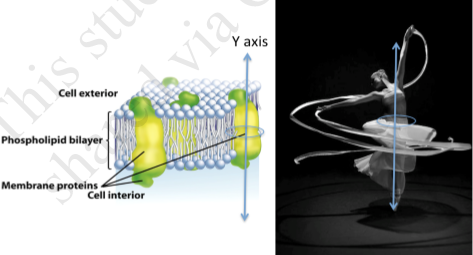
- Aa. spin about its Y axis (drawn here)
- Bb. flip so that the part formerly on the cell interior is now on the cell's exterior
- Cc. drift sideways in the membrane, so that it can bump into various other membrane proteins
- Da and b
- Ea and c
59one of your cells just finished DNA replication. How many chromatids does each chromosome have?
- A1
- B2
- C23
- D46
- E92
60"Pumps" push solutes up/against a gradient. Because this activity increases the PE stored in the gradient, the cell "pays" for this through...
- Ahydrolysis of ATP and counter-flow of another solute down a gradient
- Bthe formation of ATP
- Call of the above activities might power a biological "pump"
- Dincreasing PE is energetically favorable - no need to be "paid for"
61the photograph show two nuclei from the same organism. Which phases of the cell cycle are illustrated here?
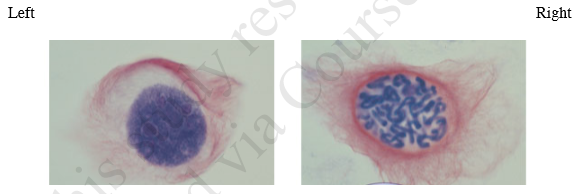
- Aleft is interphase, right is prophase
- Bleft is M phase, right is G2
- Cleft is G1 phase, right is G2
- Dleft is M phase, right is interphase
- Eleft is telophase , right is metaphase
62What is the role of the microtubules during chromatid migration to the poles of the cell
- Athey provide a route for kinetochore - attached motor proteins to travel on
- Bthey allow the cell to contact
- Cthey maintain the structure of the nucleus
- Dthey provide a substrate for the tight compaction of DNA
- Ethey are required to "pinch" the cell in two
63How do prokaryotes cope with "surface area to volume" related problems?
- Aby performing active transport
- Bby engulfing material from outside the cell, into vesicles
- Cby staying small, so they don't have this problem
- Dby expelling material via contractile vacuoles
- Eprokaryotes have large cells, so this is not an issue for them
64Bacteria with the smallest genome are those that live:
- Aa. in nutrient-rich environments
- Bb. in food-liming environments
- Cc. in very stable, unchanging environments
- Dd. in highly variable environments
- Eboth a and c, together, would require the smallest genomes
65Consider the phylogenetic tree of placental mammals, based on molecular data. Which of the following statements is correct?
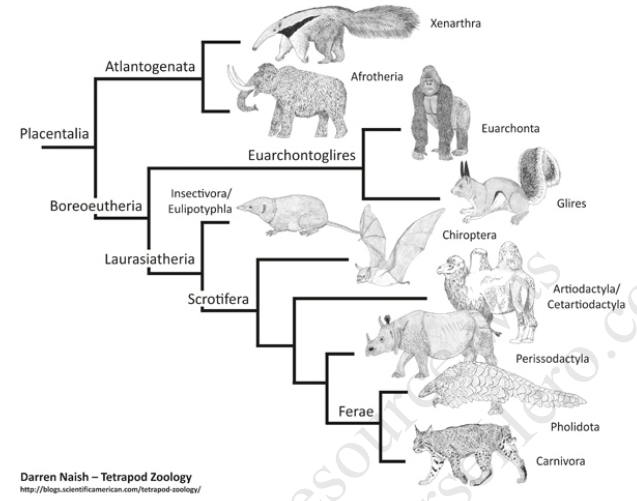
- Achiroptera and the perissodactyla share a common ancestor not shared with the carnivora
- Bafrotheria are more closely related to euarchonta than to glires
- Cthe xenarthra and glires share a common ancestor not shared with euarchonta
- Dthe perissocactyla and the xenarthra share a common ancestor not shared with glires
- Exenarthra and euarchonta share a common ancestor
66Which of the following would diffuse through a lipid bilayer the fastest?
- ANa+
- BBenzene (C6H6)
- CWater
- DGlucose
- EATP
67Kinetochores play an essential role in mitosis by
- Aa. allowing the centromeres to move along microtubules
- Bb. holding two sister chromatids together
- Cc. separating the homologs
- Dd. establishing tension and so allowing the cell to know when the sisters chromatids are properly aligned
- Ea and d
68Newly synthesized DNA is illustrated in Figure 2. The Okazaki fragments have not yet been processed. Which of the Okazaki fragments was synthesized first?
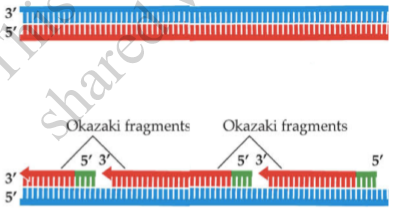
- Aone on the right
- Bone on the left
- Cone in the middle
- Dthere's no way to tell
69Two mice are heterozygus for a defective allele of telomerase (genotype T/t). They have entirely normal phenotypes. These two mice are crossed. Among their progeny are two mice that are completely defective in telomerase (genotype t/t). These mice also have completely normal phenotypes. They are bred together to produce lots of t/t progeny. All of these mice have abnormal phenotypes: small size, early aging, and many tumors. Karyotyping of these defective mice reveals that their chromosomes are very unusual - some are very short and broken, and the telomeres are missing. From this we can conclude that:
- Atelomeres in mice are long, and so can shrink for several life cycles before they are lost
- Btelomeres in mice require only one cell generation to be lost
- Cmice don't require telomeres to grow normally
- Dtelomerase needs to be present at all times in the cell for it to survive
- Emouse chromosomes are circular
70A human cell is UV irradiated in G1 and undergoes cell cycle arrest. Why is it important to arrest the cell cycle when DNA damage is detected?
- Aa. isn't important - cell just slowed down, due to damage. the phase of the cell cycle has nothing to do with DNA repair processes
- Bb. because in G1 phase you have the most copies of DNA of any phase in the cell cycle, so you have more templates for repair
- Cc. because progression through s phase results in the loss of template strand for nucleotide excision repair
- Dd. because replication past a dimer can be mutagenic
- Eboth c and d are true
71Figure 3 (glowing mice) shows sibling mice derived from a mother mouse transgenic for the Green Flourescent Protein, expressed in the skin. Some of the siblings have glowing eyes and ears; others don't. The mother mouse was:
- Aheterozygous for the transgene, possible chimeric for transformed cells
- Bheterozygous for the transgene, definitely chimeric for transformed cells
- Chomozygous for the transgene, definitely chimeric for transformed cells
- Dhomozygous for the transgene, possibly chimeric for the transformed cells
- Eit's impossible to determine from this data whether she was chimeric and/or heterozygous, but both are possible
72Mendel observed that each pea has two versions of something that determines each trait, and that only one version is transmitted to the gametes (egg or sperm). We now call that "something" a ___ and we know it's made of ____.
- AGene, enzymes
- BGene, protein
- CGene, DNA
- DEnzyme, amino acids
- EEnzyme, cofactors
73Two tabby (striped) cats are bred together, and produce 12 kittens. 9 are tabby, but 3 are black. From this we can conclude:
- Aa. One of the cats had a black parent
- Bb. Both cats had a black parent
- Cc. Tabby is recessive to black
- Dd. Black is recessive to tabby
- Ed and a are correct
74Viruses inject their genes into their hosts to reprogram them. One important experiment that demonstrated that genes are made of DNA was the observation that viruses inject a molecule that includes the element
- AN, but not O
- BO, but not N
- CS, but not P
- DP, but not S
- EP, but not O
75the DNA of virtually all organisms is double stranded. Some viruses are an exception, and have single strand genomes (though they have double stranded DNA during replication). Partly for this reason, these viruses have very high rates of mutation. Why does being double stranded make the DNA less susceptible to mutation?
- Aa. Because of one strand has a damaged base, the other strand can be used as a template to fix the damage.
- Bb. Because if there's a mismatched base, the cell can tell there is a problem and correct it
- Cc. Because single stranded DNA is more susceptible to damage than double stranded DNA - the bases are more exposed to their environment
- Da, b, c are all true
- Enone of the above
76During DNA replication, the enzyme primase has the job of:
- Aa. laying down RNA primers for leading strand synthesis
- Bb. laying down RNA primers for lagging strand synthesis
- Cc. laying down RNA primers for RNA synthesis
- Da and b
- Ea, b, and c
77How can harmful mutations be eliminated?
- Athrough DNA replication
- Bthrough DNA repair
- Cthrough natural selection
- Dthrough polymerization
- Ethrough Watson-Crick base pairing
78The catalytic activity of telomerase is...
- Aan rna polymerase that uses RNA as a template
- Ba dna polymerase that uses DNA as a template
- Ca rna polymerase that uses DNA as a template
- Da dna polymerase that uses RNA as a template
- Etelomerase has no enzymatic activity - it just provides a template
79Water is a great source of electrons, because water is always present in living things. How come PSII (P680) of green plants can pull electrons from water, while the Chlorobium photosystem (containing P840) depends on H2S as an electron source?
- ABecause PSII's electron comes from PSI (P700)
- BBecause P840 is not a strong enough oxidant to oxidize water
- CBecause P840 is not a strong enough reductant to oxidize water
- DBecause the concentration of H2S is higher than that of water
- EBecause Chlorobium fixes CO2 using the reverse citric acid cycle.
80some organisms can perform "cyclic electron transport". They do this when:
- Athey need more atp, but not more nadph
- Bthey need more nadph, but not more atp
- Cwhen photosynthetic photons are not available
- Dwhen O2 is not available
- Ewhen they have bacteriorhodopsin
81Dr. Britt describes O2 as a toxic waste product of photosynthesis. Why is O2 "toxic"?
- Aa. Because plants don't need it
- Bb. Because it destroys the ozone layer
- Cc. Because it oxidizes metals in enzymes
- Dd. Because mitochondria use it
- Eb and c are correct
82in well-lit, actively photosynthesizing green plants, a high concentration of protons would be found in:
- Athe intermembrane space of the cholorplast
- Bin the stroma
- Cin the space within the thylakoids (the lumen)
- Din the cytoplasm
- Ein the nucleus
83If you substitute one amino acid for a different one in an enzyme of 300 amino acids, how will it change the enzyme's behavior?
- Ano effect
- Bthe protein will not fold properly and therefore can't catalyze any reactions
- Cthe protein will work at low temperature, but will "denature" (unfold) at temperatures even lower than the normal denaturation temperature of the protein
- Dthe protein will fold normally but will fail to catalyze the reaction
- Eany or all of the above might be true, it depends on the change
84Normally, strains of the bacterium Bacillus subtillis die when they are placed in medium containing penicillin. These normal strains are called penS (for "penicillin sensitive"). There are also mutant strains known which can live in penicillin. These are called penR (for "penicillin resistant"). Which of the following experiments would allow you to test for transformation in the bacterium?
- Aextract enzymes from penR, mix with penS, grow the mixture on medium containing penicillin
- Bextract dna from penS, mix with penR cells, grow the mixture on medium containing penicillin
- Cextract dna from penS, mix with penR cells, grow the mixture without penicillin
- Dextract dna from penS, mix with pen5 cells, grow the mixture on medium containing penicillin
- Etreat penS cells with penicillin, look for cells that cannot grow on medium without penicillin
85Max isolated DNA from an archaean cell and hydrolyzed the ribose-phosphate bonds,separating the nucleotides. He measured the relative frequencies of the nucleotides. Which result below is the most likely?
- Aa = t = g = c
- Ba = t and g = c
- Ca = g and c = t
- Da > t > g > c
- Eall answers are equally likely, there is no basis for a decision
86Ester isolated a virus from an archaen cell and purified and analyzed its DNA. She found that the relative frequencies of the viral nucleotides were 40% A, 20% G, 25% C, and 15% T. What did this indicate?
- Ain this double stranded DNA, bases pair randomly rather than by certain rules.
- Bthe virus actually had an rna genome, not a dna genome
- Cthe virus had a genome made of a single-stranded rather than double-stranded of DNA
- Dthe virus had a genome made of protein and enzymes made of DNA
87As a long polymer of negatively charged nucleotides, DNA and RNA are obviously expensive to make. What makes the polymerization of DNA by DNA polymerase energetically favorable?
- Athe coupled hydrolysis of an ATP to AMP for each added base
- Bthe cleavage of pyrophosphate from each nucleotide added
- CAllowing H+ to go down a gradient
- Dthe extremely low concentration of nucleotide triphosphates makes this reaction favorable
- Ethe re-formation of hydrogen bonds after synthesis
88the cells in your muscles are very long, and contain multiple nuclei. these nuclei have the usual dna content (about 6 pg per nucleus). what sort of cell cycle would produce a cell with many nuclei but no increase in the DNA content per nucleus?
- A(G1-S-G1-S...) repeat
- B(G1 - S -G2 then mitosis without doing cytokinesis) repeat
- CG1, another G1, then S, then cytokinesis
89Which of the following statements regarding meiosis 1 is false?
- Acrossing-over occurs between chromosome arms
- Bmeiosis 1 involves the separation of chromosomes into daughter cells
- Csynapsis occurs during meiosis 1
- Dat the end of meiosis 1, all chromosomes have one chromatid
- EDNA double strand breaks are induced in all chromosomes
Information
- Description
- Quiz on PK mt2, created by Nts nznx on 06/11/2019.
- Author
- Nts nznx
- Language
- English
- Views
- 11
- Tags
- Rating
- No ratings yet Rate this quiz