
Quiz
Final Exam PreQuiz
Create a free account to finish this quiz
Save your progress and see your final score.
Already have an account? Sign in
Questions in this quiz (82)
113-21a
An auditor’s decision either to apply analytical procedures as substantive tests or to perform substantive tests of transactions and account balances usually is determined by the- Aavailability of data aggregated at a high level.
- Btiming of tests performed after the balance sheet date.
- Cauditor’s familiarity with industry trends.
- Drelative effectiveness and efficiency of the tests.
213-21b The auditor faces a risk that the audit will not detect material misstatements that occur in the accounting process. To minimize this risk, the auditor relies primarily on (1) internal control. (2) tests of controls.
- Ainternal control.
- Btests of controls
- Csubstantive tests.
- Dstatistical analysis.
313-21c A conceptually logical approach to the auditor’s evaluation of internal control con-sists of the following four steps:
(I) Determining the internal controls that should prevent or detect and correct er-rors and fraud.
(II) Identifying control deficiencies to determine their effect on the nature, timing, or extent of auditing procedures to be applied and suggestions to be made to the client.
(III) Determining whether the necessary internal control procedures are prescribed and are being followed satisfactorily.
(IV) Considering the types of errors and fraud that can occur.
What should be the order in which these four steps are performed?- AI, II, III, and IV
- BI, III, IV, and II
- CIII, IV, I, and II
- DIV, I, III, and II
413-22a To support the auditor’s initial assessment of control risk below maximum, the audi-tor performs procedures to determine that internal controls are operating effectively. Which of the following audit procedures is the auditor performing?
- ATests of controls
- BSubstantive tests of transactions
- CTests of details of balances
- DTests of trends and ratios
513-22b The primary objective of performing tests of controls is to obtain
- Asufficient appropriate audit evidence to afford a reasonable basis for the auditor’s opinion, without the need for additional evidence.
- Ba reasonable degree of assurance that the client’s internal controls are operating effectively on a consistent basis throughout the year.
- Cassurances that informative disclosures in the financial statements are reasonably adequate.
- Dknowledge and understanding of the client’s prescribed procedures and methods.
613-22c Tests of controls are most likely to be omitted when
- Aan account balance reflects many transactions.
- Bcontrol risk is assessed at less than the maximum.
- Cthe understanding of internal control indicates that evaluating the effectiveness of control policies and procedures is likely to be inefficient.
- Dthe auditor wishes to increase the acceptable level of detection risk.
713-23a In the financial statement audit of a nonpublic company, the auditor decides to per-form tests of the controls related to the occurrence of sales transactions. Which of the following best explains why the auditor decided to test these controls?
- AIn a nonissuer financial statement audit, the auditor is required to test the operating effectiveness of internal controls.
- BThe auditor wants to obtain an understanding of the design of the internal controls.
- CControl risk is assessed at below the maximum.
- DThe auditor wants to obtain an understanding of the implementation of the internal controls.
813-23b Substantive analytical procedures are most likely to be used to test which of the following accounts?
- AInterest income
- BCash
- CAccounts payable
- DTreasury stock
913-23c Which of the following is the auditor least likely to consider when developing the overall audit strategy?
- AComplexity of the company’s operations
- BEvaluation of accounts receivable confirmations
- CPreliminary judgment about materiality
- DThe economic conditions affecting the industry in which the company operates
1014-20a Which of the following controls would be most effective in detecting a failure to re-cord cash received from customers paying on their accounts?
- AA person in accounting reconciles the bank deposit to the cash receipts journal.
- BTransactions recorded in the cash receipts journal are posted on a real-time basis to the accounts receivable master file.
- CMonthly statements are sent to customers and any discrepancies are resolved by someone independent of cash handling and accounting.
- DDeposits of cash received are made daily.
1114-20b The accounting system will not post a sales transaction to the sales journal without a valid bill of lading number. This control is most relevant to which transaction-related objective for sales?
- AAccuracy
- BOccurrence
- CCompleteness
- DPosting and summarization
1214-20c The accounting system automatically obtains the unit price based on scans of bar codes for merchandise sold. This control is most relevant to which transaction-related objective for sales?
- APosting and Summarization
- BOccurrence
- CCompleteness
- DAccuracy
1314-21a Which of the following controls most likely will be effective in offsetting the tendency of sales personnel to maximize sales volume at the expense of high bad-debt write-offs?
- AEmployees responsible for authorizing sales and bad-debt write-offs are denied access to cash.
- BEmployees involved in the credit-granting function are separated from the sales function.
- CShipping documents and sales invoices are matched by an employee who does not have the authority to write off bad debts.
- DSubsidiary accounts receivable records are reconciled to the control account by an employee independent of the authorization of credit.
1414-21b A sales invoice for $5,200 was computed correctly but, by mistake, was entered as $2,500 to the sales journal and posted to the accounts receivable master file. The customer remitted only $2,500, the amount on his monthly statement.
- APrelistings and predetermined totals are used to control postings
- BThe customers’ monthly statements are verified and mailed by a responsible person other than the bookkeeper who prepared them
- CSales invoice numbers, prices, discounts, extensions, and footings are independently checked.
- DUnauthorized remittance deductions made by customers or other matters in dispute are investigated promptly by a person independent of the accounts receivable function.
15c. Shipments occurring in December 2019 did not get recorded until the first few days of January 2020.
- AThe system automatically assigns bill of lading numbers and ensures no duplicates are issued.
- BAs goods leave the shipping dock, the system generates a bill of lading and associated sales invoice, which is automatically recorded in the sales journal.
- CThe accounting system requires entry of a valid bill of lading number provided by the shipping department before a sales transaction is accepted for entry.
- DThe system prevents the creation of a bill of lading without a customer order dated prior to the shipping date.
1614-22a . To determine whether internal control relative to the revenue cycle of a wholesaling entity is operating effectively in minimizing the failure to prepare sales invoices, an auditor would most likely select a sample of transactions from the population represented by the
- Asales order file
- Bcustomer order file
- Cshipping document file
- Dsales invoice file.
1714-22b An auditor is performing substantive tests of transactions for sales. One step is to trace a sample of debit entries from the accounts receivable master file back to the supporting duplicate sales invoices. What will the auditor intend to establish by this step?
- ASales invoices represent existing sales
- BAll sales have been recorded.
- CAll sales invoices have been correctly posted to customer accounts
- DDebit entries in the accounts receivable master file are correctly supported by sales invoices.
1814-22c Which audit procedure is most effective in testing credit sales for overstatement?
- ATrace a sample of postings from the sales journal to the sales account in the general ledger
- BVouch a sample of recorded sales from the sales journal to shipping documents
- CPrepare an aging of accounts receivable
- DTrace a sample of initial sales orders to sales recorded in the sales journal.
1914-23a Tracing shipping documents to sales invoices provides evidence that
- Asales billed to customers were actually shipped
- Ball goods ordered by customers were shipped
- Cshipments to customers were recorded as sales
- Dshipments to customers were properly invoiced
2014-23b Which of the following procedures most likely represents an internal control designed to reduce the risk of errors in the billing process?
- AComparing control totals for shipping documents with corresponding totals for sales invoices.
- BMatching receiving documents with approved sales orders before invoice preparation
- CReconciling the control totals for sales invoices with the accounts receivable subsidiary ledger
- DRequiring customers that purchase on account to be approved by the credit department.
2114-23c An auditor wishes to test the completeness assertion for sales. Which of the following audit tests would most likely accomplish this objective?
- ASelect a sample of shipments occurring during the year and trace each one to inclusion in the sales journal
- BCompare accounts receivable turnover (net credit sales/average gross receivables) in the current year to that achieved in the prior year.
- CUse common size analysis to compare recorded sales to sales recorded by other companies in the same industry.
- DSelect large individual sales recorded during the year and review supporting documentation.
2216-20a As a result of analytical procedures, the auditor determines that the gross profit percentage has declined from 30 percent in the preceding year to 20 percent in the cur-rent year. The auditor should
- Aexpress a qualified opinion due to inability of the client company to continue as a going concern.
- Bevaluate management’s performance in causing this decline.
- Crequire footnote disclosure
- Dconsider the possibility of a misstatement in the financial statements.
2316-20b An auditor’s preliminary analysis of accounts receivable turnover revealed the following rates over these accounting periods:
2019: 4.3
2018: 6.2
2017: 7.3
Which of the following is the most likely cause of the decrease in accounts receivable turnover?- AIncrease in the cash discount offered
- BLiberalization of credit policy
- CShortening of due date terms
- DIncreased cash sales
2416-20c After a CPA has determined that accounts receivable have increased as a result of slow collections in a “tight money” environment, the CPA will be likely to
- Aexpand tests of collectibility
- Breview the going concern ramifications
- Creview the credit and collection policy
- Dincrease the balance in the allowance for bad debt account.
2516-21a The return of a positive confirmation of accounts receivable without an exception attests to the
- Acollectibility of the receivable balance
- Baccuracy of the allowance for uncollectible accounts
- Caccuracy of the aging of accounts receivable.
- Daccuracy of the receivable balance.
2616-21b Which of the following procedures will an auditor most likely perform for year-end accounts receivable confirmations when the auditor did not receive replies to second requests?
- AReview the cash receipts journal for the month prior to year end.
- BIntensify the study of internal control concerning the revenue cycle.
- CInspect the shipping records documenting the merchandise sold to the debtors
- DIncrease the assessed level of detection risk for the existence assertion.
2716-21c The negative form of accounts receivable confirmation request is useful except when
- Ainternal control surrounding accounts receivable is considered to be effective
- Ba large number of small balances is involved
- Cthe auditor has reason to believe the persons receiving the requests are likely to give them consideration
- Dindividual account balances are relatively large.
2816-22a Which of the following will likely provide the most assurance concerning the accuracy balance-related objective for accounts receivable?
- AVouch amounts in the subsidiary ledger to details on shipping documents
- BCompare receivable turnover ratios with industry statistics for reasonableness.
- CInquire about receivables pledged under loan agreements
- DAssess the allowance for uncollectible accounts for reasonableness.
2916-22b Which of the following audit procedures will best uncover an understatement of sales and accounts receivable?
- AConfirm accounts receivable
- BTest a sample of sales transactions, selecting the sample from sales invoices recorded in the sales journal.
- CTest a sample of sales transactions, selecting the sample from prenumbered shipping documents
- DReview the aged accounts receivable trial balance
3016-22c The confirmation of customers’ accounts receivable rarely provides reliable evidence about the completeness assertion because
- Acustomers may not be inclined to report understatement errors in their accounts
- Brecipients usually respond only if they disagree with the information on the request
- Cmany customers merely sign and return the confirmation without verifying details.
- Dthere is likely to be reliable third-party evidence available.
3116-23a The auditor sends out positive accounts receivable confirmations for a client. Assuming a second confirmation is sent out to a major customer who still fails to respond, which action should the auditor take?
- AConsider the nonresponse as a minor audit finding and use responding confirmations as a basis for test results.
- BIssue a qualified opinion due to the lack of sufficient audit evidence
- CSend out a third confirmation request and, if no response, perform alternative procedures
- DProvide the client a copy of the accounts receivable confirmation and request that they obtain the information from the customer
3216-23b Which of the following is least likely to be a reasonable explanation for an increase in accounts receivable turnover?
- AEarly payment incentives for customers
- BTightening of credit policy
- CImplementation of more aggressive collection policies
- DAllowance of a new grace period for customer payments
3316-23c An auditor who is auditing accounts receivable would least likely perform which of the following tests?
- ASelect cash disbursements made shortly after year end and examine the supporting documentation such as receiving reports and vendor invoices
- BConfirm a sample of accounts receivables with the customers that owe the balances
- CVouch cash receipts to the accounts receivables transactions
- DObtain an aged trial balance of accounts receivable and trace the total to the general ledger control account.
3418-16a . An auditor traced a sample of purchase orders and the related receiving reports to the purchases journal and the cash disbursements journal. The purpose of this substantive audit procedure most likely was to
- Aidentify unusually large purchases that should be investigated further
- BVerify that cash disbursements were for goods actually received
- Cdetermine that purchases were properly recorded
- Dtest whether payments were for goods actually ordered.
3518-16b Which of the following questions would be best to include in an internal control questionnaire concerning the completeness assertion for purchases?
- AIs an authorized purchase order required before the receiving department can accept a shipment or the vouchers payable department can record a voucher?
- BAre purchase requisitions prenumbered and independently matched with vendor invoices?
- CIs the unpaid voucher file periodically reconciled with inventory records by an employee who does not have access to purchase requisitions?
- DAre purchase orders, receiving reports, and vouchers prenumbered and periodically accounted for?
3618-16c Mailing disbursement checks and remittance advices should be controlled by the person who
- Aapproves the vouchers for payment
- Bmatches the receiving reports, purchase orders, and vendors invoices
- Csigns the checks last
- Dmaintains control over a mechanical check-signing machine
3718-17a In auditing accounts payable, an auditor’s procedures most likely will focus primarily on management’s assertion of
- Aexistence
- Brealizable value.
- Ccompleteness
- Dvaluation and allocation
3818-17b Which of the following audit procedures is best for identifying unrecorded trade accounts payable?
- AExamining unusual relationships between monthly accounts payable balances and recorded cash payments
- BReconciling vendors’ statements to the file of receiving reports to identify items received just prior to the balance sheet date
- CReviewing cash disbursements recorded subsequent to the balance sheet date to determine whether the related payables apply to the prior period
- DInvestigating payables recorded just prior to and just subsequent to the balance sheet date to determine whether they are supported by receiving reports
3918-17c To determine whether accounts payable are complete, an auditor performs a test to verify that all merchandise received is recorded. The population of documents for this test consists of all
- Avendor’s invoices
- Bpurchase orders.
- Creceiving reports
- Dcancelled checks
4018-18a While auditing a client’s purchase transactions, an auditor selects a sample of vouchers and then compares the dates on the vouchers to the dates on which the corresponding transactions were actually recorded in the client’s purchase journal. The audit procedure is most likely designed to test the
- Aoccurrence assertion
- Bcompleteness assertion
- Caccuracy assertion
- Dcutoff assertion
4118-18b In assessing control risk for purchases, an auditor vouches a sample of entries in the voucher register to the supporting documents. Which assertion would this test of controls most likely support?
- ACompleteness
- BOccurrence
- CValuation and allocation
- DRights and obligations
4218-18c Which of the following tests would an auditor be least likely to perform during an audit of accounts payable?
- AExamine open vouchers, receiving reports, and vendor invoices shortly after the year end
- BTrace a sample of vouchers to the purchase journal
- CSend out accounts payable confirmations
- DSelect cash disbursements made shortly after year end and examine supporting documentation such as receiving reports and vendor invoices
4321-13a . For control purposes, the quantities of materials ordered may be omitted from the copy of the purchase order that is
- Areturned to the requisitioner
- Bforwarded to the receiving department
- Cforwarded to the accounting department
- Dretained in the purchasing department’s files
4421-13b For several years, a client’s physical inventory count has been lower than the amount shown on the books at the time of the count. Contributing to the inventory problem could be material weaknesses in internal control that led to failure to record some
- Apurchases returned to vendors
- Bsales returns received.
- Csales discounts allowed
- Dcash purchases
4521-13c Which of the following internal control procedures most likely would be used to maintain accurate inventory records?
- APerpetual inventory records are periodically compared with the current cost of individual inventory items
- BA just-in-time inventory ordering system keeps inventory levels to a desired minimum
- CRequisitions, receiving reports, and purchase orders are independently matched before payment is approved
- DPeriodic inventory counts are used to adjust the perpetual inventory records.
4621-14a An auditor selected items for test counts while observing a client’s physical inventory. The auditor traced the test counts to the client’s inventory listing. This procedure likely obtained evidence about which balance-related audit objective for inventory?
- AExistence
- BRights and obligations
- CCompleteness
- DRealizable value
4721-14b If the perpetual records show lower quantities of inventory than the physical count, an explanation of the difference might be unrecorded
- Asales
- Bsales discounts.
- Cpurchases
- Dpurchase discounts
4821-14c An inventory turnover analysis is useful to the auditor because it may detect
- Ainadequacies in inventory pricing
- Bmethods of avoiding cyclical holding costs
- Cthe existence of obsolete merchandise.
- Dthe optimum automatic reorder points
4921-15a Alpha Company uses its sales invoices for posting perpetual inventory records. Inadequate controls over the invoicing function allow goods to be shipped that are not invoiced. The inadequate controls could cause an
- Aunderstatement of revenues and receivables and an overstatement of inventory
- Bunderstatement of revenues, receivables, and inventory
- Coverstatement of revenues and receivables and an understatement of inventory
- Doverstatement of revenues, receivables, and inventory
5021-15b As part of the current audit, the auditor begins performing substantive tests on a client’s inventory. To test the valuation, allocation, and accuracy assertion, the auditor should perform all of the following procedures except for
- Areviewing direct labor rates and testing the computation of the standard over-head rates used
- Bperforming inventory price tests on a sample of inventory items to ensure the inventory is properly valued.
- Ctesting the mathematical computations of the inventory report and reconciling to the inventory general ledger accounts
- Dvouching a sample of items from the client’s inventory report sheet to the cor-responding prenumbered inventory tags
5121-15c In auditing a manufacturing entity, which of the following procedures would an audi-tor most likely perform to determine whether slow-moving, defective, and obsolete items included in inventory are properly identified?
- ATest the mathematical accuracy of the inventory report
- BInquire of management about whether inventory has been pledged or assigned
- CTour the manufacturing plant or production facility
- DTest the computation of standard overhead rates
5223-15a A CPA obtains a January 10 cutoff bank statement for a client directly from the bank. Very few of the outstanding checks listed on the client’s December 31 bank reconciliation cleared during the cutoff period. A probable cause for this is that the client
- Ais engaged in kiting
- Bis engaged in lapping
- Ctransmitted the checks to the payees after year end
- Dhas overstated its year-end bank balance
5323-15b In establishing the existence and ownership of an investment held by a corporation in the form of publicly traded stock, an auditor should inspect the securities or
- Aobtain written representations from management confirming that the securities are properly classified as trading securities
- Binspect the audited financial statements of the investee company
- Cconfirm the number of shares owned that are held by an independent custodian
- Ddetermine that the investment is carried at the lower of cost or market.
5423-15c The auditor should ordinarily send confirmation requests to all banks with which the client has conducted any business during the year, regardless of the year-end balance, because
- Athis procedure will detect kiting activities that would otherwise not be detected
- Bthe confirmation form also seeks information about indebtedness to the bank.
- Cthe sending of confirmation requests to all such banks is required by auditing standards
- Dthis procedure relieves the auditor of any responsibility with respect to nondetection of forged checks
5523-16a Which of the following cash transfers results in a misstatement of cash at December 31, 2019?
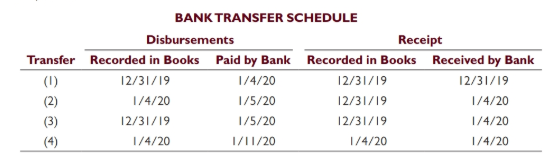
- A1
- B2
- C3
- D4
5623-16b The auditor should control and verify all liquid assets simultaneously to prevent
- Aunrecorded disbursements.
- Bconversion of assets to conceal a shortage
- Cunauthorized disbursements
- Dembezzlement
5723-16c Which of the following is one of the better auditing techniques to detect kiting?
- AReview composition of authenticated deposit slips
- BReview subsequent bank statements and cancelled checks received directly from the bank
- CPrepare year-end bank reconciliations
- DPrepare a schedule of bank transfers from the client’s books
5823-17a Which of the following controls would most likely detect a kiting scheme?
- APreparing a bank reconciliation
- BUsing a lockbox system for customer receipts
- CComparing the details of deposit tickets and recorded remittance advices
- DPreparing a bank transfer schedule
5923-17b All of the following are effective ways to prevent and/or detect lapping, except for
- Acomparing the dollar amounts and dates on the bank deposit slips with customer remittance credits entered into the accounts receivable ledger
- Bpreparing a bank transfer schedule
- Crequiring that customers send their payments directly to a lockbox
- Dindependently comparing the recorded cash receipts with funds actually deposited in the bank.
6023-17c Which of the following discovered by the auditor would be a weakness in the client’s internal control over its investments?
- AThe internal auditor performs a periodic count of the actual securities and reconciles the securities counted to the investment subsidiary ledger
- BInvestments not held by an independent third-party custodian are kept in the Treasurer’s office.
- CA designated accounting individual that has no custody or authorization responsibilities maintains the detailed records of the investment subsidiary ledger
- DThe client’s board of directors authorizes all purchases and sales of investment securities.
6124-20a When a contingency is resolved subsequent to the issuance of audited financial statements, which correctly contained disclosure of the contingency in the footnotes based on information available at the date of issuance, the auditor should
- Ainform the appropriate authorities that the report cannot be relied on
- Btake no action regarding the event.
- Cinsist that the client issue revised financial statements.
- Dinform the audit committee that the report cannot be relied on
6224-20b Which of the following would be least likely to be included in a standard inquiry to the client’s attorney
- AA list provided by the client of pending litigation or asserted or unasserted claims with which the attorney has had some involvement
- BA request that the attorney provide information about the status of pending litigation
- CA request for the attorney to identify any pending litigation or threatened legal action not identified on a list provided by the client
- DA request for the attorney to opine on the correct accounting treatment associ-ated with an outstanding claim or pending lawsuit outcome
6324-20c An example of an event occurring in the period between the end of the year being audited and the date of the auditor’s report that normally will not require disclosure in the financial statements or auditor’s report is
- Adecreased sales volume resulting from a general business recession.
- Bserious damage to the company’s plant from a widespread flood
- Cissuance of a widely advertised capital stock issue with restrictive covenants
- Dsettlement of a large liability for considerably less than the amount recorded
6424-21a Which of the following is not a required item to be communicated by the auditor to the audit committee or others charged with governance?
- AInformation about the auditor’s responsibility in an audit of financial statements
- BInformation about the overall scope and timing of the audit
- CSignificant findings arising from the audit
- DRecommendations for improving the client’s business
6524-21b Written management representations obtained by the auditor in connection with a financial statement audit should include a
- Asummary of all corrected misstatements
- Bstatement of management’s belief that any uncorrected misstatements are in fact not misstatements.
- Cstatement of management’s belief that the effects of uncorrected misstatements are not material
- Dsummary of all uncorrected misstatements
6624-21c A management letter
- Ais the auditor’s report on significant deficiencies and material weaknesses in in-ternal control.
- Bis mandatory in all audits and must be dated the same date as the audit report.
- Ccontains management’s representations to the auditor documenting statements made by management to the auditor during the audit about matters affecting the financial statements.
- Dcontains recommendations from the auditor designed to help the client improve the efficiency and effectiveness of its business
6724-22a The Form 10-K filed by management of a public company includes a section on management’s discussion and analysis (MD&A) in addition to the annual financial statements. Which of the following best describes the auditor’s responsibility for the MD&A information?
- AThe auditor must perform sufficient appropriate audit procedures to opine on the MD&A information.
- BThe auditor has no responsibilities related to the MD&A disclosures
- CThe auditor must read the MD&A information to determine whether there is any material inconsistency with the audited financial statements.
- DThe auditor must provide a disclaimer of opinion related to the MD&A information
6824-22b Management of Thurman Corporation included additional supplementary informa-tion in documents that include the audited financial statements for the year ended December 31, 2019. Management has asked its audit firm, Wally, CPAs, whether they can report on the supplementary information. Which of the following conditions would preclude Wally, CPAs, from conducting this engagement?
- AThe supplementary information is derived from the accounting records used to generate the basic financial statements
- BThe supplementary information covers the period January 1, 2019, through February 15, 2020
- CWally’s opinion on the basic financial statements was unmodified.
- DWhen evaluating supplementary information, Wally plans to use the same materiality threshold as that used in the audit of the basic financial statements
6924-22c Investment and property schedules are presented for purposes of additional analysis in a document outside the basic financial statements. The schedules are not required supplementary information. When the auditor is engaged to report on whether the supplementary information is fairly stated in relation to the audited financial statements as a whole, the measurement of materiality is the
- Agreater of the individual schedule of investments or schedule of property by itself
- Blesser of the individual schedule of investments or schedule of property by itself.
- Csame as that used in forming an opinion on the basic financial statements as a whole
- Dcombined total of both the individual schedules of investments and property as a whole.
7024-23a A client acquired 25 percent of its outstanding capital stock after year end but prior to the date of the auditor’s report. The auditor should
- Adisclose the acquisition in the opinion paragraph of the auditor’s report
- Badvise management to adjust the balance sheet to reflect the acquisition.
- Cissue pro forma financial statements giving effect to the acquisition as if it had occurred at year end
- Dadvise management to disclose the acquisition in the notes to the financial statements.
7124-23b Which of the following statements is correct about an auditor’s required communication with those charged with governance?
- AAny matters communicated with those charged with governance are also required to be communicated to the entity’s management
- BThe auditor is required to inform those charged with governance about significant misstatements discovered by the auditor and subsequently corrected by management
- CDisagreements with management about the application of accounting principles must be communicated in writing to those charged with governance.
- DThe auditor should not communicate frequently recurring misstatements unless they are material.
7224-23c . In addition to making management inquiries, an auditor should perform the following procedures to identify client contingencies with the exception of
- Aobtaining a client representation letter
- Breviewing derivative transactions reflected on the quarter-end balance sheet
- Creviewing the status of long-term leases.
- Ddiscussing sales contracts with the sales manager
7325-18a Which of the following best describes the responsibility of the CPA in performing compilation services for a company?
- AThe CPA has to satisfy only himself or herself that the financial statements were prepared in conformity with accounting standards.
- BThe CPA must understand the client’s business and accounting methods and read the financial statements for reasonableness
- CThe CPA should obtain an understanding of internal control and perform tests of controls
- DThe CPA is relieved of any responsibility to third parties
7425-18b The standard compilation report includes which statement or phrase?
- AManagement is responsible for the financial statements
- BThe accountant does not express an opinion but expresses only limited assurance on the compiled financial statements
- CThe objective of a compilation is to assist management in presenting financial information in the form of financial statements
- DThe accountant has compiled the financial statements in accordance with stan-dards established by the Auditing Standards Board
7525-18c A CPA is performing review services for a small, closely held manufacturing company. As a part of the follow-up of a significant decrease in the gross margin for the current year, the CPA discovers that there are no supporting documents for $40,000 of disbursements. The chief financial officer assures her that the disbursements are proper. What should the CPA do?
- AInclude the unsupported disbursements without further work in the statements on the grounds that she is not doing an audit
- BModify the review opinion or withdraw from the engagement unless the unsupported disbursements are satisfactorily explained.
- CExclude the unsupported disbursements from the statements.
- DObtain a written representation from the chief financial officer that the disbursements are proper and should be included in the current financial statements
7625-19a Type 1 service auditor’s report on internal controls at a service organization
- Aincludes an opinion about the suitability of the design of controls at the service organization.
- Bis based on the performance of tests of controls and substantive tests of transactions at the service organization
- Ccontains an opinion about the operating effectiveness of internal controls at the service organization.
- Dprovides an opinion about the fair presentation of the service organization’s financial statements in accordance with accounting standards
7725-19b Which of the following professional services would be considered an attestation engagement?
- APreparing the income statement and balance sheet for one year in the future based on client expectations and predictions
- BProviding financial analysis, planning, and capital acquisition services as a part-time, in-house controller
- CAdvising management in the selection of a computer system to meet business needs.
- DAdvocating on behalf of a client about trust tax matters under review by the Internal Revenue Service
7825-20a An auditor is reporting on cash basis financial statements. These statements are best referred to in the opinion of the auditor by which of the following descriptions?
- ACash receipts and disbursements and the assets and liabilities arising from cash transactions
- BFinancial position and results of operations arising from cash transactions
- CBalance sheet and income statements resulting from cash transactions
- DCash balance sheet and the source and application of funds
7925-20b When asked to perform an audit to express an opinion on one or more specified elements, accounts, or items of a financial statement, the auditor
- Amay not describe auditing procedures applied
- Bshould advise the client that the opinion can be issued only if the financial statements have been audited and found to be fairly presented
- Cmay assume that the standards of reporting with respect to GAAP do not apply.
- Dshould comply with the request only if they constitute a major portion of the financial statements on which an auditor has disclaimed an opinion based on an audit
8025-21a . Which of the following is a prospective financial statement for general use upon which an accountant may appropriately report?
- AFinancial projection
- BPartial presentation
- CPro forma financial statement
- DFinancial forecast
8125-21b Which of the following procedures would most likely be performed during an engagement to compile the financial statements of a nonissuer?
- ARead the financial statements and consider whether they are appropriate in form and free from obvious material errors
- BPerform inquiry and analytical procedures
- CObtain a representation letter from management
- DSend accounts receivable confirmations
8225-21c Which of the following procedures would most likely be performed during the engagement to review the annual financial statements of a nonissuer?
- AObservation of inventory
- BConfirmation of notes receivable
- CCommunication with the predecessor accountant
- DComparison of the current financial statements with prior period financial statements
Information
- Description
- Auditing chapters 13, 16, 18, 21, 23, 24, 25
- Author
- Kassy Weston
- Language
- English
- Views
- 27
- Tags
- Rating
- No ratings yet Rate this quiz