
Quiz
APP -1
This quiz has question types that open in the usual player.
Questions in this quiz (82)
1ATOM: This is the smallest particle of matter. All matter is made up of atoms. An atom is like a tiny solar system. In the centre of the atom is the [blank_start]nucleus[blank_end] which is a cluster of [blank_start]protons[blank_end] ([blank_start]positively[blank_end] charged) and [blank_start]neutrons[blank_end] ([blank_start]no[blank_end] charge). Whirling at fantastic speeds around the [blank_start]nucleus[blank_end] are smaller and lighter particles called [blank_start]electrons[blank_end] ([blank_start]negatively[blank_end] charged).
- Anucleus
- Bprotons
- Cpositively
- Dneutrons
- Eno
- Fnucleus
- Gelectrons
- Hnegatively
2Each circle can only hold a certain number of [blank_start]electrons[blank_end] before it becomes full and stable. Thus:
- Innermost circle (or shell) = [blank_start]2[blank_end]
- Second circle (or shell) = [blank_start]8[blank_end]- A2
- B8
- Celectrons
3the electrons in the [blank_start]outer[blank_end]most shell that take part in [blank_start]chemical bonding[blank_end].
- Achemical bonding
- Bouter
4A chemical element is a pure chemical substance consisting of one type of atom distinguished by its [blank_start]ATOMIC NUMBER[blank_end], which is the number of [blank_start]protons[blank_end] in its [blank_start]nucleus[blank_end].
- AATOMIC NUMBER
- Bprotons
- Cnucleus
5[blank_start]Molecule[blank_end] is formed when two or more atoms join together chemically e.g. Oxygen.
- AMolecule
6[blank_start]6[blank_end] electrons in Carbon
- A6
7[blank_start]8[blank_end] electrons in Oxygen
- A8
8Hydrogen: number of electron =[blank_start]1[blank_end], proton =[blank_start]1[blank_end], neutron = [blank_start]0[blank_end]
- A1
- B1
- C0
9When different elements join together they form a substance called a [blank_start]compound[blank_end]. Compounds are divided into [blank_start]two[blank_end] categories:
- Acompound
- Btwo
10- [blank_start]ORGANIC[blank_end] – complicated compounds containing several elements. One of the elements always contains [blank_start]carbon[blank_end] e.g. carbohydrates.
- [blank_start]INORGANIC[blank_end] – small compounds e.g. water (H2O) and ammonia (NH3)- AORGANIC
- Bcarbon
- CINORGANIC
11[blank_start]COVALENT[blank_end] BONDS: this type of bond comes from the sharing of [blank_start]electrons[blank_end] in outer ring of two or more atoms.
- ACOVALENT
- Belectrons
12
[blank_start]IONIC[blank_end] BONDS: this type of bond arises when an [blank_start]electron[blank_end] is donating from one [blank_start]atom[blank_end] to another. This results in one of the atoms becoming negatively charged and the other [blank_start]positively[blank_end] charged. E.g. Sodium chloride (NaCl).- AIONIC
- Belectron
- Cpositively
- Datom
13Name Anatomical directions
[blank_start]Superior[blank_end] Above
[blank_start]Inferior[blank_end] Below
[blank_start]Anterior[blank_end] In front of
[blank_start]Posterior[blank_end] Behind
[blank_start]Medial[blank_end] Towards the centre
[blank_start]Lateral[blank_end] To the side
[blank_start]Proximal[blank_end] Near
[blank_start]Distal[blank_end] Further
[blank_start]Superficial[blank_end] Near to surface
[blank_start]Deep[blank_end] Further from surface- ASuperior
- BInferior
- CAnterior
- DPosterior
- EMedial
- FLateral
- GProximal
- HDistal
- ISuperficial
- JDeep
14[blank_start]Sagittal[blank_end] plane: Divides the body into left and right side
- ASagittal
15[blank_start]Coronal[blank_end] plane: Divides the body into and anterior and posterior
- ACoronal
16[blank_start]Transverse[blank_end] plane: Section which cuts across a body region
- ATransverse
17[blank_start]Buccal[blank_end] - cheek
[blank_start]Cutaneous[blank_end] - skin
[blank_start]Cranial[blank_end] - skull
[blank_start]Cephalic[blank_end] - head
[blank_start]Occipital[blank_end] - back of head
[blank_start]Cervical[blank_end] - cervical
[blank_start]Cubital[blank_end] - elbow
[blank_start]Carpal[blank_end] -wrist
[blank_start]Palmer[blank_end] - palm
[blank_start]Lumbar[blank_end] - loin
[blank_start]Gluteal[blank_end] - buttock
[blank_start]Perineal[blank_end] -between the anus and the external reproductive organs
[blank_start]Calcaneal[blank_end] -heel
[blank_start]Planter[blank_end] - sole
[blank_start]Popliteal[blank_end] - back of the knee- ABuccal
- BCutaneous
- CCranial
- DCephalic
- EOccipital
- FCervical
- GCubital
- HCarpal
- IPalmer
- JLumbar
- KGluteal
- LPerineal
- MCalcaneal
- NPlanter
- OPopliteal
18Name Anatomical Regions:
[blank_start]Frontal[blank_end] - forehead
[blank_start]Orbital[blank_end] - eye
[blank_start]Oral[blank_end] - mouth
[blank_start]Thoracic[blank_end] - chest
[blank_start]Mammary[blank_end] - breast
[blank_start]Brachial[blank_end] - arm
[blank_start]Axillary[blank_end] - armpit
[blank_start]Costal[blank_end] - ribs
[blank_start]Umbilical[blank_end] - naval
[blank_start]Abdominal[blank_end] - abdomen
[blank_start]Pelvic[blank_end] - pelvis
[blank_start]Inguinal[blank_end] - groin
[blank_start]Femoral[blank_end] - thigh
[blank_start]Patellar[blank_end] - front of knee
[blank_start]Crural[blank_end] - leg
[blank_start]Tarsal[blank_end] - ankle
[blank_start]Pedal[blank_end] - foot- AFrontal
- BOrbital
- COral
- DThoracic
- EMammary
- FBrachial
- GAxillary
- HCostal
- IUmbilical
- JAbdominal
- KPelvic
- LInguinal
- MFemoral
- NPatellar
- OCrural
- PTarsal
- QPedal
19Name basic body types:
[blank_start]ECTOMORPH[blank_end] - very hard to gain weight. They have a fast metabolism which burns up calories very quickly.
[blank_start]ENDOMORPH[blank_end] - gain fat very easily.
[blank_start]MESOMORPH[blank_end] - gain muscles very quick but gain fat easily as well.- AECTOMORPH
- BENDOMORPH
- CMESOMORPH
20ANATOMY: Study of the [blank_start]structures[blank_end] of the body
PHYSIOLOGY: Study of the [blank_start]processes[blank_end] that occur in the body
HISTOLOGY: Study of structure and function of [blank_start]cells[blank_end] & [blank_start]tissues[blank_end]- Astructures
- Bprocesses
- Ccells
- Dtissues
21[blank_start]CELL[blank_end]: single unit of matter that can [blank_start]live[blank_end] independently and [blank_start]reproduce[blank_end].
- ACELL
- Blive
- Creproduce
22[blank_start]TISSUES[blank_end]: group of cells of similar type and function
- ATISSUES
23[blank_start]ORGAN[blank_end]: is made up of [blank_start]tissues[blank_end] of related function, e.g. heart, kidney, liver.
- AORGAN
- Btissues
24For something to be classed as living, it must exhibit the following properties:
- [blank_start]Movement[blank_end]
- [blank_start]Respiration[blank_end]
- [blank_start]Sensitivity[blank_end]
- [blank_start]Growth[blank_end]
- [blank_start]Reproduction[blank_end]
- [blank_start]Excretion[blank_end]
- [blank_start]Metabolism[blank_end]- AMovement
- BRespiration
- CSensitivity
- DGrowth
- EReproduction
- FExcretion
- GMetabolism
25The chemical reactions, which occur inside the cell.
[blank_start]Anabolism[blank_end]: Chemical activity involved in the building up of new products
[blank_start]Catabolism[blank_end]: Chemical activity involved in the breakdown of complex substances into simple forms.- AAnabolism
- BCatabolism
26The human body has many different types of cells. It is made up of:
- AOrganic & inorganic salts
- BCarbohydrates
- CLipids (fatty substances)
- DNitrogen containing substances
- Eenzymes
- FProteins
- GVitamin
- Hcalcium
27The small-formed structures, which lie within the cell, are called [blank_start]organelles[blank_end].
- Aorganelles
28[blank_start]NUCLEUS[blank_end] – Is the largest organelle of the cell. Is the [blank_start]control[blank_end] centre of the cell controlling all the functions from growth, repair to reproduction. The nucleus contains [blank_start]DNA[blank_end] (deoxyribonucleic acid), which carries the cells genetic code and [blank_start]chromatin[blank_end], the material needed to form [blank_start]chromosomes[blank_end].
- ANUCLEUS
- BDNA
- Cchromatin
- Dchromosomes
- Econtrol
29[blank_start]MITOCHONDRIA[blank_end] - these are the “[blank_start]POWER[blank_end] HOUSE” of the cell. They contain [blank_start]enzymes[blank_end], which are involved in the production of energy for cellular activity through the formation of ATP ([blank_start]adenosine triphosphate[blank_end]).
- AMITOCHONDRIA
- BPOWER
- Cenzymes
- Dadenosine triphosphate
30[blank_start]ENDOPLASMIC RETICULUM[blank_end] (ER) – network of canals and sacs connected with the [blank_start]nucleus[blank_end] and [blank_start]cell[blank_end] membrane. It forms the [blank_start]CHANNELS[blank_end] of the cell, allowing movement of different substances.
- AENDOPLASMIC RETICULUM
- Bnucleus
- Ccell
- DCHANNELS
31[blank_start]RIBOSOMES[blank_end] - they are responsible for [blank_start]PROTEIN[blank_end] synthesis in the cell.
- ARIBOSOMES
- BPROTEIN
32[blank_start]LYSOSOMES[blank_end] - contain [blank_start]enzymes[blank_end] that digest and remove [blank_start]particles[blank_end] which are useless or may be harmful to the cell.
- ALYSOSOMES
- Benzymes
- Cparticles
33[blank_start]VACULOES[blank_end] - these are [blank_start]empty[blank_end] spaces within the [blank_start]cytoplasm[blank_end]. They contain [blank_start]WASTE[blank_end] material and [blank_start]SECRETIONS[blank_end] formed by the cytoplasm and are used for [blank_start]storage[blank_end] or [blank_start]digestion[blank_end].
- AVACULOES
- Bcytoplasm
- CWASTE
- DSECRETIONS
- Estorage
- Fdigestion
- Gempty
34[blank_start]GOLGI APPARATUS[blank_end] - this consists of closely packed [blank_start]membranous[blank_end] sacs and is especially prominent in [blank_start]secretary[blank_end] cells. They function in [blank_start]COMBIN[blank_end]ING [blank_start]CARBOHYDRATES[blank_end] AND [blank_start]PROTEINS[blank_end] for use to other parts of the cell.
- AGOLGI APPARATUS
- BCARBOHYDRATES
- CPROTEINS
- DCOMBIN
- Emembranous
- Fsecretary
35[blank_start]CENTRIOLES[blank_end] - these are paired rod like structures which play an important part in cell replication ([blank_start]mitosis[blank_end]). They are contained within the [blank_start]CENTROSOME[blank_end]
- ACENTRIOLES
- Bmitosis
- CCENTROSOME
36The cell membrane is a structure that is made up of fats ([blank_start]lipids[blank_end]), [blank_start]phosphate[blank_end] and [blank_start]protein[blank_end] molecules. It is a “[blank_start]BILAYER[blank_end]” - two-layered structure.
- Alipids
- Bphosphate
- Cprotein
- DBILAYER
37Name A to E from the Diagram: A [blank_start]Carbohydrate molecules[blank_end], B [blank_start]Lipid[blank_end], C [blank_start]Phosphate[blank_end], D [blank_start]Protein molecules[blank_end], E [blank_start]Lipid[blank_end]
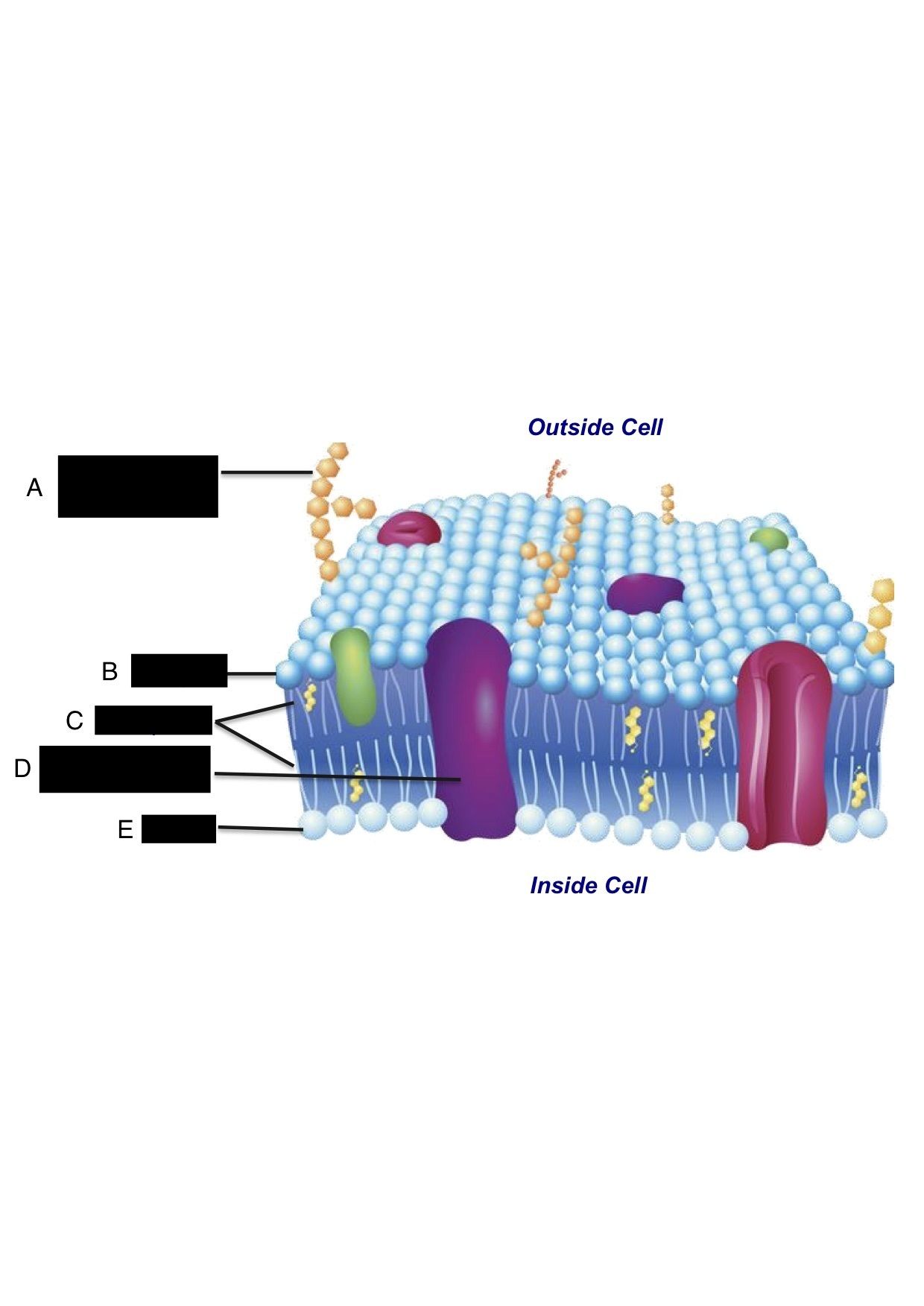
- ACarbohydrate molecules
- BLipid
- CPhosphate
- DProtein molecules
- ELipid
38[blank_start]SEMI-PERMEABLE[blank_end] means that it allows the entry of some particles, but not others. Substances are transferred across the membrane via several different processes:
- ASEMI-PERMEABLE
39[blank_start]Diffusion[blank_end] – process where dissolved substances cross the semipermeable membrane until [blank_start]equal concentration[blank_end] is achieved on both sides. Note that the particles of the dissolved substance are smaller than the pores of the membrane and that their movement is [blank_start]random[blank_end].
- ADiffusion
- Bequal concentration
- Crandom
40[blank_start]Osmosis[blank_end] – passage of [blank_start]water[blank_end] across the cell membrane from a [blank_start]weaker[blank_end] concentration to a [blank_start]higher[blank_end] concentration until equal concentrations are achieved on both sides. Note that it is water that moves here, as the particles of the substance are too big to go across the membrane.
- AOsmosis
- Bwater
- Cweaker
- Dhigher
41[blank_start]Dissolution[blank_end] – as [blank_start]fat[blank_end] molecules are too big to pass through the cell membrane pores, they transport into the cell by dissolving into [blank_start]fatty[blank_end] part of the cell membrane.
- ADissolution
- Bfat
- Cfatty
42[blank_start]Active Transport[blank_end] – transfer of large particles through the cell membrane using [blank_start]energy[blank_end] and a carrier [blank_start]protein[blank_end] in the cell membrane.
- AActive Transport
- Benergy
- Cprotein
43[blank_start]Filtration[blank_end] – passage of substances through cell membrane due to [blank_start]pressure[blank_end] differences on either side of the membrane
- AFiltration
- Bpressure
44[blank_start]Phagocytosis[blank_end] – process in which [blank_start]phagocytes[blank_end] (white blood cells) engulf and digest [blank_start]microorganisms[blank_end] and cellular debris thereby protecting the body against [blank_start]infection[blank_end].
- APhagocytosis
- Bphagocytes
- Cmicroorganisms
- Dinfection
45
This is the unique protein structure that is contained within the nucleus. It contains all the genetic information which is inherited from our parents.
[blank_start]CHROMOSOME[blank_end] - two strands of [blank_start]chromatids[blank_end] held together by a [blank_start]centromere[blank_end].
[blank_start]CENTROMERE[blank_end] - the point where two [blank_start]chromatids[blank_end] are held- ACHROMOSOME
- Bchromatids
- Ccentromere
- DCENTROMERE
- Echromatids
46There are 2 types of cell division,
1. [blank_start]Mitosis[blank_end] - this type of reproduction is for growth
2. [blank_start]Meiosis[blank_end] - this type of reproduction is for formation of sex cells ([blank_start]gametes[blank_end])- AMitosis
- BMeiosis
- Cgametes
47 All human cells have [blank_start]23[blank_end] PAIRED [blank_start]Chromosomes[blank_end] (except sex cells, i.e. sperm & egg).
- A23
- BChromosomes
48MITOSIS: This is a [blank_start]5[blank_end] stage process in which cellular replication occurs which maintains the [blank_start]23[blank_end] pairs of [blank_start]chromosomes[blank_end]. It takes about [blank_start]2 1⁄2[blank_end] hours.
- A23
- Bchromosomes
- C2 1⁄2
- D5
49mnemonics: 5 stage process for Mitosis [blank_start]I Pro MAT[blank_end]
- AI Pro MAT
50What are the 5 stages process of Mitosis?
1 [blank_start]Interphase[blank_end]
2 [blank_start]Prophase[blank_end]
3 [blank_start]Metaphase[blank_end]
4 [blank_start]Anaphase[blank_end]
5 [blank_start]Telophase[blank_end]- AInterphase
- BProphase
- CMetaphase
- DAnaphase
- ETelophase
51Interphase
[blank_start]DNA[blank_end] is reproduced
[blank_start]Nuclear protein[blank_end] is synthesised
[blank_start]Cell[blank_end] size increases- ADNA
- BNuclear protein
- CCell
52Prophase
[blank_start]Centrosome[blank_end] divides into 2 [blank_start]centrioles[blank_end]
[blank_start]Chromatin[blank_end] in nucleus becomes visible forming chromosomes
Chromosome consists of 2 [blank_start]chromatids[blank_end] joined by [blank_start]centromere[blank_end]
[blank_start]Nucleolus[blank_end] disappears- ACentrosome
- Bcentrioles
- CChromatin
- Dchromatids
- Ecentromere
- FNucleolus
53Metaphase
Nuclear membrane of [blank_start]nucleus[blank_end] disappears
[blank_start]Chromosomes[blank_end] arrange in centre of cell
A “[blank_start]spindle[blank_end] network” forms
End stage of Metaphase is when each chromatid begins to [blank_start]pull apart[blank_end]- Anucleus
- BChromosomes
- Cspindle
- Dpull apart
54Anaphase
Centromere stretches as [blank_start]centrioles[blank_end] are drawn apart.
Pairs of [blank_start]chromatids[blank_end] divide & identical halves move to opposite ends of the cell
Spindles and centrioles divide to form new [blank_start]centromere[blank_end]
Cell membrane [blank_start]constricts[blank_end] in centre- Acentrioles
- Bchromatids
- Ccentromere
- Dconstricts
55Telophase
A new [blank_start]nuclear[blank_end] membrane appears around each set of chromosome
Spindle fibre [blank_start]disintegrate[blank_end] and centrioles [blank_start]replicate[blank_end]
Cell membrane continues to [blank_start]constrict[blank_end] to form two identical cells.- Anuclear
- Bdisintegrate
- Creplicate
- Dconstrict
56What are 4 types of tissue in the body?
1 [blank_start]Epithelial[blank_end], 2 [blank_start]Connective[blank_end], 3 [blank_start]Muscular[blank_end], 4 [blank_start]Nervous[blank_end]- AEpithelial
- BConnective
- CMuscular
- DNervous
57Simple Epithelium - functions as a [blank_start]COVERING[blank_end] or [blank_start]LINING[blank_end] tissue. It has 1 layer of [blank_start]cells[blank_end] and a [blank_start]BASEMENT[blank_end] membrane.
- ACOVERING
- BLINING
- Ccells
- DBASEMENT
58There are 4 types of Simple Epithelium:
1 [blank_start]Squamous[blank_end], 2 [blank_start]Cuboidal[blank_end], 3 [blank_start]Columnar[blank_end], 4 [blank_start]Ciliated[blank_end]- ASquamous
- BCuboidal
- CColumnar
- DCiliated
59Name A and B in the diagram.
A [blank_start]Flattened Cells[blank_end]
B [blank_start]Basement Membrane[blank_end]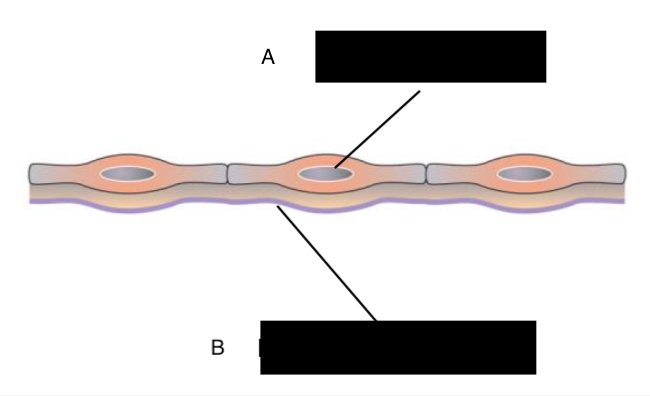
- AFlattened Cells
- BBasement Membrane
60Function of Squamous:
Forms a smooth lining – e.g. inside of blood vessels, heart, lungs, etc. to help reduce any [blank_start]friction[blank_end] and [blank_start]turbulence[blank_end] in flow of [blank_start]substances[blank_end].- Afriction
- Bturbulence
- Csubstances
61Name A and B in the diagram:
A [blank_start]Cuboidal Shape[blank_end]
B [blank_start]Basement Membrane[blank_end]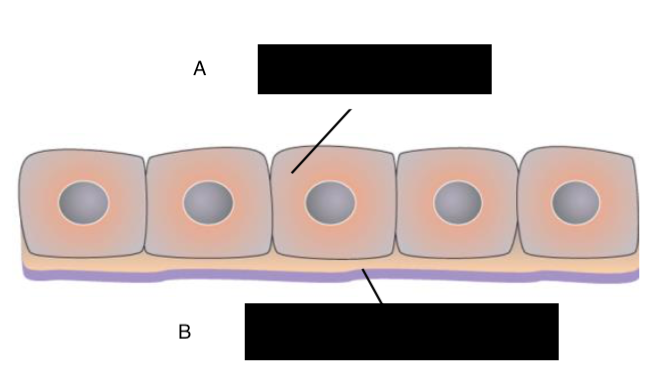
- ACuboidal Shape
- BBasement Membrane
62Function of Cuboidal:
Forms lining of [blank_start]kidney tubules[blank_end] as well as some [blank_start]glands[blank_end].
Can [blank_start]secrete[blank_end] substances and [blank_start]absorb[blank_end] them.- Akidney tubules
- Bglands
- Csecrete
- Dabsorb
63Name A and B in the diagram:
A [blank_start]Columnar Shape[blank_end]
B [blank_start]Basement Membrane[blank_end]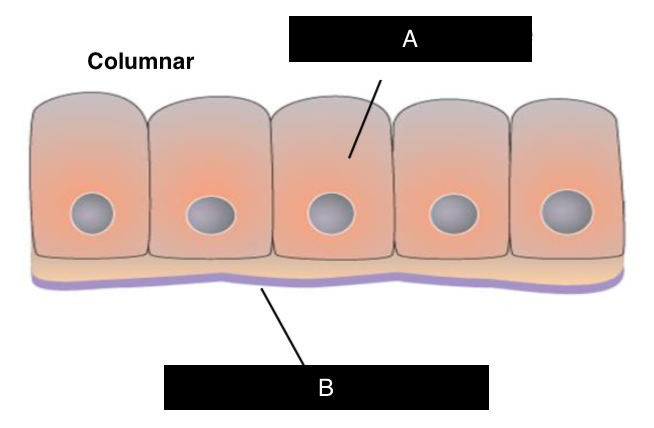
- AColumnar Shape
- BBasement Membrane
64Function of Columnar:
Forms [blank_start]lining[blank_end] in very [blank_start]active[blank_end] parts of the body e.g. stomach, intestine and urethra.
Some cells are specialised to secrete [blank_start]mucus[blank_end].- Amucus
- Blining
- Cactive
65Name of the tissue: [blank_start]Ciliated[blank_end]
Name A and B:
A [blank_start]Cilia[blank_end]
B [blank_start]Basement Membrane[blank_end]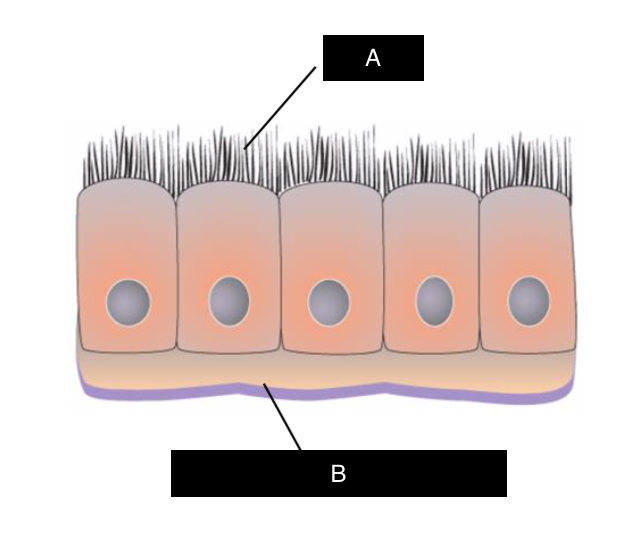
- ACiliated
- BCilia
- CBasement Membrane
66Function of Ciliated:
The cilia help to [blank_start]move[blank_end] mucus, foreign matter etc by [blank_start]WAVE[blank_end] like motion, helping keep the passageway clear.
Found in the [blank_start]trachea[blank_end] and [blank_start]fallopian[blank_end] tubes.- Amove
- BWAVE
- Ctrachea
- Dfallopian
67Compound Epithelium - functions to [blank_start]PROTECT[blank_end].
It is made up of many layers of [blank_start]columnar[blank_end] cells which are flattened cells towards the
[blank_start]surface[blank_end]. There is usually no [blank_start]basement[blank_end] membrane.- APROTECT
- Bcolumnar
- Csurface
- Dbasement
68What are 2 types of Compound Epithelium?
1 [blank_start]Stratified[blank_end]
2 [blank_start]Transitional[blank_end]- AStratified
- BTransitional
69Stratified has 2 types:
1. [blank_start]Keratinised[blank_end] (Dry) – eg
Hair, Skin, Nails.
2. [blank_start]Non Keratinised[blank_end] (Wet) – eg
Lining of the mouth, oesophagus, conjunctiva.- AKeratinised
- BNon Keratinised
70Keratin is a fibrous [blank_start]Protein[blank_end] which is [blank_start]waterproof[blank_end].
It acts as a [blank_start]protective[blank_end] layer and prevents deeper cells from [blank_start]drying out[blank_end].- AProtein
- Bwaterproof
- Cprotective
- Ddrying out
71What is this Compound Epithelium ?
[blank_start]Stratified[blank_end]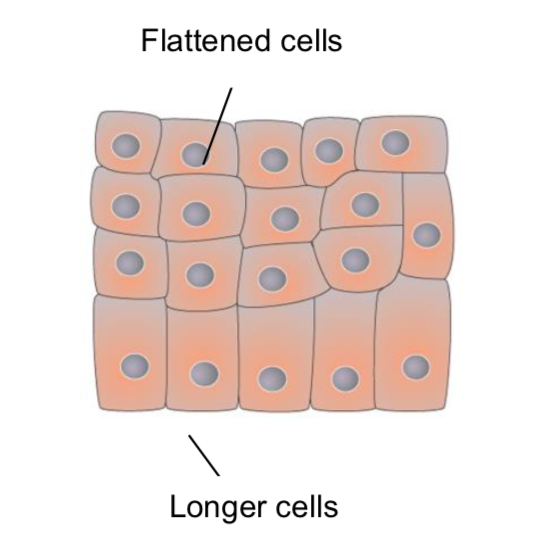
- AStratified
72What is this Compound Epithelium?
[blank_start]Transitional[blank_end]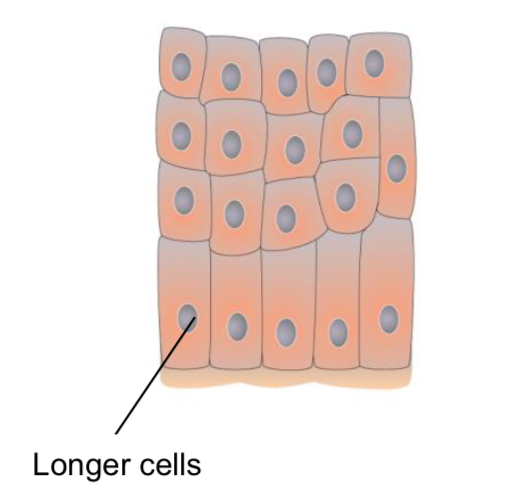
- ATransitional
73Transitional: Similar to Stratified Epithelium, but cells are not [blank_start]flattened[blank_end] and can thus change [blank_start]shape[blank_end].
Found in organs that need a [blank_start]waterproof[blank_end] and [blank_start]expandable[blank_end] lining e.g. Bladder- Aflattened
- Bshape
- Cwaterproof
- Dexpandable
74CONNECTIVE TISSUE
These are the [blank_start]supporting[blank_end] tissues of the body and mostly have a [blank_start]mechanical[blank_end] function. They can range from being [blank_start]LIQUID[blank_end], [blank_start]SEMI-SOLID[blank_end] to [blank_start]SOLID[blank_end]- Asupporting
- Bmechanical
- CLIQUID
- DSEMI-SOLID
- ESOLID
75[blank_start]Areolar[blank_end]: Loose connective tissue. Most general connective tissue found in body.
It is [blank_start]semi solid[blank_end] and [blank_start]permeable[blank_end] - allows fluid to pass through it.
Connects and [blank_start]supports[blank_end] other tissue.- AAreolar
- Bsemi solid
- Cpermeable
- Dsupports
76[blank_start]Adipose[blank_end]:
Structure:
Fatty tissue. Made up of Fat cells.
Found in-between [blank_start]muscle[blank_end] fibres and with [blank_start]areolar[blank_end] tissue under skin
Function:
Protective
[blank_start]Insulates[blank_end] – helps retain heat. Food [blank_start]reservoir[blank_end]- AAdipose
- Bmuscle
- Careolar
- DInsulates
- Ereservoir
77[blank_start]White Fibrous[blank_end]:
Structure:
Strong, but not elastic. Consists of [blank_start]Collagen[blank_end] (protein) fibres which run in the [blank_start]same[blank_end] direction.
Function:
[blank_start]Connection[blank_end] and [blank_start]protection[blank_end] of parts of body, e.g. ligaments, dura membranes (membranes surrounding brain), fascia of muscle.- AWhite Fibrous
- BCollagen
- Csame
- Dprotection
- EConnection
78[blank_start]Yellow Elastic[blank_end]
Structure:
Mainly composed of [blank_start]elastic[blank_end] fibres, giving the tissue the ability to stretch and recoil.
Function:
To enable stretch and recoil in a tissue e.g. [blank_start]lungs[blank_end], arteries, stomach etc.- AYellow Elastic
- Belastic
- Clungs
79Blood
Structure:
Fluid connective tissue
[blank_start]45[blank_end]% Cells
[blank_start]55[blank_end]% Plasma
Function:
Transport:
Increases [blank_start]circulation[blank_end] of nutrients to tissues like glucose & oxygen. Increases [blank_start]drainage[blank_end] of waste from tissues like lactic acid & urea- A45
- B55
- Ccirculation
- Ddrainage
80Bone
Structure:
Two types:
1. [blank_start]Compact[blank_end]
2. [blank_start]Cancellous[blank_end] Composition:
25% [blank_start]water[blank_end]
30% [blank_start]organic material[blank_end] 45% [blank_start]inorganic salts[blank_end]
Function:
1.Supports
2.Protects
3.Produces cells in [blank_start]bone marrow[blank_end] 4. Act as a [blank_start]reservoir[blank_end] of minerals 5. Help movement / locomotion- ACompact
- BCancellous
- Cwater
- Dorganic material
- Einorganic salts
- Fbone marrow
- Greservoir
81Cartilage
Firm tough Tissue 3 types:
[blank_start]Hyaline[blank_end] - found around joints
[blank_start]Yellow Elastic[blank_end] - found where flexibility is needed - ear
[blank_start]White Fibrocartilage[blank_end] - Found where shock absorption is
needed – in between vertebra- AHyaline
- BYellow Elastic
- CWhite Fibrocartilage
82Lymphoid
Structure:
Semi-solid tissue.
Majority of cells are [blank_start]LYMPHOCYTES[blank_end] which help kill [blank_start]BACTERIA[blank_end]
Function:
Forms lymphatic system cells and blood cells and thus protects against diseases. Found in:
1. [blank_start]LYMPH[blank_end] NODES
2. [blank_start]TONSILS[blank_end]
3. [blank_start]THYMUS[blank_end]
4. [blank_start]SPLEEN[blank_end]
5. [blank_start]APPENDIX[blank_end]
6. Glands of the [blank_start]SMALL INTESTINE[blank_end] 7. Wall of [blank_start]LARGE INTESTINE[blank_end]- ALYMPHOCYTES
- BBACTERIA
- CLYMPH
- DSPLEEN
- EAPPENDIX
- FTHYMUS
- GTONSILS
- HSMALL INTESTINE
- ILARGE INTESTINE
Information
- Description
- ACA Teaching Quiz on APP -1, created by F T on 13/03/2020.
- Author
- F T
- Language
- English
- Views
- 3
- Tags
- Rating
- No ratings yet Rate this quiz