
Quiz
Subset 1
Create a free account to finish this quiz
Save your progress and see your final score.
Already have an account? Sign in
Questions in this quiz (40)
1Which of the following teacher practices in a kindergarten class is likely to be most effective in reinforcing students' development of phonemic awareness?
- Aleading students in daily recitation of simple chants related to basic classroom procedures
- Bhaving students line up or join a group when they hear the teacher say the first sound in their name
- Clabeling key objects around the classroom with the first letter of the object's name
- Dreading aloud each day's schedule and asking students questions about the planned activities
2Which of the following methods would be most appropriate to use as part of an assessment of a kindergarten student's phonological awareness skills?
- Apronouncing a target phoneme and prompting the student to point to the printed letter most commonly associated with it
- Bhaving the student listen to a sentence presented orally and try to repeat the sentence exactly
- Csaying a familiar multisyllable word and asking the student to repeat the word while clapping for each syllable in the word
- Dasking the student to listen to a spoken word and identify the final letter in the word
3A kindergarten teacher routinely conducts read-alouds with students. During the reading, the teacher stops periodically to discuss the story events with the students. Which of the following literacy elements is the teacher most directly supporting with this approach?
- Aproviding the students with text details that they can use in their journal writing
- Bencouraging the students to become comfortable engaging in public speaking
- Cactivating the students' prior background knowledge and language experiences
- Dpromoting the students' listening comprehension skills and oral language development
4A kindergarten teacher plans instruction to develop students' phonological awareness at the word level. Which of the following directions would be most effective for the teacher to use to promote this skill?
- A"Tell me which word does not belong: man, can, fin, pan, van."
- B"Clap your hands for each part you hear in the word sister."
- C"Tap a finger for each word you hear in this sentence: I cannot run fast."
- D"Count and then say how many sounds you hear in this word: fizz."
5Prior to a class reading of a story, a second-grade teacher selects some action words from the text, writes the words on the board, and teaches them to the students. Next the teacher and students read the story together. The teacher directs the students to act out each word while repeating it aloud every time the words appear in the story. The teacher's actions primarily reflect the importance of:
- Aproviding an opportunity for students to do a kinesthetic learning activity.
- Breinforcing students' oral and phonics skills through an engaging activity.
- Cfostering students' phonemic awareness skills through an interactive approach.
- Dpromoting a friendly community in which students work together collaboratively.
6 A first grader makes the following types of spelling errors during independent writing.
Which of the following statements provides the most likely explanation for the student's errors?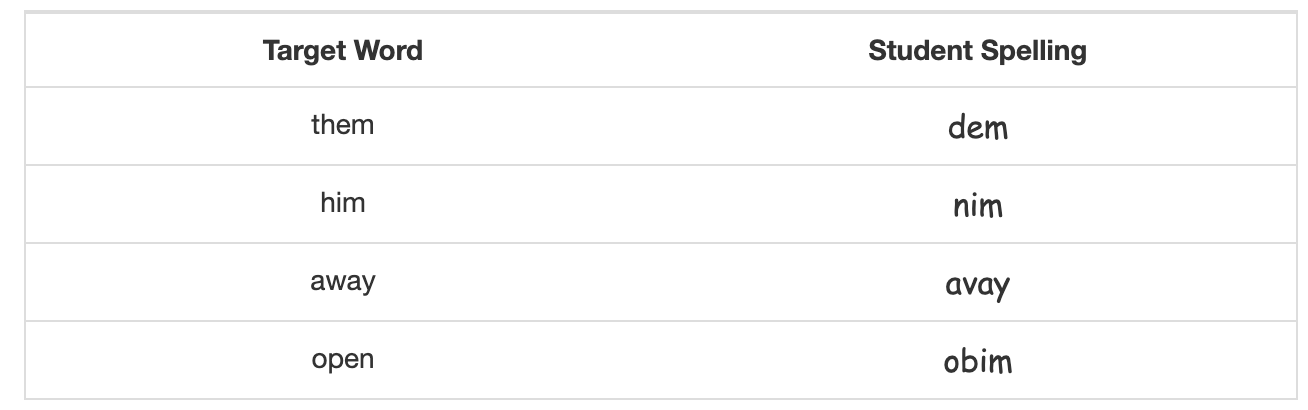
- AThe student mispronounces the vowel sounds of some words.
- BThe student has not yet fully grasped the alphabetic principle.
- CThe student has not yet developed phonemic-awareness skills.
- DThe student is confusing visually and auditorily similar letters.
7 A kindergarten teacher models the following procedure for a student who is experiencing difficulty with letter recognition. The teacher looks at the target letter p with the student, says the letter's name, and then traces the letter while verbalizing the strokes involved in its formation. Then the teacher provides the student with guided practice following the same procedure with other target letters (e.g., b, d, q). This multisensory activity would be most effective to use in an intervention designed to promote the student's ability to:
- Ause letter names as a strategy for developing phonetic spelling.
- Bmap speech to print in regular single-syllable words.
- Cform letters correctly as a result of hearing them pronounced orally.
- Ddistinguish between the features of visually similar letters.
8A teacher places printed labels on various objects in the classroom and frequently points to and refers to the objects by name in conversation with the students. Which of the following early literacy skills is the teacher most directly promoting?
- Aconcepts of print
- Bletter recognition
- Cletter-sound correspondence
- Dphonemic awareness
9Kindergarten students each have a notecard with their first name written on it. The teacher asks a series of questions, such as "Whose name has a t in it?" and "Who has a capital K at the beginning of their name?" The students respond affirmatively by giving a thumbs up. By engaging students in this activity, the teacher is providing practice in:
- Adecoding
- Bletter recognition
- Cletter formation
- Dsight-word recognition
10In a research-based, systematic program of phonics instruction, which of the following complex letter combinations should be taught last?
- Aee
- Bau
- Cea
- Doa
11A third-grade student can read grade-level literary texts at an appropriate rate with strong accuracy and good prosody. When reading grade-level, self-selected informational texts, however, the student reads in a slow, halting manner. Which of the following statements best explains the most likely reason for this discrepancy in the student's reading styles?
- AThe informational texts contain vocabulary and/or syntactic structures that are unfamiliar to the student.
- BThe student has limited decoding and word recognition skills, which hinders automaticity when reading the informational texts.
- CThe informational texts provide the student with fewer textual supports (e.g., diagrams, photographs) than do literary texts.
- DThe student is less interested in the subject matter of the informational texts than in the subject matter of literary texts.
12A first-grade student struggles to read and comprehend grade-level texts. The results of informal assessments indicate that the student can identify basic letter-sound correspondences and sight words and is able to read CVC words that have already been taught explicitly. However, the student has difficulty reading new CVC words and other single-syllable words presented in word lists and relies heavily on context clues as a decoding strategy when reading connected text. Which of the following instructional strategies would likely be most effective in addressing this student's reading needs and promoting reading development?
- Aexpanding the student's automatic reading of irregular words through the use of flashcards and explicit drill and practice exercises
- Bbuilding the student's oral vocabulary knowledge using read-alouds and discussions of high-quality literary and informational texts
- Cproviding the student with explicit instruction and guided practice in sounding out and blending the letters of simple regular words
- Dmodeling for the student how to use semantic and syntactic clues to determine the pronunciation and meaning of multi-meaning words in a text
13In order to accurately read and spell words such as sight, treat, and mock, students would benefit most from instruction focused on which of the following phonics principles?
- Asilent letters
- Bword families
- Clong vowel sounds
- Dletter-sound correspondences
14On an oral reading fluency (ORF) assessment administered in the winter, a third-grade student reads 62 words correct per minute (WCPM). This accuracy and rate place the student in the twenty-fifth percentile. Further diagnostic assessments reveal that the student's nonfluent reading stems mainly from a lack of word automaticity. Given these results, which of the following instructional practices would be most appropriate for the teacher to consider for the purpose of promoting automaticity?
- Aindependent silent reading
- Bphrase-cued reading
- Ctimed repeated oral reading
- Dreaders theatre
15A second-grade teacher is planning to read aloud a chapter book to students over the course of several days. Which of the following strategies is likely to be most effective in reinforcing and expanding students' understanding of vocabulary words found in each chapter?
- Awriting target words from each chapter and their meanings on the board before beginning the reading
- Bpausing periodically during each reading to elaborate on and question students about key words in the chapter
- Casking students to make note of unfamiliar words they hear and would like to discuss after each chapter is read
- Dhaving students answer oral and written questions about the meanings of key words from the chapter after each reading
16A third-grade teacher would like students to learn how to use classroom print reference materials such as age-appropriate dictionaries and thesauruses to support independent word learning. Which of the following skills would be most important for the teacher to introduce first?
- Ausing guide words
- Bordering words alphabetically
- Cselecting appropriate definitions
- Dinterpreting pronunciation keys
17 Fifth-grade students read the passage below from Anne of Green Gables, a novel by Lucy Maud Montgomery:
But Mrs. Spencer said distinctly that you wanted a girl about eleven years old. And the matron said she thought I would do. You don't know how delighted I was. I couldn't sleep all last night for joy. "Oh," she added reproachfully, turning to Matthew, "why didn't you tell me at the station that you didn't want me and leave me there? If I hadn't seen the White Way of Delight and the Lake of Shining Waters it wouldn't be so hard." . . .
But Anne could not eat. In vain she nibbled at the bread and butter and pecked at the crab-apple preserve out of the little scalloped glass dish by her plate. She did not really make any headway at all.
"You're not eating anything," said Marilla sharply, eying her as if it were a serious shortcoming. Anne sighed.
"I can't. I'm in the depths of despair. Can you eat when you are in the depths of despair?"
"I've never been in the depths of despair, so I can't say," responded Marilla.
"Weren't you? Well, did you ever try to imagine you were in the depths of despair?"
"No, I didn't."
"Then I don't think you can understand what it's like. It's a very uncomfortable feeling indeed. When you try to eat a lump comes right up in your throat and you can't swallow anything, not even if it was a chocolate caramel."
Which of the following methods would be most effective for the students to use to understand the meaning of the idiomatic phrase "the depths of despair" in the passage?- Aapplying morphologic analysis
- Bevaluating semantic clues
- Cusing a dictionary
- Dstudying context clues
18A teacher is helping a fourth-grade emerging-level English learner understand essential vocabulary in a reading selection from Charlotte's Web (e.g., pitcher, scratch). Which of the following strategies would likely be most effective for the teacher to use to help the student understand the meaning of such unfamiliar English words?
- Aproviding the student with the dictionary meaning of each targeted word and an example of its use
- Bdemonstrating the meaning of each targeted word by showing the student pictures or using gestures
- Chaving the student write down unknown targeted words and look up their meanings later
- Dguiding the student in using context clues to understand the meaning of targeted words
19Which of the following reading processes provides an example of inferential comprehension?
- Ausing background knowledge to recognize the implications of information presented in a text
- Bemploying a familiarity with textual features to help identify the steps in a writer's argument
- Cdrawing on knowledge of root words and affixes to deduce the general meaning of any unfamiliar words
- Dapplying an understanding of logical argument to evaluate the validity of a writer's conclusions
20During an assessment, a fourth-grade teacher observes that a student makes errors on four words when reading a 150-word text aloud. The teacher wants to confirm that this text is at the student's independent reading level. Which of the following strategies would best accomplish this goal?
- Ahaving the student read the text again and noting if the number of errors the student makes decreases during the second reading
- Bprompting the student to explain what metacognitive strategies he or she used to monitor understanding of the text
- Cgiving the student a similar text to read and comparing the number of errors the student makes on each text
- Dasking the student a series of questions about the text and determining how much of the text the student has comprehended
21 A new student in a fifth-grade class demonstrates strong oral language proficiency and participates successfully in class discussions in all subject areas but seems to have difficulty comprehending most literary and informational grade-level texts. Given this information, the teacher should most likely administer an assessment in which of the following areas of reading first to help determine the exact nature of the student's difficulty?
- Aoral reading fluency
- Bvocabulary knowledge
- Cacademic language
- Dbackground knowledge
22As part of a reading comprehension activity, a teacher asks third-grade students to orally retell a story they have just read to a partner. Which of the following strategies for scaffolding this assignment would be most appropriate for the teacher to use to support the needs of students who are struggling readers?
- Aproviding sentence starters and frames for the students to complete
- Bhaving the students listen while the teacher rereads the story
- Csummarizing the story and having the students repeat the words
- Dallowing the students to draw pictures that depict plot events
23A fourth-grade teacher gives frequent book talks and allows students class time for independent reading but notices that some students do not seem engaged in reading. Which of the following strategies would be most appropriate for the teacher to use to promote students' motivation to read independently?
- Aproviding the students with a variety of high-interest reading materials in the classroom library
- Bsending books home for the students to read and having parents/guardians help students complete reading logs
- Casking the students to provide short written summaries after reading a particularly exciting book
- Drewarding the students for the books they read with reading-related prizes such as books and bookmarks
24Which of the following sentences contains a metaphor?
- AThe river was a spill of silk cascading down the hillside.
- BA solitary crow called out go! go! from its lofty perch.
- CThe stars were like tiny sparks aglow in the darkness.
- DI think the mountain understands why I have come.
25A second-grade teacher regularly has students write and illustrate brief paragraphs about concepts they are learning in science and social studies. The teacher uses the following questions to help guide the students in developing their paragraphs.
- What idea are you trying to explain in your paragraph?
- What title can you give your paragraph to tell the reader what the paragraph is about?
- What kind of picture would show the reader something important that you describe in your paragraph?
- What labels will your picture need to help the reader understand it?
This writing activity is likely to promote students' understanding of informational texts primarily in which of the following ways?- Adeveloping their awareness of ways in which features of a text can help support comprehension
- Bimproving their ability to vary their reading strategies when reading texts for different purposes
- Chelping them learn to recognize text structures used to describe cause-and-effect relationships
- Dproviding them with models of strategies for monitoring their comprehension of a text
26Read the transcript below of a student-teacher conversation about an excerpt from the novel Sounder by William H. Armstrong; then answer the question that follows
Teacher: How do we know that the family is poor?
Student: They live in a drafty cabin with windows that rattle in the wind. And all they have to eat is corn mush.
Teacher: How does the father try to get food?
Student: He takes the dog Sounder out to hunt.
Teacher: Why doesn't the family eat what the father hunts?
Student: he hunting has been really bad.
Teacher: But one night the father leaves Sounder at home and goes hunting without him. Why do you think he does that?
Student: The book says Sounder's bark was loud. Maybe Sounder was scaring away the animals.
Teacher: Does the father bring back anything for the family to eat?
Student: I guess so. I mean, there were pork sausages and ham cooking on the stove the next morning, but we don't know where they came from.
Teacher: The family must be happy to have good food to eat.
Student: I thought they would be, but the mother is humming. The book says she only hums when she's worried. When she's happy, she sings.
Teacher: Why do you think she's worried?
Student: I don't know, but it might have something to do with the food on the stove.
During the conversation, the teacher's questions and comments are primarily intended to promote the student's ability to use critical thinking to:- Aparaphrase text.
- Bretell events in sequence.
- Cmake inferences.
- Didentify central themes.
27Read the excerpt below from a novel; then answer the question that follows.
Omakayas's family were Anishinabeg and this was their island. Her father, her Deydey, was in the fur trade business, which meant that he was often gone, paddling the great canoes for the fur company or sometimes trapping animals himself. Yellow Kettle, her mother, was quick-tempered but always laughing, and her eyes shrewdly took in the world. Yellow Kettle was a strong-looking woman, and beautiful. Her smile was generous, enigmatic, slightly crooked, and kind. She missed nothing when it came to her children—it was impossible to hide a half-done job, ridiculous even to think of sneaking away in the morning before gathering wood for the fire and water for her cooking pot. And if Mama didn't notice the younger children's whereabouts, Omakayas's older sister, Angeline, surely would.
In the excerpt, the author uses the description of Yellow Kettle to imply that Omakayas and her siblings:- Aaspire to be like their mother.
- Bdislike doing household chores.
- Cresent their father's absences.
- Dlive an idyllic life on the island.
28A fifth-grade class has just returned from a field trip to a local museum. The teacher can best help students become attentive to the differences between spoken and written English conventions through which of the following student activities related to their field trip?
- Ameeting with the teacher to brainstorm writing ideas for a story related to the trip, then reading aloud the finished story to the class
- Bselecting a topic of interest from the trip, then writing a research paper using observation notes and reference books to share with classmates
- Cdiscussing the trip as a whole class and writing down interesting thoughts and comments mentioned by other classmates
- Dworking in pairs to record and transcribe interviews with one another about the trip, then using the recordings to write short collaborative essays
29Following explicit instruction on the conjunctions that, because, although, when, and until, a fourth-grade teacher has small groups of students play a sentence-combining game. In the game, students randomly choose two teacher-selected simple sentences from texts and combine them into one meaningful sentence using a learned conjunction. This activity promotes students' reading development primarily by:
- Aincreasing their motivation to read a variety of texts that contain different sentence types.
- Bproviding them with practice constructing meaning from contextual clues.
- Cenhancing their ability to interpret complex sentences during independent reading.
- Dhelping them learn to vary their reading strategies when encountering unknown language structures.
30 In an introductory paragraph to a written research project, a sixth-grade student includes the following sentences.
Each of these famous Minnesotans made their own unique contribution to the history of Minnesota and the United States. However, only one of them had the distinct honor of having their portrait appear on a U.S. postage stamp.
The pattern of errors in this writing sample suggests the student would benefit most from explicit instruction focused on which of the following language structures or conventions used in standard written English?- Apunctuation usage
- Babbreviations and capitalization
- Cpronoun number agreement
- Ddependent and independent clauses
31A sixth-grade teacher notices that several students are having difficulty understanding the meaning and appropriate usage of general academic words that have been taught (e.g.,status, elaborate, strategic). The teacher can best help these students develop an understanding of such general academic words by:
- Ahaving students keep a vocabulary notebook in which they keep track of target words and definitions for reference.
- Brequiring students to use the target words in conversation on a daily basis throughout the school day.
- Cproviding students with repeated exposure to target words in various ways in written and oral classroom activities.
- Dgiving students differentiated word sort activities to perform using the target words.
32Which of the following forms of writing would most likely include the use of footnotes and a "works cited" section?
- Ajournal entry
- Bnewspaper article
- Cresearch paper
- Dbusiness letter
33Read the draft paragraph below from an informative essay; then answer the question that follows.
The Appalachian Trail is a 2,190-mile hiking trail in the eastern United States. Considered the longest hiking-only footpath in the world, the trail runs through fourteen states, from Springer Mountain, Georgia, to Katahdin, Maine. Over 3 million people visit the Appalachian Trail annually, but only about one percent of them attempt to cover the entire trail, a feat known as a "thru hike." Hikers must prepare in advance for a thru hike. ____________________________________________________________ blank Once they are out on the trail, hikers face many challenges and sometime experience serious setbacks. Only about twenty percent of those who attempt a thru hike manage to complete it.
Which of the following sentences, if inserted in the blank, would most effectively develop the topic with relevant facts?- AMost thru-hikers arrange to have food and supplies sent to mail drops along the way.
- BShelters are available for hikers, but reservations are necessary along the most popular portions of the trail.
- CCompleting the "thru hike" takes from five to seven months and costs about $3,000 3,000 dollars.
- DEvery four miles or so, the trail passes near a town where hikers may or may not be able to purchase supplies.
34Read the draft paragraph below; then answer the question that follows.
China has sought to try a novel concept for combatting its environmental pollution: constructing forest buildings and—more ambitious yet—forest cities. Forest buildings, distinct from traditional structures, feature living trees, groundcover plants, and shrubs affixed to their outer surfaces. ____________________________________________________________ blank City planners and officials are hoping that forest buildings will bring some noticeable benefits to their urban areas.
Which of the following sentences, if inserted in the blank, would most effectively develop the topic?- AVertical farming is another way to add greenery to city buildings.
- BCovering walls with living plants creates a unique visual aesthetic.
- CForest cities will look different in each region, depending on the climate.
- DPlants filter the air around them by absorbing carbon and releasing oxygen.
35A student is developing an explanatory essay about how professional collectors determine the monetary value of comic books. Which of the following strategies would best help the student develop a strong conclusion to the essay?
- Areviewing key points and pointing out how they may relate to readers' own experience
- Bciting references to motivate readers to investigate the topic more thoroughly
- Cdirecting readers to compare information in the essay to information found elsewhere
- Dintroducing a new example that illustrates a point made earlier in the essay
36 When evaluating a media message for bias, which of the following questions should a student ask first?
- AWhat other types of media are conveying the same message?
- BWhose interests are protected and promoted by the message?
- CHow does the message compare and contrast with my beliefs?
- DHow relevant to my own life is the information in the message?
37A fifth-grade teacher is planning a media literacy lesson in which students will analyze persuasive techniques used in magazine advertisements as compared to television commercials for the same products. Which of the following questions would be most important for the teacher to consider when determining how to address the needs of English learners in the class during the lesson?
- AAre students familiar with the language structures used in the advertisements and commercials?
- BWhat types of media are most common in the students' home cultures?
- CAre the students familiar with the products featured in the advertisements and commercials?
- DWhat cultural assumptions are made in the advertisements and commercials?
38A student wants to incorporate a brief excerpt from a reference book into a research report. To best comply with principles of fair use and attribution, the student should:
- Ause a different font to set off the excerpt in the report.
- Bembed a link to a digital edition of the book in the report.
- Crequest permission from the book's authors to include the excerpt in the report
- Denclose the excerpt in quotation marks and include a source citation in the report.
39 Which of the following actions by a middle school student exemplifies a safe practice in online communications?
- Asetting up a social media account under a pseudonym
- Busing an avatar as a personal identifier on gaming sites
- Cengaging in a live chat with other visitors to a Web site
- Dsharing personal contact information on a public forum
40A teacher notices that one member of a small group is not completing assigned tasks for a collaborative project. Which of the following approaches would be most effective for the teacher to take first to address the situation?
- Aposting a chart detailing group members' assigned tasks and corresponding due dates
- Basking another group member to help the student complete the assigned tasks
- Csuggesting that the student work on the project independently rather than collaboratively
- Dconvening the group and asking each member to describe their assigned tasks
Information
- Description
- Reading and Communication arts. Objectives 0001-0009.
- Author
- myah anderson
- Language
- English
- Views
- 9
- Tags
- Rating
- No ratings yet Rate this quiz