
Quiz
Untitled
Create a free account to finish this quiz
Save your progress and see your final score.
Already have an account? Sign in
Questions in this quiz (35)
1The visible spectrum of the Sun shows:
- Aa continuous bright spectrum, crossed by many dark absorption lines.
- Ba uniform continuous spectrum, with the same level of brightness at all wavelengths.
- Conly a few bright emission lines.
- Donly yellow light.
- Ea perfect blackbody spectrum.
2The temperature of the corona of the Sun is:
- Aabout 1,000,000K.
- Babout the same as the photosphere, 6000K.
- Cabout the same as the lower chromosphere, 4500K.
- Dabout the same as the atmosphere of the Earth, about 300K.
- E0K.
3What is the strongest piece of evidence that convection occurs in the Sun?
- Athe existence of absorption lines in the spectrum of the Sun.
- Bthe reddish color of the chromosphere of the Sun.
- Cthe existence of sunspots, where very strong convection is occuring.
- Dthe observation that the peak of the Sun's spectrum is in the visible range, not gamma rays.
- Ethe measurement of blueshifts and redshifts, respectively, in the bright and dark granules visible in the photosphere.
4Sunspots:
- Aare regions on the Sun with very intense magnetic fields.
- Bare regions on the Sun where convection is inhibited.
- Care generally found in pairs.
- Dare places where the magnetic field lines of the Sun break through the surface of the Sun.
- Eall of the above.
5Sunspots:
- Ahave weaker magnetic fields than the rest of the Sun.
- Bare hot spots in the Sun's photosphere.
- Care regions in the sun where convection is inhibited.
- Dare locations where nuclear fusion is occuring.
- Eare black since they are not producing any light at all.
6A H-alpha photon is produced:
- Aduring hydrogen fusion.
- Bwhen an electron escapes from a hydrogen atom.
- Cwhen an electron in a hydrogen atom drops from energy level 3 to energy level 2.
- Dwhen an electron in a hydrogen atom jumps up from energy level 1 to energy level 2.
- Ewhen an electron in a helium atom drops from energy level 3 to energy level 2.
7An annular eclipse is:
- AAn eclipse that occurs every year.
- BAn eclipse of the Sun during which the photosphere is not completely blocked by the Moon.
- CAn eclipse of the Sun during which only the corona is seen.
- DAn eclipse of the Sun during which only the chromosphere is seen.
- EAn artificial eclipse of the Sun, produced by a coronagraph.
8Star A has a magnitude of 6, Star B has a magnitude of 5. Therefore:
- AThe brightness of Star A is 10 times that of Star B.
- BThe brightness of Star B is 10 times that of Star A.
- CThe brightness of Star A is 2.5 times that of Star B.
- DThe brightness of Star B is 2.5 times that of Star A.
- EThe brightness of Star A is the same as that of Star B.
9Sunspots are caused by:
- AComets hitting the Sun, stirring up cooler material from under the surface.
- BStrong magnetic fields inhibiting convection.
- CThe shadow of planets in front of the Sun.
- DWeaker magnetic fields than the surrounding photosphere, causing cooler gas.
- EWhat causes sunspots is still unknown.
10A solar prominence is:
- Aa dark spot on the photosphere of the Sun, where cool gas is sinking.
- Ba large arch of gas extending above the surface of the Sun, where gas is suspended along magnetic field lines.
- Ca huge explosion on the Sun, that may be caused by magnetic field lines crossing.
- Da hole in the corona, where the solar wind may escape.
- Ea convective cell in the interior of the Sun.
11Which of the following is a consequence of the solar wind?
- Athe magnetic field of the Earth.
- Bthe Northern Lights.
- Cthe absorption lines in the spectrum of the Sun.
- DNeutrino oscillations.
- EThe Solar Neutrino Problem.
12The energy carried by a gamma ray photon produced in the core of the Sun reaches the Earth:
- AImmediately after the photon is produced.
- B8.3 minutes after the photon is produced.
- C2-3 days after the photon is produced.
- DA year after the photon is produced.
- EAbout million years after the photon is produced.
13What produces a spectrum with ONLY certain color (wavelength) bright lines?
- Aa low density gas.
- Ba high density gas.
- Ca low density gas in front of a hot dense gas.
- Da low density gas in front of a hot solid.
- Ea hot solid.
14The huge arcs of gas sometimes seen suspended for days above the Sun are:
- Asolar flares.
- Bmostly carbon and oxygen.
- Cloops in the magnetic field lines, typically connecting sunspots.
- Dgenerally more energetic than solar flares.
- Ecaused by neutrino bursts from the Sun.
15The vapor lamps shown in class produce light at only certain specific wavelengths. This light is produced by:
- Aelectrons in lower energy levels of atoms jumping to higher energy levels.
- Ba hot dense solid in the lamp.
- Ca low density gas in front of a hot dense solid.
- Delectrons in high energy levels of the atoms in the gas jumping to lower energy levels.
- Eelectrons escaping from atoms.
16Why does the chromosphere of the Sun appear red?
- AIt is hotter than the photosphere.
- BIt is redshifted relative to the rest of the Sun.
- CIt has strong H-alpha emission.
- DNuclear reactions are occurring in the chromosphere.
- EIt is mainly rusty iron.
17Alpha Centauri A, the brightest star in the Alpha Centauri triple, has a magnitude of 0. Barnard's Star, the next closest star to us after the Alpha Centauri triple, has a magnitude of 10. Therefore:
- AAlpha Centauri A is 10 times brighter than Barnard's Star.
- BAlpha Centauri A is 100 times brighter than Barnard's Star.
- CAlpha Centauri A is 100 X 100 = 10,000 times brighter than Barnard's star.
- DAlpha Centauri A and Barnard's Star have the same brightness.
- EBarnard's Star is 10 times brighter than Alpha Centauri A.
18An emission-line spectrum:
- Ais produced by a hot solid object.
- Bis sometimes called a dark line spectrum, since it looks like a continuous spectrum with dark lines across it.
- Cis produced by a low density gas in front of a source of continuous light.
- Dis a spectrum where light is seen at all wavelengths, except at certain specific wavelengths.
- Eis a spectrum in which light is only seen at certain specific wavelengths.
19Polaris (the North Star) is a 2nd magnitude star, while Capella (the brightest star in Auriga) has a magnitude of 0. Therefore:
- APolaris is twice as bright as Capella.
- BCapella is twice as bright as Polaris.
- CPolaris is 2.5 X 2.5 = 6.25 times brighter than Capella.
- DCapella is 2.5 X 2.5 = 6.25 times brighter than Polaris.
- ECapella is 10 X 10 = 100 times brighter than Polaris.
20The layer in the Sun which is the most convective is:
- AThe core.
- BThe layer just outside the core: between one quarter and one half of the radius.
- CThe thick layer just below the photosphere.
- DThe Radiative Zone.
- EThere is no convection going on in the Sun.
21From inside to out, what is the correct order of the following regions in the Sun?
- Acore, radiative zone, convective zone, photosphere, chromosphere, corona.
- Bcore, convective zone, radiative zone, photosphere, chromosphere, corona.
- Ccore, radiative zone, convective zone, chromosphere, photosphere, corona.
- Dcore, convective zone, radiative zone, chromosphere, photosphere, corona.
- Ecore, radiative zone, chromosphere, convective zone, photosphere, corona.
22How long does an individual sunspot last?
- A5 - 10 minutes.
- B1 - 100 days.
- C11 years.
- D22 years.
- Emore than four hundred years. We still see the same sunspots that Galileo saw.
23Proxima Cen, the closest star to us besides the Sun, has a magnitude of 15.5, while Lalande 21185, the 6th closest star to us, has a magnitude of 10.5. This means:
- AProxima Cen is 5 times brighter than Lalande 21185.
- BProxima Cen is 10 times brighter than Lalande 21185.
- CProxima Cen is 100 times brighter than Lalande 21185.
- DLalande 21185 is 5 times brighter than Proxima Cen.
- ELalande 21185 is 100 times brighter than Proxima Cen.
24An emission-line spectrum is produced by:
- Aa hot dense gas.
- Ba hot solid.
- Ca hot low density gas.
- Da hot low density gas in front of a hot dense gas.
- Ethe filament in a light bulb.
25Which of the following statements about the sunspot cycle is NOT true?
- AThe number of sunspots peaks approximately every 11 years.
- BThe number of neutrinos from the Sun varies with an 11-year period.
- CWith each successive sunspot cycle, the magnetic polarity of the Sun changes from that of the previous cycle.
- DThe sunspot cycle is a cycle of magnetic activity.
- EThe number of solar flares varies with a period of about 11 years.
26The solar wind is:
- Aultraviolet photons from the Sun.
- Bvisible photons from the Sun.
- Cgamma ray photons from the Sun.
- Dhigh speed charged particles streaming out from the Sun.
- Estreams of high speed charged particles circulating in the interior of the Sun.
27What is responsible for exciting molecules in our atmosphere, producing the Aurora Borealis?
- AUltraviolet light from the Sun.
- BVisible light from the Sun.
- CInfrared light from the Sun.
- DGamma rays from the Sun.
- EHigh speed charged particles from the Sun.
28The thickness of the corona of the Sun, compared to the radius of the Sun (as measured from the center to the photosphere), is:
- Aabout the same size.
- Babout as thick as a piece of wrapping paper, compared to the radius of a basketball.
- Cabout as thick as three pieces of wrapping paper, compared to the radius of a basketball.
- Dabout 15 times larger.
- Eabout a billion times larger.
29The magnitude scale used in astronomy was invented by:
- AGalileo, in approximately 1600 A.D.
- BAlbert Einstein.
- Cthe ancient Greek astronomer Hipparchus.
- Dthe scientists who built the Hubble Space Telescope.
- Ethe scientists who developed Charged Coupled Devices (CCDs), used to accurately measure the brightnesses of stars.
30Which of the following can NOT be deduced from the spectrum of a star?
- AThe star's radial velocity.
- BThe star's chemical composition.
- CThe amount of ionization of the atoms in its atmosphere.
- DThe relative amount of various isotopes in its atmosphere.
- EThe star's proper motion.
31The locations of Stars X, Y, and Z are marked on the H-R diagram to the right. What types of stars are they?
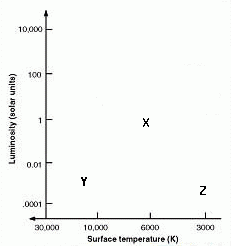
- AStar X: main sequence B star. Star Y: white dwarf star. Star Z: main sequence A star.
- BStar X: GV star. Star Y: main sequence A star. Star Z: supergiant M star.
- CStar X: giant G star. Star Y: AV star. Star Z: MV star.
- DStar X: GIII star. Star Y: white dwarf star. Star Z: main sequence M star.
- EStar X: G star with hydrogen fusion in core. Star Y: white dwarf star. Star Z: main sequence M star.
32MV stars are:
- Athe hottest known stars.
- Bwhite dwarfs.
- Csupergiant stars.
- Dsimilar in temperature, luminosity, and size to our Sun.
- Efusing hydrogen to helium in their cores.
33Stars in the lower left corner of the H-R diagram (with high temperatures and low luminosities) are called:
- Asupergiant stars.
- Bgiant stars.
- Cmain sequence stars.
- Dwhite dwarfs.
- Ebright giants.
34During a 6 month period, the apparent position of Star A changes on the sky by 0.4 arcseconds, and then shifts back again to the same location 6 months later. This means:
- AStar A has a proper motion of 0.8 arcseconds per year.
- BStar A is 1/0.4 = 2.5 parsecs away from us.
- CStar A is 1/0.8 = 1.25 parsecs away from us.
- DStar A is 1/0.2 = 5 parsecs away from us.
- EStar A is moving away from us at a rate of 8 light years per year.
35During a 6 month period, the apparent position of Star A moved East by 0.5 arcseconds. Six months later, the apparent position had moved another 0.5 arcseconds East. Therefore:
- AStar A has a proper motion of 1 arcsecond per year.
- BStar A is 1/1 = 1 parcsec away from us.
- CStar A is 1/2 = 0.5 parsecs away from us.
- DStar A is 1/0.5 = 2 parsecs away from us.
- EStar A has a Doppler Shift of 1 arcsecond per year.
Information
- Description
- Quiz on Untitled, created by Taylor Campbell on 03/05/2015.
- Author
- Taylor Campbell
- Language
- English
- Views
- 0
- Rating
- No ratings yet Rate this quiz