
Quiz
PHYS 105 - Test 3
Create a free account to finish this quiz
Save your progress and see your final score.
Already have an account? Sign in
Questions in this quiz (43)
1What type of object could be associated with both a nova and a supernova?
- Aprotostar
- Bwhite dwarf
- Cpulsar
- Dneutron star
- Eblack hole
2Which of the following is NOT relevant to the process of a supernova?
- Aelectron degeneracy pressure suddenly stiffness the collapsing core
- Bneutrons form from protons and electrons releasing neutrinos
- Cheat and radiation breaks up the iron core
- Dthe stellar envelope is hit by the bouncing core
- Enone of the above
3Ultimately, a white dwarf star is a -
- Aremnant carbon/oxygen core of a low-mass star
- Bstage before the asymptotic giant branch
- Ccore helium burning star
- Dresult of a type I supernova
- Eresult of a type II supernova
4What is the basic condition for the supernova distance measure?
- Aa white dwarf exceeds the Chandrasekhar limit
- Ba high-mass star explodes
- Ca black hole and neutron star collide
- Da neutron star collapses
- Ea black hole stops spinning
5Supernova saints measures are most valuable because -
- Athey occur so often
- Bthey are so reliable
- Care detectable at vast distances
- Dthey occur for the lowest mass stars
- Enone of the above
6What happens to the rotation rate (speed) of a molecular cloud as it collapses to form a star?
- Athe rotation rate slows, so the star will rotate very slowly
- Bthe rotation rate remains the same at all times
- Cthe rotation rate increases and the gas flattens into a disk around a protostar
7Elements beyond iron which exist in nature were probably created through the process of -
- Aneutrino emission
- Bpair annihilation
- Cnuclear fission
- Dnucleosynthesis
- Enone of the above
8You discover a binary star system in which one member is a 15Msun main-sequence star and the other star is a 10Msun giant. Why should you be surprised, at least at first?
- AThe two stars in a binary system should both be at the same point in stellar evolution; that is, they should either be main-sequence stars or both be giants.
- BIt doesn't make sense to find a giant in a binary star system
- CThe offs of ever finding two such massive stars in the same binary system are so small as to make it inconceivable that such a system could be discovered.
- DThe two stars should be the same age, so the more massive one should have become a giant first
- EA star with a mass of 15Msun is too big to be a main-sequence star.
9The heaviest chemical elements are produced in -
- Ablack holes
- Bnovae
- Cstellar fusion
- Dplanetary nebula mass loss
- Esupernovae
10When a star is at the Horizontal branch, what element is being fused in the core?
- Ahydrogen
- Bhelium
- Ccarbon
- Doxygen
- Eiron
11By mass, the interstellar medium in our region of the Milky Way consists of
- A70% Hydrogen, 30% Helium
- B50% Hydrogen, 50% Helium
- C50% Hydrogen, 30% Helium, 20% heavier elements
- D70% Hydrogen, 20% Helium, 10% heavier elements
- E70% Hydrogen, 28%helium, 2% heavier elements
12Which of the following statements about degeneracy pressure is NOT true?
- ADegeneracy pressure varies with the temperature of the star
- BDegeneracy pressure can halt gravitational contraction of a star even when no fusion is occurring in the core
- CDegeneracy pressure arises out of the ideas of quantum mechanics
- DDegeneracy pressure supports white dwarfs against gravity
- EDegeneracy pressure keeps any protostar less than 0.08 solar mass from becoming a true, hydrogen-fusing star.
13Which is the correct sequence for the following end points of stellar evolution, in order of increasing mass (smallest to largest)?
- AWhite dwarf, black hole, neutron star
- BWhite dwarf, neutron star, black hole
- CNeutron star, black hole, white dwarf
- DBlack hole, neutron star, white dwarf
14Every stage of a star's evolution is ultimately a reaction to -
- Aelectric forces
- Bfusion
- Crotation
- Dgravity
- Ebad sushi
15A star undergoing a nova has to be -
- Anear the center of a galaxy
- Bin a binary orbit
- Cin a supernova remnant
- Dmore than 8 solar masses
- Enone of the above
16The boundary inside of which light does not escape from a black hole is called the -
- Asingularity
- Bdark zone
- Cturn-off point
- Dnucleus
- Eevent horizon
17Which of the main sub-types of supernova remnants has the most distinctive origin (which one is fundamentally different from the others)?
- A1a
- B1b
- C1c
- DII
- EIII
18When does a protostar become a true star?
- Awhen the star is 1 million years old
- Bwhen the stellar winds and jets blow away the surrounding material
- Cwhen the central temperature reaches 1 million Kelvin
- Dwhen the thermal energy becomes trapped in the center
- Ewhen nuclear fusion begins in the core
19The upper limit to the mass of a neutron star is called the -
- ASchwarzchild limit
- BChandrasekhar limit
- CKerr limit
- DOppenheimer-Volkoff limit
- ESmirnov limit
20What is photodisentigration?
- AThe heating and ejection of mass from the surface of a normal star
- BThe destruction of a star by the pressure of the radiation inside it
- CThe splitting apart of atomic nuclei by gamma rays
- DThe ejection of a neutron or proton from an atomic nucleus
21How do we categorize various supernova types?
- Amass of the original star
- Bmembership in a binary
- Cby spectral lines
- Dage of the original star
- Espatial location of the supernova
22The pulses seen from a radio pulsar are caused by
- Athe star's radius expanding and contracting as it burns iron in its core
- Bthe star's rapid rotation sweeping beams of radiation across the viewer's line of sight
- Cglobs of hot gas from an accretion disk falling rhythmically onto the star's surface
- Da dark companion periodically eclipsing the bright "pulsar" itself
- Estarquakes
23No stars have been found with masses greater than 300 times our Sun because
- Amolecular clouds do not have enough material to form such massive stars
- Bthey would generate so much power that they would blow themselves apart
- Cthey shine exclusively at X-ray wavelengths and become difficult to detect
- DThey would fragment into binary stars because of their rapid rotation
- Ethey are not bright enough to be seen nearby
24What do astronomers mean when they say that we are all "star stuff"?
- Athat life would be impossible without energy from the sun
- Bthat the Sun formed from the interstellar medium: the "stuff" between the stars
- Cthat the Universe contains billions of stars
- Dthat Earth formed at the same time as the Sun
- Ethat the carbon, oxygen, and many elements essential to life were created by nucleosynthesis in stellar cores
25The supernova explosion of high-mass star appears to leave behind
- Aa rapidly rotating shell of gas, dust, and radiation, but no central object
- Ba rapidly expanding shell of gas and a compact white dwarf at its center
- Cnothing; the explosion changes all the matter completely into energy, which then radiates into space at the speed of light
- Da rapidly expanding shell of gas and a central neutron star
26When a star is on the asymptotic giant branch of the HR diagram it is
- Acontracting, cooling, and hence becoming less luminous
- Bexpanding, heating up, and becoming more luminous
- Ccontracting, becoming hotter, and becoming much less luminous
- Dexpanding, cooling, and becoming more luminous
27As the mass of a white dwarf increases the radius ______, and as the mass of a black hole increases the Schwarzschild radius ______.
- Aincreases, increases
- Bincreases, decreases
- Cdecreases, decreases
- Ddecreases, increases
- Eboth stay the same
28Which of the following stars will become hot enough to fuse elements heavier than oxygen?
- AA star that is half the mass of the Sun
- BA star having the same mass as the Sun
- CA star that is twice as massive as our Sun
- DA star that is nine times more massive than our Sun
29Why aren't all neutron stars seen as pulsars?
- Ait takes a long time for a neutron star to turn into a pulsar
- Btheir beam of radiation is not along our line of sight
- Cmost neutron stars are hidden by dense nebulae
- Dthey are
30Compared to low mass stars, high mass stars -
- Ahave longer lifetimes
- Bhave final states with less mass
- Cfuse more elements in the core
- Dare not as likely to undergo a supernova
- Eall of the above
31In astronomical terms, planetary nebulae are
- Avery long-lived objects, having been in existence since just after the Big Bang
- Brelatively short-lived, existing around a white dwarf star for millions of years
- Crelatively long-lived since they form when the original stars form
- Dvery short-lived with lifetimes of about 50,000 years due to the cooled gases
32All the distance-measuring methods we have discussed so far have relied on the distance-modulus method except
- Astellar parallax
- Bspectroscopic parallax
- Cvariable stars
- Dtype 1a supernova
- Eall have utilized this method
33Which of the following will a high-mass star (say, 20 times the mass of the Sun) NOT do at or near the end of its life?
- AEject its outer layers and become a neutron star
- BConvert silicon into iron in its core
- CEmit copious amounts of neutrinos
- DEject its outer layers and become a white dwarf
34What is the Crab Nebula?
- Aa star that is right now undergoing a supernova explosion
- Ba classic example of a planetary nebula
- Ca star forming cloud that will eventually give birth to hundreds of stars
- Dan expanding clouds of remains from a star that died in a supernova
35The light from an object close to, but outside, a black hole event horizon is (will) -
- Ablueshifted
- Bredshifted
- Cunaffected
- Dhave zero speed
36The particle who's properties are responsible for the stability of a white dwarf is a(n) -
- Aproton
- Bneutron
- Canti-electron
- Dneutrino
- Eelectron
37The thermal pressure of gas depends on
- ATemperature only
- BComposition
- CDensity and temperature
- DDensity only
- EGravity
38What is the minimum mass, in solar masses, for a main sequence star to end up as a black hole?
- A0.08
- B1
- C8
- D25
- E100
39As a star makes its way up the Asymptotic Giant Branch, the energy source is -
- AH core only
- BH shell only
- CHe core and H shell
- DHe shell and H shell
- Enone of the above
40The image shows the evolutionary path of a star after leaving the main sequence, which is the straight line from upper left to lower right. Which of the following could be a likely mass of the star in question, in until of solar masses?
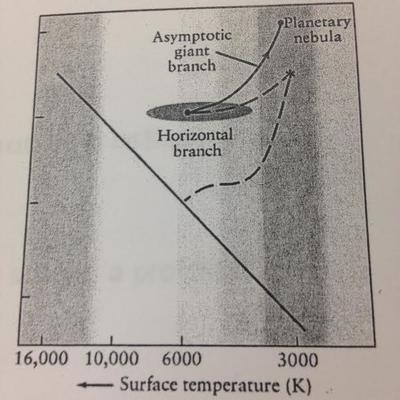
- A1
- B10
- C25
- D50
- E100
41The star tracked in the image will probably end up as a -
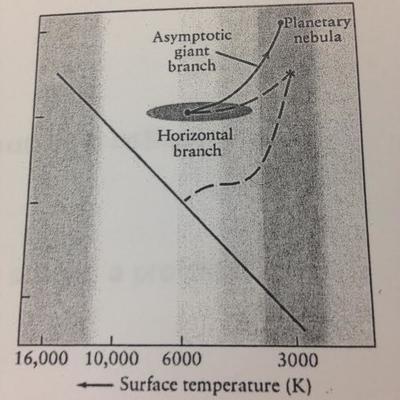
- Aprotostar
- Bneutron star
- Cblack hole
- Dred dwarf
- Ewhite dwarf
42The particle who's properties are responsible for the stability of a neutron star is a(n) -
- Aproton
- Bneutron
- Canti-electron
- Dneutrino
- Eelectron
43Which element has the lowest mass per nuclear particle and therefore cannot release energy by either fusion or fission?
- AOxygen
- BUranium
- CIron
- DSilicon
- EFlubber
Information
- Description
- Quiz on PHYS 105 - Test 3, created by Amelia Newton on 04/05/2015.
- Author
- Amelia Newton
- Language
- English
- Views
- 0
- Rating
- No ratings yet Rate this quiz