
Quiz
Untitled
Create a free account to finish this quiz
Save your progress and see your final score.
Already have an account? Sign in
Questions in this quiz (44)
1With regard to the NIST 800-131/2010 document, which are the recommended minimal levels of security for
ES?- AUntil 2010 – DSA : L=1024 bits; N=160 bits; RSA: K=1024 bits; ECDSA: f=160
- BUntil 2030 – DSA : L=4096 bits; N=256 bits; RSA: K=4096 bits; ECDSA: f=256
- CUntil 2010 – DSA : L=2048 bits; N=196 bits; RSA: K=2048 bits; ECDSA: f=196
- DUntil 2030 – DSA : L=2048 bits; N=224 bits; RSA: K=2048 bits; ECDSA: f=224
2About public key Cryptographic Systems, we can say that they
- AAre symmetric
- BUse different keys, that are math linked, for encrypting and decrypting
- CUse different keys, randomly chosen, for encrypting and decrypting
- DAre based on trap-door, one-way function
3The RSA system uses:
- AOperations with large integer number
- BOne key, publicly available
- COne public key, one private key
- D. Operation on elliptic curves
4The revocation of certificate is done :
- AWhen the public key inside the certificate is compromised
- BWhen the validity of the certificate has expire
- CBy publishing the certificate according to the OCSP protocol
- DWhen the private key is compromised
5Which is the role of HSM (Hardware Security Mode)?
- AKeeps the used cryptographic algorithm secret
- BAssures the protection of the cryptographic keys
- CAccelerate the cryptographic operations
- DAssures the protection of the computer which the CA software is installed
6The certificate Policy –CP
- ADescribes the security which governs a CA
- BDescribes in detail the mechanism and procedures of the CA
- CDescribes the registration process of the users
- DRepresents an operational manual for the CA
7The law regarding the ES adopted by Parliament of Romania, in July 2001, establish
- AThe fees for providing CA
- BThe legislative environment to electronic documents
- CThe conditions for providing electronic signatures certificate services
- DThe conditions for the ES of documents, in electronic communication
8The extended electronic signature represents an electronic signature which complies with the following
conditions:- AIt is uniquely linked to the signer, assuring his identification
- BIs created using specific hardware devices (smart cards or tokens)
- CIt is linked to the electronic document being signed
- DIt is created with means owned exclusively by signer (discutabil)
9RSA is a cryptographic algorithm based on
- ADifficulty of computing discrete logarithms in finite field
- BFermat’s theorem
- CDifficulty of computing exponents in finite field
- DDifficulty of large integer numbers factorization
10About time-stamping, we can say that::
- Athe RFC 3161 – Internet X.509 PKI Time Stamp Protocol (TSP), represents its standard environment
- Bis accomplished by a certificate service provider
- Cit's generated by the application and counter-signed by a time-stamping service provider
- Dthe law on time-stamping, adopted in Romania, in 2004, represents its legislative environment
11Electronic document is equivalent, in condition of effect, with written documents if:
- AIt has an extended ES associated
- BThe signature is based on a qualified article
- CThe signature is created using a secure mechanism for creating digest signature
- DThe certificate service provider is accredited
12The effort for breaking a symmetric system with a 128 bits key, with a specialized system, using brute force
attack, is around:- A10 **18 years
- B3.6 hours
- C18 **18 years
- D7000 years
13DSA is a standard which:
- Awas created by Rivest-Shamir and
Adleman - Bis used for encrypting data
- Ccan be implemented on elliptic curves
- Dis used only for digital signature
- Awas created by Rivest-Shamir and
14Diffie-Hellman key distribution scheme , with 3 users. The common values are the base, a=2
and the modulus , p=7. User A has PubKXA = 3 and computes with Priv KYA . User B has
PubKXb =4 and computes with Priv KYb . User C has PubKXc =5 and computes with Priv KYc .
The 3 users exchange their Public keys. Compute the secret keys used to encrypt the traffic
between users- AKAB=1 , KAC=4 , KBC=1
- BKAB=4 , KAC=1 , KBC=1
- CKAB=4 , KAC=1 , KBC=4
- DKAB=1 , KAC=1 , KBC=4
15Which solution(s) was/were proposed for satisfying the WYSIWYG request?
- A. the signing of a graphic representation of the document
- Bthe use of a secure display program, for viewing the documents
- Cthe use of logos for certifying the authenticity of the document
- Dthe use of a document format, which has an unique graphic representation
16If, at the moment of validating a signature, the signing certificate is revoked, the signature may be declared
valid only if:- Athe signed document was time-stamped after being stamped and before the
revocation of the certificate - Bthe signed document was time-stamped before being signed
- Cthe signature will be declared invalid anyway, because the certificate is revoked when the
validations is done - Dthe certificate of the signer hasn't expired at the moment of validation
- Athe signed document was time-stamped after being stamped and before the
17The secured mechanism for creating electronic signatures must satisfy the following conditions:
- Athe signature creation data must be protected effectively by the signer against their use by unauthorized persons
- Bit must not modify the electronic document which will be signed and not prevent its view by the signer, before finishing the signing process
- Cthe signature creation data must appear only once and its confidentiality must be assured
- Dthe signature creation data must not be deduced and the signature must be protected against forgery
18Which of the following devices are specific for Secure Signature Creation Devices
- ASmart cards
- BUSB tokens
- CPCMCIA
- DBiometric readers
19The electronic signature assures:
- Athe authentication of the data link between sender and receiver
- Bthe authentication of the signed message (its integrity verification)
- Cthe authentication of the sender of the signed message
- Dthe authentication of the receiver of the signed message
20The OCSP server, in order to obtain revocation information, may:
- Aprocess CRLs, issued by the Certification Authority
- Bcall the services of another OCSP server, authoritative for the PKI domain in which the certificate was issued
- Cuse SSL protocol
- Duse LDAP v2 protocol
21The law no. 589/2004, regarding the legislative environment for the electronic notary activity states that:
- A. the electronic notary closure contains as signatures: the extended electronic signature of the parties, the
extended electronic signature of the public notary, the extended electronic signature of the notary bureau - Bthe electronic notary closure contains as signatures: the extended electronic signature of the parties, the
extended electronic signature of the notary bureau - Cthe public notary is obliged to keep the electronic archive of electronic notary documents for 20 years
- Dthe requests for an electronic notary document shall be handed to the public notary in electronic form, signed
with the extended electronic signature of the requester
- A. the electronic notary closure contains as signatures: the extended electronic signature of the parties, the
22Let there be a RSA protocol for transporting the key, with 2 users. User A publishes his public key [eA =3,
nA =55] and computes his private key [dA =27, nA =55]. Let us suppose that user B wants to issue an
encrypted message towards user A. User B envelopes the session key (KAB=7), using the public key of user
A: K’ = (KAB )eA mod nA = 73 mod 55 = 13. Please show the way in which user A determines the session key
(KAB =7), using his private key and the received enveloped key (K’=13).- AKAB = (K’ )dA mod nA = (13)^27 mod 55
- BKAB = (K’ )nA mod eA = (13^)55 mod 3
- CKAB = (K’ )eA mod nA = (13)^3 mod 55
- DKAB = (K’ )nA mod dA = (13)^55 mod 27
23The Windows operating system, in order to build the certificate chain, it automatically discovers the
necessary certificates in the following certificate stores:- A„Personal”
- B„Intermediate Certification Authorities“
- C„Enterprise Trust”
- D“Trusted Root Certification Authorities”
24According to the time stamping law, the time stamp information contains, among other data:
- Athe extended electronic signature of the author of the electronic data
- Bthe electronic data or a has function of it
- Cthe extended electronic signature of the time stamping issuing authority
- Ddate and time
25See the picture
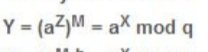
- A1
- B2

- C3

- D4

- A1
26In Chaum blind signature scheme, for (blinding) A computers: m*=mk
^e mod n.indicate the signing and
un-blinding mechanism:- A1

- B2

- C3

- D4

- A1
27See picture
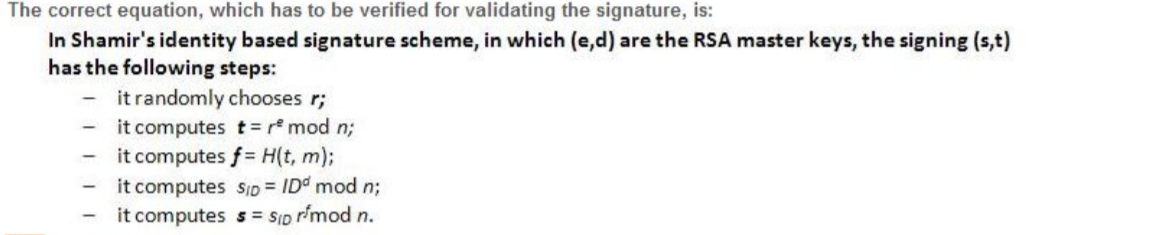
- A1

- B2

- C3

- D4

- A1
28About blind signatures we can say
- Athey were theoretically developed by Chaum
- Bthey were theoretically developed by Chaum-van-Antwerpen
- Cthey were initially designed as a protocol for securing Web applications
- Dthey are used in the field of electronic cash
29MQV (Menezes -Qu-Vanstone) is
- Aan authenticated protocol for establishing a key, based on Diffie-Hellman
- Ban authentication protocol based on Diffie-Hellman
- Cbased on a pair of keys: a static one and a ephemeral one
- Da distribution key protocol, based on Diffie-Hellman
30DSA is a crytographic algorithm based on:
- Athe difficulty of multiplying large prime numbers
- Bthe difficulty of computing exponents in a finite field
- Cthe difficulty of large integer numbers factorization
- Dthe difficulty of computing discrete logarithms in finite field
31Electronic signatures are based on:
- Ascanned handwritten signatures
- Bcryptographic systems with public keys and hash functions
- Cbiometric data (finger prints, iris, etc.)
- Dcryptographic systems with secret keys and hash function
32Signing a document is done using:
- Athe private key of the private message sender
- Bthe private key of the message recipient
- Cthe sender's public key message
- D.the public key of the recipient
33Signature Verification of n document is done using:
- A. the private key of message sender
- Bthe private key of the message recipient
- Cthe public key of the sender
- Dthe public key of the recipient
34For electronic signature can be used the next cryptographic algorithms:
- ARSA, DSA, DSA over elliptic curves
- BSHA-1
- CAES over elliptic curve
- DDES
35XML signatures are:
- Adata structures containing the signature value and signature algorithms used
- Bdata structures containing the signature value and the necessary data for the
verification process - Cat the envaloped XML signatures, the signed object encapsulates signature
- Dat the enveloped XML signatures, the signed object encapsulates signature (asta e corecta, e de doua ori...)
36Time stamping
- Ait is realized by the the application and countersigned by a time stamping service provider
- Bit is legal regulated by time stamping law enacted in Romania in 2004
- Cit is legal regulated by RFC-3161 Internet X.509 PKI Time Stamp Protocol (TSP);
- Dis performed by a certification service provider
37RFC 2587 (Internet X.509 PKI Operational Protocols - LDAPv2):
- Adefines the access method to the certificates repository
- Bis a PKCS standard developed by RSA Data Security for access to storage
repository - Cdefines the attributes and object classes supported by the LDAP server
- Ddefines the method of online checking certificates
38For an RSA cryptographic system with public key (e = 5, n = 21), the pair private key (d, n) of
this key is:- AR: d=___5__ , n=___21__
- Bblank
39Among static biometric methods are:
- Afingerprint
- BHand geometry
- Cidentification of the retina
- DVoice recognition
40Main current issues concerning the use of biometric signature methods are:
- Athe reliability of biometric identification methods
- Black of appropriate standard
- Clack of smartcards with biometric sensors
- Dthe impossibility of memorizing biometric characteristics due to lack of space on card
41The electronic signatures Directive issued by the Commission of the European Communities the
subject of debate and adoption in the Parliament and the Europe Council in 1999 refers to:- Athe definition of terminology used in electronic signature
- Bthe legal effects of electronic signatures
- Cinternational aspects of using electronic signatures
- Dthe requirements for certification service providers and how their certification and
authorization
42A secure mechanism to create electronic signature must meet the following conditions:
- Anot to change the content of the document that must be electronically signed and shall not prevent it to be
presented to signer prior to the completion of signature - Bsignature creation dates can not be deducted and the signature to be protected against
forgery - Csignature creation dates can not occur only once and their confidentiality to be assured
- Dsignature creation dates to be effectively protected by the signatory against
their use by unauthorized persons
- Anot to change the content of the document that must be electronically signed and shall not prevent it to be
43Accreditation of certification service providers:
- Ais mandatory
- Bis done by the Regulatory Authority and Supervision
- Cis voluntary
- Dregularly made by surveillance procedure
44DSA is a cryptographic algorithm based on:
- Athe difficulty of computing discrete logarithms in finite fields
- Bthe difficulty of large integer numbers factorization
- Cthe difficulty of computing exponents in finite field
- Dthe difficulty of multiplying large prime numbers
Information
- Description
- Quiz on Untitled, created by Andrew Hoover on 26/01/2021.
- Author
- Andrew Hoover
- Language
- English
- Views
- 75
- Rating
- No ratings yet Rate this quiz