
Quiz
Lesson 10
Create a free account to finish this quiz
Save your progress and see your final score.
Already have an account? Sign in
Questions in this quiz (79)
1"How do seed-eating animals affect the distribution and abundance of the trees?" This question
- Awould be difficult to answer because a long-term experiment would be required.
- Bis one that a present-day ecologist would be likely to ask.
- Cwould be difficult to answer because a large experimental area would be required.
- Dwould require an elaborate experimental design to answer.
- EAll options are correct.
2What is the limiting factor for the growth of trees in the tundra?
- Acold temperatures
- Binsufficient minerals in bedrock
- CpH of soils
- Dprecipitation
- Epermafrost
3Which marine zone would have the lowest rates of primary productivity (photosynthesis)?
- Aintertidal
- Bneritic
- Ccontinental shelf
- Dpelagic
- Eabyssal
4A certain species of pine tree survives only in scattered locations at elevations above 2800 m in the western United States. To understand why this tree grows only in these specific places, an ecologist should
- Ainvestigate the various biotic and abiotic factors that are unique to high altitude.
- Bstudy the anatomy and physiology of this species.
- Canalyze the soils found in the vicinity of these trees, looking for unique chemicals that may support their growth.
- Dconclude that lower elevations are limiting to the survival of this species.
- Ecollect data on temperature, wind, and precipitation at several of these locations for a year.
5Turnover of water in temperate lakes during the spring and fall is made possible by which of the following?
- Acold, more dense water layered at the bottom
- Bwarm, less dense water layered at the top
- Ca distinct thermocline between less dense warm water and cold, dense water
- Dcurrents generated by nektonic animals
- Ethe changes in the density of water as seasonal temperatures change
6Which of the following is the best example of uniform distribution?
- Asnails in an intertidal zone at low tide
- Ba cultivated cornfield in the Midwest
- Cmushrooms growing on the floor of an old growth forest
- Dbees collecting pollen in a wildflower meadow
- Eterritorial songbirds in a mature forest during mating season
7Which of the following statements about the evolution of life histories is correct?
- AK-selected populations are most often found in environments where density-independent factors are important regulators of population size.
- BThe reproductive efforts of r-selected populations are directed at producing just a few offspring with good competitive abilities.
- CStable environments with limited resources favour r-selected populations.
- DMost populations have both r- and K-selected characteristics that vary under different environmental conditions.
- EK-selected populations rarely approach carrying capacity.
8Which pattern of reproduction is correctly paired with a species?
- Asemelparity—rabbit
- Biteroparity—elephant
- Csemelparity—oak tree
- Diteroparity—Pacific salmon
- Esemelparity—polar bear
9Why do populations grow more slowly as they approach their carrying capacity?
- ADensity-dependent factors lead to fewer births and increased mortality.
- BDensity-independent factors lead to fewer births and increased mortality.
- CIndividuals voluntarily stop mating so that overcrowding does not occur.
- DThe incoming energy decreases in populations experiencing a high rate of increase.
- EHormonal changes promote higher death rates in crowded populations.
10Natural selection involves energetic trade-offs between
- Aincreasing the number of individuals produced during each reproductive episode with a corresponding decrease in parental care.
- Bthe emigration of individuals when they are no longer reproductively capable or committing suicide.
- Chigh survival rates of offspring and the cost of parental care.
- Dchoosing how many offspring to produce over the course of a lifetime and how long to live.
- Eproducing large numbers of gametes when employing internal fertilization versus fewer numbers of gametes when employing external fertilization.
11Which of the following abiotic factors has the greatest influence on the metabolic rates of plants and animals?
- Atemperature
- Bwind
- Cdisturbances
- Dwater
- Erocks and soil
12Community ecology focuses on
- Aorganisms' physiology and behaviour that enables them to cope in a particular environment.
- Banalyzing factors that affect population sizes.
- Cflow of energy and chemical cycling of energy between organisms and the environment.
- Dinteractions among species that affect the structure and organization of a community.
- Einteractions of individuals in many different populations.
13Generally speaking, deserts are located in places where air masses are usually
- Atropical.
- Bexpanding.
- Crising.
- Ddescending.
- Ehumid.
14The main reason polar regions are cooler than the equator is that
- Athe polar atmosphere is thinner and contains fewer greenhouse gases.
- Bthe poles are farther from the sun.
- Cthe poles are permanently tilted away from the sun.
- Dsunlight strikes the poles at a lower angle.
- Ethere is more ice at the poles.
15Which of the following are important biotic factors that can affect the structure and organization of biological communities?
- Atemperature, water
- Blight intensity, seasonality
- Cpredation, competition
- Dnutrient availability, soil pH
- Eprecipitation, wind
16Which of the following is the most important assumption for the capture-recapture method to estimate the size of wildlife populations?
- AAll females in the population have the same litter size.
- BThere is a 50:50 ratio of males to females in the population before and after trapping and recapture.
- CMarked individuals have the same probability of being recaptured as unmarked individuals during the recapture phase.
- DOver 50% of the marked individuals need to be trapped during the recapture phase.
- EMore individuals emigrate from, as opposed to immigrate into, a population.
17Exponential growth of a population is represented by dN/dt =
- ArN
- BrN ((N - K)/K)
- CrN/K
- DrN ((K - N)/K)
- ErN (K + N)
18Which of the following assumptions have to be made regarding the capture-recapture estimate of population size?
I. Marked and unmarked individuals have the same probability of being trapped.
II. The marked individuals have thoroughly mixed with the population after being marked.
III. No individuals have entered or left the population by immigration or emigration, and no individuals have been added by birth or eliminated by death during the course of the estimate.- AI, II, and III
- BI and II only
- CII and III only
- DI only
- EII only
19Which of the following is not an example of density-dependent regulation?
- Aa severe frost
- Bterritoriality
- Ccompetition and predation
- Ddisease
- Eintrinsic physiological factors
20The three basic variables that make up the life history of an organism are
- Aage when reproduction begins, how often reproduction occurs, and how many offspring are produced per reproductive episode.
- Bnumber of reproductive females in the population, age structure of the population, and life expectancy.
- Cthe number of reproductive females in the population, how often reproduction occurs, and death rate.
- Dlife expectancy, birth rate, and death rate.
- Ehow often reproduction occurs, life expectancy of females in the population, and number of offspring per reproductive episode.
21In the development of terrestrial biomes, which factor is most dependent on all the others?
- Amineral nutrient availability
- Bthe species of colonizing animals
- Cprevailing rainfall
- Dprevailing temperature
- Esoil structure
22Trees are not usually found in the tundra biome because of
- Aextreme winter temperatures.
- Bacidic soils.
- Cpermafrost.
- Dinsufficient annual precipitation.
- Eoverbrowsing by musk ox and caribou.
23Which of the following statements best describes the effect of climate on biome distribution?
- ACorrelation of climate with biome distribution is sufficient to determine the cause of biome patterns.
- BNot only is the average climate important in determining biome distribution, but so is the pattern of climatic variation.
- CAverage annual temperature and precipitation are sufficient to predict which biome will be found in an area.
- DSeasonal fluctuation of temperature is not a limiting factor in biome distribution if areas have the same annual temperature and precipitation means.
- ETemperate forests and grasslands are different biomes because they receive a different quality and quantity of sunlight, even though they have essentially the same annual temperature and precipitation.
24Which of the following levels of ecological organization is arranged in the correct sequence from most to least inclusive?
- Apopulation, ecosystem, individual, community
- Bcommunity, ecosystem, individual, population
- Cindividual, community, population, ecosystem
- Decosystem, community, population, individual
- Eindividual, population, community, ecosystem
25Which of the following examples would most accurately measure the density of the population being studied?
- Acounting the number of times a 1 kilometre transect is intersected by tracks of red squirrels after a snowfall
- Bcounting the number of zebras from airplane census observations
- Ccounting the number of prairie dog burrows per hectare
- Dmultiplying the number of moss plants counted in 10 quadrats of 1m2 each by 100 to determine the density per kilometre2
- Ecounting the number of coyote droppings per hectare
26A researcher has told you that she recorded 100 births in a population of 2000 individuals. What is the annual per capita birth rate and the expected number of births per year if the population size was 3000?
- A0.05 and 100
- B0.2 and 10
- CYou cannot be sure because you were not given the death rate.
- D0.5 and 150
- E0.05 and 150
27Which statement best explains survivorship curve B?
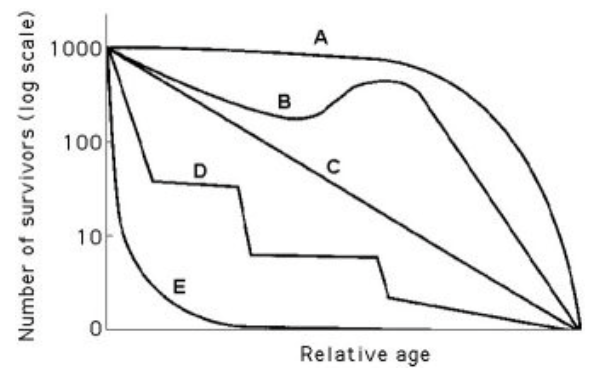
- AThere was a mass emigration of young to middle-aged individuals in this cohort.
- BThis curve is likely of a species that produces lots of offspring, only a few of which are expected to survive.
- CIt is likely a species where no individuals in the cohort die when they are at 60-70% relative age.
- DIt is likely a species that provides little postnatal care, but lots of care for offspring during midlife as indicated by increased survivorship.
- ESurvivorship can only decrease; therefore, this curve could not happen in nature.
28Which of the following groups would be most likely to exhibit uniform dispersion?
- Ared squirrels, who actively defend territories
- Blake trout, which seek out cold, deep water high in dissolved oxygen
- Cdwarf mistletoes, which parasitize particular species of forest tree
- Dmoths, in a city at night
- Ecattails, which grow primarily at edges of lakes and streams
29Which of the following best defines a cohort?
- Aa group of the individuals from the same age group, from birth until they are all dead
- Bthe number of individuals that annually die or emigrate out of a population
- Ca group of individuals that inhabits a small isolated region within the range for the species
- Dthe reproductive males and females within the population
- Eall of the individuals that are annually added to a population by birth and immigration
30Which of the following statements best describes the interaction between fire and ecosystems?
- AChaparral communities have evolved to the extent that they rarely burn.
- BThe suppression of forest fires by man has prevented certain communities, such as grasslands, from reaching their climax stage.
- CThe likelihood of a wildfire occurring in a given ecosystem is highly predictable over the short term.
- DMany kinds of plants and plant communities have adapted to frequent fires.
- EFire is unnatural in ecosystems and should be prevented.
31In the pelagic zone of oceans, which abiotic factors would reduce or limit productivity to the greatest extent?
- Adepth
- Btemperature
- Clight penetration
- Dseasonal turnover
- Enutrients
32Deserts typically occur in a band at 20 degrees north and south latitude because
- Amoisture-laden air is heavier than dry air and is not carried to these latitudes.
- Bdescending air masses tend to be cool and dry.
- Cthese locations get the most intense solar radiation of any location on Earth.
- Dtrade winds have a little moisture.
- Eascending air tends to be moist.
33In which of the following situations would you expect to find the largest number of K-selected individuals?
- Athe flora and fauna of a coral reef in the Caribbean
- Ba recently abandoned agricultural field in Ohio
- CSouth Florida after a hurricane
- Da newly emergent volcanic island
- Ethe sand dune communities of south Lake Michigan
34In models of logistic population growth,
- Anew individuals are added to the population most rapidly at the beginning of the population's growth.
- Bthe population growth rate slows dramatically as N approaches K.
- Ccarrying capacity is never reached.
- Donly density-dependent factors affect the rate of population growth.
- Enew individuals are added to the population as N approaches K.
35To measure the population of lake trout in a 250-hectare lake, 400 individual trout were netted and marked with a fin clip, then returned to the lake. The next week, the lake was netted again, and out of the 200 lake trout that were caught, 50 had fin clips. Using the capture-recapture estimate, the lake trout population size could be closest to which of the following?
- A400
- B200
- C1600
- D160
- E80 000
36An ecologist recorded 12 white-tailed deer, Odocoileus virginianus, per square mile in one woodlot and 20 per square mile in another woodlot. What was the ecologist comparing?
- Acohorts
- Bcarrying capacity
- Crange
- Ddensity
- Edispersion
37Which of the following is most key to understanding the demographic transition in human population growth?
- Aimproved worldwide health care
- Beducation of global famine
- Creduction of casualties of war
- Dvoluntary reduction of family size
- Eimproved sanitary conditions in the world's hospitals
38Which of the following is responsible for the differences in summer and winter temperature stratification of deep temperate zone lakes?
- AWinter ice sinks in the summer.
- BStratification always follows the fall and spring turnovers.
- CWater is densest at 4°C.
- DStratification is caused by a thermocline.
- EOxygen is most abundant in deeper waters.
39Why is the climate drier on the leeward side of mountain ranges that are subjected to prevailing winds?
- AThe sun illuminates the leeward side of mountain ranges at a more direct angle, converting to heat energy, which evaporates most of the water present.
- BPushed by the prevailing winds on the windward side, air is forced to rise, cool, condense, and drop its precipitation, leaving only dry air to descend the leeward side.
- CMore organisms live on the sheltered, leeward side of mountain ranges where their utilization of water lowers the amount available when compared to the windward side.
- DDeserts usually are found on the leeward side of mountain ranges.
- EAir masses pushed by the prevailing winds are stopped by mountain ranges and the moisture is used up in the stagnant air masses on the leeward side.
40Generalized global air circulation and precipitation patterns are caused by
- Apolar, cool, moist high-pressure air masses from the poles that move along the surface, releasing precipitation along the way to the equator where they are heated and dried.
- Brising, warm, moist air masses that cool and release precipitation as they rise and then, at high altitude, cool and sink back to the surface as dry air masses after moving north or south of the tropics.
- Cmountain ranges that deflect air masses containing variable amounts of moisture.
- Dthe revolution of Earth around the sun.
- Eair masses that are dried and heated over continental areas that rise, cool aloft, and descend over oceanic areas followed by a return flow of moist air from ocean to land, delivering high amounts of precipitation to coastal areas.
41If you are interested in observing a relatively simple community structure in a clear water lake, you would do well to choose diving into
- Aan oligotrophic lake.
- Ba lake with consistently warm temperatures.
- Ca relatively shallow lake.
- Da nutrient-rich lake.
- Ea eutrophic lake.
42Uniform spacing patterns in plants such as the creosote bush are most often associated with
- Athe concentration of nutrients within the population's range.
- Bpatterns of high humidity.
- Cthe random distribution of seeds.
- Dchance.
- Ecompetitive interaction between individuals of the same population.
43Which of the following could be a density-independent factor limiting human population growth?
- Apollution
- Bplagues
- Cfamines
- Dsocial pressure for birth control
- Eearthquakes
44Which of the following sets of measurements is the most useful when studying populations?
- Adensity, dispersion, and demographics of a population
- Bminimum and maximum amounts of precipitation and annual temperature extremes
- Cgene frequency over time and the ratio of reproductive to nonreproductive individuals
- Dratio of predators and the number of immigrants and emigrants
- Eannual precipitation averages and mean annual temperatures
45A population is correctly defined as having which of the following characteristics?
I. inhabiting the same general area
II. belonging to the same species
III. possessing a constant and uniform density and dispersion- AII and III only
- BIII only
- CI and II only
- DI, II, and III
- EI only
46In which of the following terrestrial biome pairs are both parts dependent upon periodic burning?
- Adesert and savanna
- Btropical forest and temperate broadleaf forest
- Ctundra and coniferous forest
- Dgrassland and tundra
- Echaparral and savanna
47Which of the following statements about the ocean pelagic biome is true?
- AThe ocean is a vast, deep storehouse that always provides sustenance; it is the next "frontier" for feeding humanity.
- BThe most abundant animals are vertebrate fishes.
- CPelagic ocean photosynthetic activity is disproportionately low in relation to the size of the biome.
- DBecause it is so immense, the pelagic ocean biome is globally uniform.
- EGlobally, more photosynthesis occurs in the ocean neritic biome than in the pelagic biome.
48A population of ground squirrels has an annual per capita birth rate of 0.06 and an annual per capita death rate of 0.02. Calculate an estimate of the number of individuals added to (or lost from) a population of 1000 individuals in one year.
- A20 individuals added
- B120 individuals added
- C400 individuals added
- D20 individuals lost
- E40 individuals added
49Starting from a single individual, what is the size of a population of bacteria that reproduce by binary fission every 20 minutes at the end of a 3-hour time period? (Assume unlimited resources and no mortality.)
- A128
- B512
- C1024
- D6
- E18
50The following questions refer to the figure, which depicts the age structure of three populations. Which population(s) is (are) in the process of decreasing?
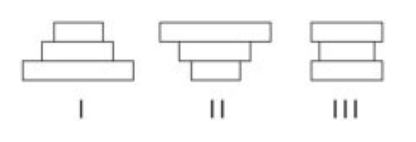
- AI
- BII
- CIII
- DI and II
- EII and III
51Which of the following is a likely graphic outcome of a population of deer introduced to an island with inadequate herbivory (i.e., limited food source) and without natural predators, parasites, or disease?
- Aslay
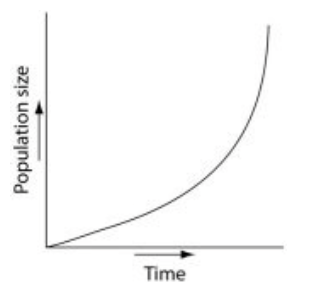
- Bslayy
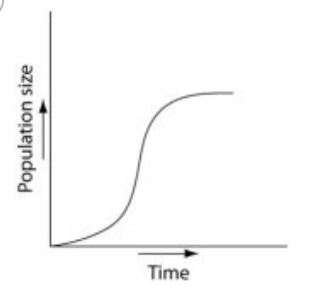
- Cslayyy
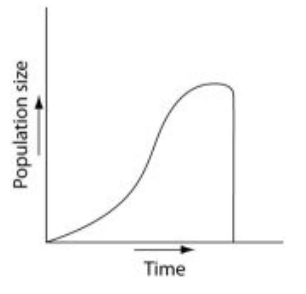
- Dslayyyy
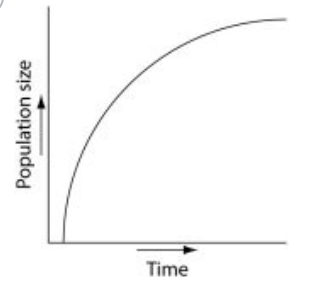
- Eslayyyyy
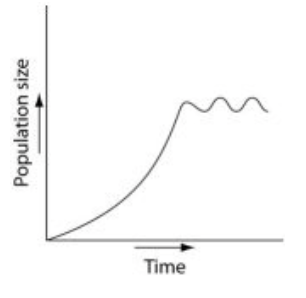
- Aslay
52Elephants and sea turtles are both long-living vertebrates. What type of survivorship curve would you expect to see for these two species, respectively?
- AType I and Type III
- BType I and Type I
- CType II and Type II
- DType III and Type III
- EType I and Type II
53Which zone experiences the most abiotic change over a 24-hour period?
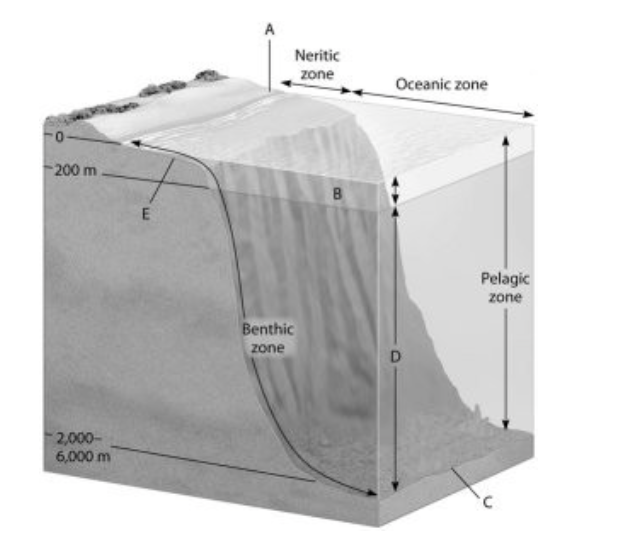
- AA
- BB
- CC
- DD
- EE
54A rain shadow is
- Athe windward side of the mountain that receives much of rain.
- Bthe windward side of the mountain that receives little rain.
- Cthe leeward side of the mountain that receives dry air.
- Dthe region close to shore sheltered by the mountains.
- Eregions near 30 degrees N and 30 degrees S latitude that have dry air.
55Two plant species live in the same biome but on different continents. Although the two species are not at all closely related, they may appear quite similar as a result of
- Aallopatric speciation.
- Bconvergent evolution.
- Cintrogression.
- Dparallel evolution.
- Egene flow.
56Which of the following choices includes all of the others in creating global terrestrial climates?
- Aocean currents
- BEarth's rotation on its axis
- Cevaporation of water from ocean surfaces
- Ddifferential heating of Earth's surface
- Eglobal wind patterns
57Carrying capacity is
- Aseldom reached by marine producers and consumers because of the vast resources of the ocean.
- Bthe term used to describe the stress a population undergoes due to limited resources.
- Cdetermined by density and dispersion data.
- Dfixed for most species over most of their range most of the time.
- Ethe maximum population size that a particular environment can support.
58Which of the following examples of an ecological effect leading to an evolutionary effect is most correct?
- AFish that swim the fastest in running water catch the most prey and more easily escape predation.
- BA few organisms of a larger population survive a drought and then these survivors emigrate to less arid environments.
- CThe insects that spend the most time exposed to sunlight have the most mutations.
- DWhen seeds are not plentiful, trees produce more seeds.
- EA few individuals with denser fur survive the coldest days of an ice age, and the reproducing survivors of the ice age all have long fur.
59In temperate lakes, the surface water is replenished with nutrients during turnovers that occur in the
- Aspring and summer.
- Bautumn and spring.
- Cautumn and winter.
- Dsummer and autumn.
- Esummer and winter.
60Species introduced by humans to new geographic locations
- Aincrease the diversity and therefore the stability of the ecosystem.
- Bcan outcompete and displace native species for biotic and abiotic resources.
- Care always considered pests by ecologists.
- Dalways spread because they encounter none of their natural predators.
- Eare usually successful in colonizing the area.
61A population of white-footed mice becomes severely overpopulated in a habitat that has been disturbed by human activity. Sometimes intrinsic factors cause the population to increase in mortality and lower reproduction rates to occur in reaction to the stress of overpopulation. Which of the following is an example of intrinsic population control?
- AClumped dispersion of the population leads to increased spread of disease and parasites, resulting in a population crash.
- BBecause the individuals are vulnerable, they are more likely to die off if a drought or flood were to occur.
- CFemales undergo hormonal changes that delay sexual maturation and many individuals suffer depressed immune systems and die due to the stress of overpopulation.
- DAll of the resources (food and shelter) are used up by overpopulation and much of the population dies of exposure and/or starvation.
- EOwl populations frequent the area more often because of increased hunting success.
62Which of the following is characteristic of K-selected populations?
- Aearly parental reproduction
- Boffspring with good chances of survival
- Cmany offspring per reproductive episode
- Dsmall offspring
- Ea high intrinsic rate of increase
63Which of the following graphs illustrates the growth curve of a small population of rodents that has grown to reach a static carrying capacity?
- Aslayyy
- Bslayyyy
- Cslayyyyy
- Dslayy
- Eslay
- Aslayyy
64Which of the following can be said about light in aquatic environments?
- AWater selectively reflects and absorbs certain wavelengths of light.
- BPhotosynthetic organisms that live in deep water probably use red light.
- CMost photosynthetic organisms avoid the surface where the light is too intense.
- DLonger wavelengths penetrate to greater depths.
- ELight penetration seldom limits the distribution of photosynthetic species.
65Air masses formed over the Pacific Ocean are moved by prevailing westerlies where they encounter extensive north-south mountain ranges, such as the Sierra Nevada and the Cascades. Which statement best describes the outcome of this encounter between a landform and an air mass?
- AThe cool, moist Pacific air heats up as it rises, releasing its precipitation as it passes the tops of the mountains, and this warm, now dry air cools as it descends on the leeward side of the range.
- BThese air masses remain essentially unchanged in moisture content and temperature as they pass over these mountain ranges.
- CThe warm, moist Pacific air rises and cools, releasing precipitation as it moves up the windward side of the range, and this cool, now dry air mass heats up as it descends on the leeward side of the range.
- DThese air masses are blocked by the mountain ranges, producing high annual amounts of precipitation on the windward sides of these mountain ranges.
- EThe cool, dry Pacific air heats up and picks up moisture from evaporation of the snowcapped peaks of the mountain range, releasing this moisture as precipitation when the air cools while descending on the leeward side of the range.
66In mountainous areas of western North America, north-facing slopes would be expected to
- Abe warmer and drier than comparable southern exposed slopes.
- Bsupport biological communities similar to those found at higher elevations on similar south-facing slopes.
- Creceive more sunlight than similar southern exposures.
- Dconsistently be steeper than southern exposures.
- Esupport biological communities similar to those found at lower elevations on similar south-facing slopes.
67Which of the following choices would most likely promote random distribution?
- Aterritorial species
- Bhomogeneous chemical and physical factors in the environment
- Cspecies that secrete chemicals to attract or inhibit other individuals
- Dspacing during the breeding season
- Eflocking and schooling behaviours
68The human population
- Ais no longer growing exponentially but still increasing rapidly.
- Band its carrying capacity can be estimated using age structure pyramids.
- Cworldwide has reached its demographic transition.
- Dis still growing exponentially, but is increasing slowly.
- Ecan keep increasing because technology will enable continuous growth.
69Which of the following is most likely to contribute to density-dependent regulation of populations?
- Athe removal of toxic waste by decomposers
- Bintraspecific competition for nutrients
- Cfloods
- Dfires
- Eearthquakes
70Which variables define the ecological life history of a species?
- Atiming breeding sessions with optimal environmental conditions and the number of offspring produced during each breeding session
- Bthe amount of parental care given after birth, the number of reproductive episodes per year, and the number of years females are capable of producing viable offspring
- Cthe age at which reproduction begins, frequency of reproduction, and the number of offspring for each reproductive episode
- Dthe number of offspring produced over a lifetime by a breeding pair and the survivability of the offspring
- Ethe ratio of females to males, the length of the breeding season, and the number of offspring for each reproductive episode
71Population ecologists are primarily interested in
- Ahow humans affect the size of wild populations of organisms.
- Bunderstanding how biotic and abiotic factors influence the density, distribution, size, and age structure of populations.
- Cthe overall vitality of a population of organisms.
- Dhow populations evolve as natural selection acts on heritable variations among individuals and changes in gene frequency.
- Estudying interactions among populations of organisms that inhabit the same area.
72Which of the following is the equation for zero population growth (ZPG)?
- AdN/dt = rmax N (K - N)/K
- BdN/dt = 1.0N
- CR = b - m
- DdN/dt = rmax N
- EdN/dt = rN
73Logistic growth of a population is represented by dN/dt =
- ArN ((K - N)/K)
- BrN ((N - K)/K)
- CrN
- DrN/K
- ErN (K + N)
74Why is territoriality an adaptive behaviour for songbirds maintaining populations at or near their carrying capacity?
- AMany individuals are killed in the agonistic behaviours that go along with territorial defence.
- BAdult songbirds make improvements to the territories they inhabit so that they can produce successfully fledged chicks.
- COnly the fittest males defend territories and they attract the fittest females so the best genes are conveyed to the next generation.
- DSongbird males defend territories commensurate with the size from which they can derive adequate resources for themselves, their mate, and their chicks.
- ESongbirds expend a tremendous amount of energy defending territories so that they spend less time feeding their young and fledgling mortality increases.
75Often the growth cycle of one population has an effect on the cycle of another. As moose populations increase, for example, wolf populations also increase. Thus, if we are considering the logistic equation for the wolf population,
dN/dt = rN ((K - N)/K), which of the factors accounts for the effect on the moose population?- Adt
- Br
- CN
- DK
- ErN
76Which of the following scenarios would provide the most legitimate data on population density?
- ACalculate the difference between all of the immigrants and emigrants to see if the population is growing or shrinking.
- BCount the number of pine trees in several randomly selected 10 m x 10 m plots and extrapolate this number to the fraction of the study area these plots represent.
- CUse the mark-and-recapture method to estimate the size of the population.
- DCount the number of nests of a particular species of songbird and multiply this by a factor that extrapolates these data to actual animals.
- EAdd the number of births and subtract the individuals that die to see if the population's density is increasing or decreasing.
77Consider two forests: one is an undisturbed old-growth forest, while the other has recently been logged. In which forest are species likely to experience exponential growth, and why?
- Alogged, because the various populations are stimulated to a higher reproductive potential
- Bold growth, because of stable conditions that would favour exponential growth of all species in the forest
- Clogged, because the disturbed forest affords more resources for increased specific populations to grow
- Dold growth, because each of the species is well established and can produce many offspring
- EExponential growth is equally probable in old-growth and logged forests.
78Which of the following statements does not apply to the logistic growth model?
- AThe model assumes that populations approach K smoothly.
- B(K-N)/K is the fraction of K that is available for population growth.
- CThe logistic model of population growth produces a sigmoid growth curve.
- DWhen N = K, the per capita rate of increase is small.
- EWhen the population is large, then (K-N)/K approaches 0.
79Which of the following life history traits is incorrectly matched?
- Ar selection—density dependent selection
- Bsemelparity—a one-shot, large reproductive effort
- Clife history traits—are trade-offs between conflicting demands
- Diteroparity—relatively few but large offspring are produced at each reproduction
- Esemelparity—recorded in Pacific salmon
Information
- Description
- Quiz on Lesson 10, created by Emmy Guye on 13/04/2023.
- Author
- Emmy Guye
- Language
- English
- Views
- 0
- Rating
- No ratings yet Rate this quiz