
Quiz
MicroBio 2440 Lab midterm
This quiz has question types that open in the usual player.
Questions in this quiz (42)
1Match the waste items below with the appropriate receptacle.
Glass slides [blank_start]sharps container[blank_end]
Used test tubes [blank_start]racks in back by sink[blank_end]
used agar plates [blank_start]biohazard bin[blank_end]
stain runoff in tray [blank_start]chemical waste carboy[blank_end]
paper towel soaked in ethanol [blank_start]regular trash[blank_end]- Asharps container
- Bregular trash
- Cbio hazard bin
- Dracks in the back by sink
- Echemical waste carboy
- Fracks in back by sink
- Gsharps container
- Hregular trash
- Ibio hazard bin
- Jchemical waste carboy
- Kbiohazard bin
- Lsharps container
- Mregular trash
- Nracks in the back by sink
- Ochemical waste carboy
- Pchemical waste carboy
- Qsharps container
- Rregular trash
- Sbiohazard bin
- Tracks in the back by sink
- Uregular trash
- Vsharps container
- Wbiohazard bin
- Xcks in the back by sink
- Ychemical waste carboy
2Our lab is a BSL-[blank_start]2[blank_end] lab. This means that the organisms used in this lab are [blank_start]commonly[blank_end]
encountered in the community and present a [blank_start]moderate[blank_end] environmental and/or health hazard.
Although they are associated with a number of human diseases, these diseases can be
[blank_start]treated[blank_end] if identified in a timely manner.- A2
- Bcommonly
- Cmoderate
- Dtreated
3What are some safety precautions one must take in a BSL-2 lab?
proper [blank_start]attire[blank_end], [blank_start]gloves[blank_end], [blank_start]autoclave[blank_end] for waste disposal, [blank_start]biohazard[blank_end] bins, [blank_start]sharps[blank_end] container- Aattire
- Bgloves
- Cautoclave
- Dbiohazard
- Esharps
4What are some pieces of personal protective equipment we use in our BSL-2 lab?
[blank_start]gloves[blank_end], [blank_start]closed[blank_end]-[blank_start]toed[blank_end] shoes, [blank_start]eye[blank_end] protection, etc- Agloves
- Bclosed
- Ctoed
- Deye
5Before you begin working, you should always:
Wash your [blank_start]____________[blank_end]
Wipe down your workbench with [blank_start]_______________[blank_end]
Put on appropriately sized [blank_start]_____________[blank_end]
Whenever you are finished working, you should always:
Throw away waste in the appropriate [blank_start]_________________[blank_end]
Wipe down your workbench with [blank_start]______________[blank_end]
Wash your [blank_start]___________[blank_end]- Ahands
- Bethanol
- Cgloves
- Dwaste containers
- Eethanol
- Fhands
6We flame the loop before and after using it to prevent contamination.
- ATrue
- BFalse
7Eating and drinking: [blank_start]yes no[blank_end]
Texting: [blank_start]yes no[blank_end]
Applying makeup: [blank_start]yes no[blank_end]
Applying lip balm: [blank_start]yes no[blank_end]
Coming in outside of lab times: [blank_start]yes no[blank_end]
Coming in during other labs: [blank_start]yes no[blank_end]
Run around the room: [blank_start]yes no[blank_end]
Take pictures with your phone: [blank_start]yes no[blank_end]- Ayes
- Bno
- Cyes
- Dno
- Eyes
- Fno
- Gyes
- Hno
- Iyes
- Jno
- Kyes
- Lno
- Myes
- Nno
- Oyes
- Pno
8What conditions are used in an autoclave cycle?
Temp: [blank_start]121 C[blank_end]
psi: [blank_start]15 psi[blank_end]
time: [blank_start]15 minutes[blank_end]- A121 C
- B15 psi
- C15 minutes
9[blank_start]Fomite[blank_end] - object likely to be a mode of transportation for pathogenic microbes
- AFomite
10[blank_start]colony forming units[blank_end]: unit used to estimate the number of visible cells in a sample
- Acolony forming units
11[blank_start]mixed culture[blank_end]: 2 or more species of bacteria within a culture
- Amixed culture
12[blank_start]turbidity[blank_end]: measure of cell density in a broth culture (degree of [blank_start]cloudiness[blank_end])
- Aturbidity
- Bcloudiness
13[blank_start]aseptic[blank_end]: free from contamination caused by pathogenic microbes
- Aaseptic
14[blank_start]defined media[blank_end]: all ingredients known- concentration and amount
- Adefined media
15defined media includes animal and biological products
- ATrue
- BFalse
16[blank_start]complex media[blank_end]: contains material of biological origin so can't be defined
- Acomplex media
17In a streak plate for isolation, it does matter in which quadrant isolated colonies appear.
- ATrue
- BFalse
18What is the goal of a streak plate for isolation?
To obtain [blank_start]isolated[blank_end] colonies of microbes for [blank_start]morphological[blank_end] study. Separates organisms in a [blank_start]mixed[blank_end] culture.- Aisolated
- Bmorphological
- Cmixed
194. Why are the two incubators we commonly use set at 25ºC and 37ºC?
25ºC [blank_start]room temp[blank_end]
37ºC [blank_start]body temp[blank_end]- Aroom temp
- Bbody temp
- Cbody temp
- Droom temp
20state of being everywhere
- Aubiquity
- Bturbidity
- Caseptic
21What practical consequences does microbial ubiquity have?
[blank_start]Healthcare[blank_end]- aseptic technique is critical to preventing spread of [blank_start]pathogens[blank_end] to patients
[blank_start]Lab setting[blank_end]- [blank_start]contamination[blank_end] of cultures and experiments- AHealthcare
- Bpathogens
- CLab setting
- Dcontamination
22label
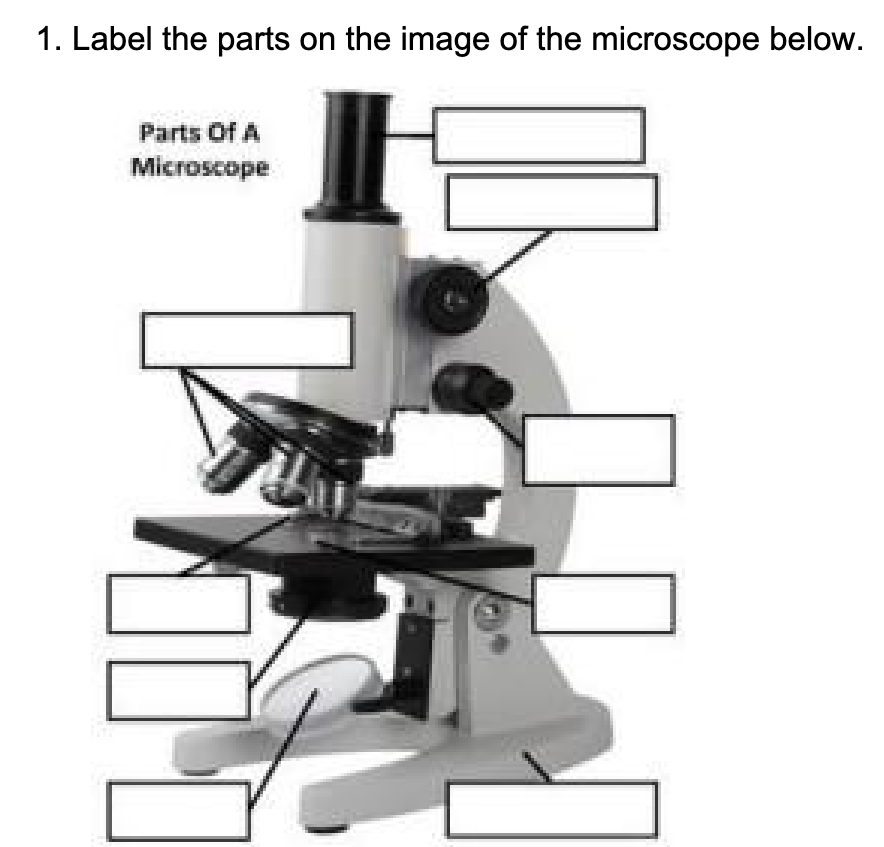
- Afine focus
- Bstage
- Cdiaphragm
- Dbase
- Elight source
- Fcondenser
- Gstage clip
- Hobjective lenses
- Iocular tube
- Jcoarse focus
23 What is involved in a negative stain?
Used for bacteria that cannot withstand [blank_start]heat[blank_end] fixing.
use an [blank_start]acidic[blank_end] stain ([blank_start]Nigrosin[blank_end]) to stain [blank_start]background[blank_end] of slide- Aheat
- Bacidic
- CNigrosin
- Dbackground
24What is involved in a capsule stain?
Use [blank_start]acidic[blank_end] and [blank_start]basic[blank_end] stains. [blank_start]Acidic[blank_end] stain background so you can see the capsule. [blank_start]Basic[blank_end] stains the cell within the capsule.- Aacidic
- Bbasic
- CAcidic
- DBasic
25Make a smear on a clean microscope slide. Allow the smear to
[blank_start]_____________[blank_end]. When the smear is dry, [blank_start]______________[blank_end] the smear.
Apply [blank_start]_________________[blank_end] for [blank_start]_________[blank_end] second(s).
Apply [blank_start]_________________[blank_end] for [blank_start]_________[blank_end] second(s).
Decolourise with [blank_start]_______________[blank_end] until [blank_start]______________________[blank_end].
Apply [blank_start]_________________[blank_end] for [blank_start]_________[blank_end] second- Aair dry
- Bheat fix
- Ccrystal violet
- D60
- Eiodine
- F60
- Gacid alcohol
- Hclear run off
- Isafranin
- J60
26What is the total magnification of the oil immersion lens when you factor in the eyepiece (10X)?
- A1000
- B10,000
- C100
27When can you use the coarse focus knob? The fine focus?
FF- [blank_start]any[blank_end] objective. [blank_start]refining[blank_end].
CF- [blank_start]initial[blank_end] focusing. [blank_start]4x[blank_end] lens.- Aany
- Brefining
- Cinitial
- D4x
28What are the purposes of each of these components that make up a stain?
[blank_start]Solvent[blank_end]: carries chromogen and aids in permeability
[blank_start]Chromophore[blank_end]: colored part of chromogen
[blank_start]Auxochrome[blank_end]: charged part of chromogen- Asolvent
- Bchromogen
- Cauxochrome
- Dchromophore
- Eauxochrome
- Fsolvent
- Gauxochrome
- Hchromophore
- Isolvent
29Switch on the microscope and start on the [blank_start]_______[blank_end] objective lens. Focus the microscope using the [blank_start]_______________________________[blank_end] and visualize the stain.
Move to the [blank_start]__________[blank_end], then the [blank_start]___________[blank_end], using the [blank_start]___________________________[blank_end]_to refocus the lens.
When using the 100X lens, it is imperative to use
[blank_start]__________________________[blank_end]. When finished, move to the [blank_start]________[blank_end] objective lens. Wipe the [blank_start]________________[blank_end] off the [blank_start]100X[blank_end] lens using [blank_start]_________[blank_end]. Switch off the microscope and wrap the [blank_start]_________________[blank_end] neatly around the base- A4x
- Bcoarse focus
- C10x
- D40x
- Efine focus
- Flens oil
- G4x
- Hlens oil
- I100X
- Jlens paper
- Kcord
30What is the difference between a Gram-negative cell and a Gram-positive cell?
GN- [blank_start]pink[blank_end] because of [blank_start]safranin[blank_end]. Outer membrane [blank_start]present[blank_end]. [blank_start]Thin[blank_end] peptidoglycan layer.
GP- [blank_start]purple[blank_end] because of crystal violet. [blank_start]No[blank_end] outer membrane. [blank_start]Thick[blank_end] peptidoglycan layer.- Apink
- Bsafranin
- Cpresent
- DThin
- Epurple
- FNo
- GThick
31What makes a stain basic or acidic?
Charge of [blank_start]auxochrome[blank_end].
Basic= [blank_start]positive[blank_end]
Acidic= [blank_start]negative[blank_end]
[blank_start]Basic[blank_end] is attracted to cell, [blank_start]acidic[blank_end] is repelled- Aauxochrome
- Bpositive
- Cnegative
- DBasic
- Eacidic
32How does a bacterial capsule enhance virulence?
protection from [blank_start]phagocytosis[blank_end]
protection from loss of [blank_start]moisture[blank_end]
mediates adherence of certain [blank_start]molecules[blank_end] to surface- Aphagocytosis
- Bmoisture
- Cmolecules
33The capsule is not stained in a capsule stain because it has no charge.
- ATrue
- BFalse
34What happens to a bacterial cell in a hypotonic solution? In a hypertonic solution?
[blank_start]Hypotonic[blank_end] = lyse bc water flows in
[blank_start]Hypertonic[blank_end]= plasmolysis bc water leaves- AHypotonic
- BHypertonic
- CHypertonic
- DHypotonic
35[blank_start]Tonicity[blank_end]- measure of osmotic pressure (hyper/hypo/iso)
[blank_start]Osmotic pressure[blank_end]- the pressure of solution against a semipermeable membrane to prevent water flowing inward- ATonicity
- BOsmotic pressure
36What effect does UV-C light have on bacterial cells?
Damages [blank_start]DNA[blank_end] by creating [blank_start]thymine[blank_end] dimers- ADNA
- Bthymine
37Pathogen: [blank_start]disease-causing microbe[blank_end]
Ubiquity: [blank_start]state of being everywhere[blank_end]
thermophile: [blank_start]>40C[blank_end]
Psychrophile: [blank_start]<20C[blank_end]
Psychrotroph: [blank_start]able to tolerate temp as low as 0C[blank_end], but the optimal temp is 20-40C
Mesophile: [blank_start]15-40C. found in the human body[blank_end]
Acidophile: [blank_start]pH 5.5 of less[blank_end]
Alkaliphile: [blank_start]pH 8.5 or more[blank_end]
Neutrophile: [blank_start]pH range of 5.5-8.5[blank_end]
Halophile: [blank_start]NaCl concentration greater than 3%[blank_end]
Plasmolysis: [blank_start]contents of cell pull away[blank_end] from membrane due to loss of water
Osomotolerant: grow at a wide range of NaCl- Adisease-causing microbe
- Bstate of being everywhere
- C<20C
- DpH range of 5.5-8.5
- Estate of being everywhere
- FpH range of 5.5-8.5
- GpH 8.5 or more
- H>40C
- I<20C
- JpH 8.5 or more
- K5-40C. found in the human body
- L<20C
- M5-40C. found in the human body
- NNaCl concentration greater than 3%
- Oable to tolerate temp as low as 0C
- Pstate of being everywhere
- Q>40C
- R15-40C. found in the human body
- SpH 5.5 of less
- TpH range of 5.5-8.5
- U>40C
- VpH 5.5 of less
- Wdisease-causing microbe
- X5-40C. found in the human body
- YpH 8.5 or more
- ZpH 8.5 or more
- AA>40C
- AB<20C
- ACpH 5.5 of less
- ADpH range of 5.5-8.5
- AEpH 5.5 of less
- AF>40C
- AGNaCl concentration greater than 3%
- AHgrow at a wide range of NaCl
- AIcontents of cell pull away from membrane
- AJcontents of cell pull away
- AKcontents of cell pull toward
38Cardinal temperatures: min, max, optimum temp an organism survives at
- ATrue
- BFalse
39Heat control incubation: [blank_start]cardinal[blank_end] temps
Extreme freezing temps: cell structures are [blank_start]damaged[blank_end] from ice crystals- Acardinal
- Bdamaged
40What is the difference between planktonic growth and biofilm growth?
planktonic growth= [blank_start]free floating[blank_end]
biofilm growth= [blank_start]adhere to surface, quorum sensing,[blank_end] stationary and in a community- Afree floating
- Badhere to surface, quorum sensing, stati
- Cadhere to surface, quorum sensing,
- Dfree floating
41Define each of the stages of biofilm growth:
[blank_start]Reversible attachment[blank_end]: planktonic/free floating. attach and detach freely
[blank_start]Irreversible attachment[blank_end]: cell adhesion structures formed, biofilm begins to grow
[blank_start]Growth[blank_end]: growth of biofilm in 2D; quorum sensing begins
[blank_start]Maturation[blank_end]: growth of biofilm in 3D; extracellular matrix strengthed
[blank_start]Dispersal[blank_end]: planktonic cells break off and leave to create another biofilm- AReversible attachment
- BIrreversible attachment
- CGrowth
- DMaturation
- EDispersal
- FIrreversible attachment
- GReversible attachment
- HGrowth
- IMaturation
- JDispersal
- KGrowth
- LReversible attachment
- MIrreversible attachment
- NMaturation
- ODispersal
- PMaturation
- QDispersal
- RIrreversible attachment
- SReversible attachment:
- TGrowth
- UDispersal
- VIrreversible attachment:
- WReversible attachment:
- XGrowth
- YMaturation
42What are the cardinal temperatures for bacteria?
ALL bacteria grow between the range of [blank_start]10C[blank_end] and [blank_start]110C[blank_end]- A10C
- B110C
Information
- Description
- Quiz on MicroBio 2440 Lab midterm, created by Elissa Atkinson on 20/02/2024.
- Author
- Elissa Atkinson
- Language
- English
- Views
- 3
- Tags
- Rating
- No ratings yet Rate this quiz