
3928945
Description

Quiz by Srushti Saxena, updated more than 1 year ago

|
Created by Srushti Saxena
about 10 years ago
|
|
Question 1
Question
Which of the following was not one of Mendel's main inferences from his research?
Answer
-
The basic units of genetics are material elements.
-
The genetic material elements come in pairs.
-
Genes are lengths of DNA.
-
The genetic material elements can retain their character through many generations.
-
The genetic material elements separate during the formation of gametes.
Question 2
Question
What is the term for an observable trait of an organism?
Answer
-
Element
-
Phenotype
-
Hybrid
-
Genotype
-
Allele
Question 3
Question
The seeds in a pod of one of Mendel's pea plants are:
Answer
-
produced only when a plant is cross-fertilized.
-
genetically identical to each other but different from other peas in other pods.
-
produced only when a plant is self-fertilized.
-
each the result of a separate fertilization event.
-
genetically identical to each other and all other peas from that plant.
Question 4
Question
Mendel postulated that individuals have genetic elements that exist in pairs, which determine a single phenotype. What do we now know these pairs of elements to be?
Answer
-
two haploid sets of chromosomes
-
two alleles of a gene on homologous chromosomes
-
pairs of sister chromatids
-
pairs of centromeres
-
a sperm and an egg
Question 5
Question
Mendel wanted to make sure his starting plants bred true, meaning the:
Answer
-
seeds would always sprout.
-
peas would always be green.
-
phenotypes of the offspring in each generation could not be predictable.
-
phenotypes of the offspring in each generation were always the same as the parent.
-
phenotypes of the offspring in each generation would sometimes look like the male parent and sometimes look like the female parent.
Question 6
Question
The D gene controls pea plant height. The DD and dd genotypes confer tall and dwarf phenotypes, respectively. What is the relationship between D and d?
Answer
-
They are two different plant chromosomes.
-
They are two different genes on the same chromosome.
-
They are alleles of the same gene.
-
They are two possible homozygous genotypes.
-
They are two possible heterozygous genotypes.
Question 7
Question
Before Mendel, people had observed inheritance of dominant and recessive traits by following many generations of plants and animals. What was different about Mendel's work?
Answer
-
He used a plant that had never been cultivated before.
-
He kept careful count of his results, including mathematical analysis.
-
His results were immediately accepted and applied to other studies.
-
He followed more generations than anyone else.
-
He did both cross- and self-fertilizations.
Question 8
Question
Mendel crossed true-breeding pea plants and found the dominant trait always appeared in the
F1 generation, but it appeared in a ________ ratio of dominant to recessive in the F2 generation.
Answer
-
1:3
-
1:2
-
3:1
-
1:1
Question 9
Question
A and a are dominant and recessive alleles, respectively, of the same gene. Which genotype(s) would result in an individual with the dominant phenotype?
Answer
-
AA and aa
-
Aa and aa
-
only AA
-
AA and Aa
-
only Aa
Question 10
Question
A and a are dominant and recessive alleles, respectively, of the same gene. Which genotype(s) would result in an individual with the recessive phenotype?
Answer
-
Aa and aa
-
AA and aa
-
Aa only
-
AA only
-
aa only
Question 11
Question
Cystic fibrosis (CF) is caused by a recessive allele. A child has CF, even though neither of his parents has CF. Which of the following describes the genotypes of the parents?
Answer
-
One is homozygous dominant for the CF gene, and the other is heterozygous.
-
One is homozygous recessive for the CF gene, and the other is heterozygous.
-
They are both homozygous recessive for the CF gene.
-
They are both homozygous dominant for the CF gene.
-
They are both heterozygous for the CF gene.
Question 12
Question
Cystic fibrosis (CF) is caused by a recessive allele. A child has CF, even though neither of his parents has CF. This couple also has a child who does not have CF. What is the probability the unaffected child is heterozygous?
Answer
-
2/3
-
1/3
-
1/2
-
3/4
-
1/4
Question 13
Question
When a yellow-seeded pea plant with the genotype Yy produces gametes, what will be the genotype(s) of the gametes?
Answer
-
All will be YY.
-
All will be Yy.
-
They will be either all Y or all y.
-
Half will be YY, and half will be yy.
-
Half will be Y, and half will be y.
Question 14
Question
In Mendel's pea plant experiments, in order for him to have observed a 3:1 phenotypic ratio
in the F2 generation, which of the following must be true?
Answer
-
The two alleles of a pair separate in gamete formation.
-
The pairs of alleles must be either homozygous dominant or homozygous recessive.
-
Both alleles of a pair must go into each gamete together.
-
Both of the F1 parents must be breed true.
Question 15
Question
The genotype Ff is an example of a:
Answer
-
trait controlled by multiple genes.
-
homozygous genotype.
-
monohybrid genotype.
-
heterozygous genotype.
-
dihybrid genotype.
Question 16
Question
Widow's-peak hairline in humans is dominant to non-widow's-peak hairline. If a person has a widow's-peak hairline, what is his or her genotype?
Answer
-
The genotype must be homozygous recessive.c
-
The genotype is either homozygous dominant or homozygous recessive.
-
The genotype must be heterozygous.
-
The genotype is either heterozygous or homozygous dominant.
-
The genotype must be homozygous dominant.
Question 17
Question
The Law of Segregation states that:
Answer
-
gene pairs assort independently of each other during gamete formation.
-
differing characters in organisms result from two alleles that separate in gamete formation, such that each gamete gets only one of the two alleles.
-
differing characters are the result of either the homozygous dominant or the homozygous recessive condition.
-
phenotypes are always determined by genotypes.
-
one allele of a pair must always be dominant and the other must always be recessive.
Question 18
Question
If an individual exhibits a recessive trait, which of the following statements can you be sure of?
Answer
-
The phenotype for this trait is different from the phenotype of the homozygous dominant genotype for this trait.
-
The genotype of this trait will be heterozygous.
-
Both parents of this individual had the same genotype for this trait.
-
Any siblings of this individual will have the same phenotype for this trait.
-
Any children this individual has will always exhibit the trait, regardless of the genotype of the other parent.
Question 19
Question
Dimpled cheeks are dominant to undimpled cheeks. If there exists a 50 percent chance that a child will have dimpled cheeks, the parental genotypes must be:
Answer
-
dd and dd
-
Dd and dd
-
DD and Dd
-
Dd and Dd
-
DD and dd
Question 20
Question
When two identical alleles for a character are present, the genotype is referred to as:
Answer
-
Heterozygous
-
Homozygous
-
Dominant
-
Recessive
Question 21
Question
In Mendel's pea plants, yellow seeds are dominant to green seeds. If a true-breeding green- seed-producing plant is crossed to a heterozygous yellow-seed-producing plant, what percentage of offspring produces green seeds?
Answer
-
10%
-
50%
-
33%
-
25%
-
100%
Question 22
Question
In humans, "unattached" earlobes are dominant over "attached" earlobes. Widow's-peak hairline is dominant over non-widow's-peak hairline. Use E and e for the earlobe phenotype alleles and W and w for the hairline phenotype alleles. A woman and a man, both with genotype EeWw, have a child. What is the probability that the child will have attached earlobes and a widow's peak?
Answer
-
1/16
-
9/16
-
1/3
-
3/4
-
3/16
Question 23
Question
Which of the following represents a dihybrid cross?
Answer
-
YYyy x PPpp
-
YY xpp
-
YyPp x YyPp
-
YP xYp
-
Yp x YY
Question 24
Question
In humans, "unattached" earlobes are dominant over "attached" earlobes. Widow's-peak hairline is dominant over non-widow's-peak hairline. Use E and e for the earlobe phenotype alleles and W and w for the hairline phenotype alleles. A woman with unattached earlobes and a widow's peak and a man with attached earlobes and a widow's peak have a child. The child has attached earlobes and a non-widow's-peak hairline. What are the genotypes of the parents?
Answer
-
EEWW and eeww
-
EeWw and eeWw
-
EEWW and eeWw
-
EeWw and EeWW
-
EeWw and eeww
Question 25
Question
What is the physical basis for the independent assortment observation that Mendel made?
Answer
-
Male and female gametes are produced in separate organs in separate individuals.
-
Sister chromatids do not separate until meiosis II.
-
There are two chromosome divisions in meiosis.
-
Homologous chromosomes are randomly aligned and separated during meiosis.
-
Recombination (crossing over) occurs in meiosis.
Question 26
Question
The Law of Independent Assortment states that:
Answer
-
in meiosis, crossing over creates genetically diverse gametes.
-
in fertilization, the combining of sperm and eggs is random.
-
generation of male and female gametes must occur in separate organisms.
-
in any dihybrid cross, it is possible to get any combination of phenotypes.
-
in gamete formation, gene pairs are transmitted independently of each other.
Question 27
Question
When Mendel crossed plants and followed two traits (a dihybrid cross), he saw a 9:3:3:1
ratio of traits in the F2 generation. What did he conclude?
Answer
-
The two traits affect each other's transmission.
-
Dominant traits are always more common than recessive ones.
-
In meiosis, one allele of each gene is passed to each gamete.
-
The transmission of one trait is unaffected by the other.
Question 28
Question
Let S = smooth pea and s = wrinkled pea; Y = yellow pea and y = green pea. What are the different possible genotypes of the gametes produced by a plant that is heterozygous for both characters?
Answer
-
All will be SsYy.
-
Ss, Yy
-
S, s, Y, y
-
SY, Sy, sY, sy
-
SY, sy
Question 29
Question
Let S = smooth pea and s = wrinkled pea; Y = yellow pea and y = green pea. What pea phenotype would be produced by the genotype SsYy?
Answer
-
smooth, yellow
-
smooth, green
-
wrinkled, yellow
-
wrinkled, green
Question 30
Question
In order to track the inheritance of a single character, you would need to do a:
Answer
-
monohybrid cross.
-
dihybrid cross.
-
trihybrid cross.
-
true-breeding cross.
Question 31
Question
In order to track the inheritance of two characters, you would need to do a:
Answer
-
monohybrid cross.
-
dihybrid cross.
-
trihybrid cross.
-
true-breeding cross.
Question 32
Question
In humans, freckles are dominant to no freckles, and unattached earlobes are dominant to attached earlobes. Two individuals who both have freckles and unattached earlobes have a child with no freckles and attached earlobes. What are the genotypes of the parents? (F = freckles; E = unattached earlobes)
Answer
-
FFEE x ffee
-
Ffee x FFEE
-
FfEe x FfEe
-
FFEE x FFEe
-
ffee x ffee
Question 33
Question
In Mendel's pea plants, yellow seeds are dominant to green seeds. Purple flowers are dominant to white flowers. Use Y and y for the seed color alleles and P and p for the flower color alleles. Flower color and seed color assort independently. A plant of unknown genotype with yellow seeds and purple flowers is crossed to a plant with green seeds and white flowers. The offspring all have yellow seeds, but some have purple flowers, and some have white flowers. What is the genotype of the yellow-seeded, purple-flowered plant?
Answer
-
YyPp
-
YYPp
-
YyPP
-
YYPP
-
Yypp
Question 34
Question
In Mendel's pea plants, yellow seeds are dominant to green seeds. Purple flowers are dominant to white flowers. Use Y and y for the seed color alleles and P and p for the flower color alleles. Flower color and seed color assort independently. A true-breeding plant with green seeds and white flowers is crossed to a plant that is heterozygous for the genes for both phenotypes. What is the probability that the cross will yield a plant with green seeds and white flowers?
Answer
-
3/16
-
3/32
-
1/32
-
1/16
-
1/4
Question 35
Question
In Mendel's pea plants, yellow seeds are dominant to green seeds. Purple flowers are dominant to white flowers. Use Y and y for the seed color alleles and P and p for the flower color alleles. Flower color and seed color assort independently. If a plant that is heterozygous for both flower color and seed color genes is self-fertilized, what proportion of the offspring will have one of the dominant phenotypes, either the seed color or flower color, but not both?
Answer
-
6/64
-
6/32
-
6/16
-
9/32
-
9/16
Question 36
Question
When Mendel crossed heterozygotes for flower color and seed color, what proportion of the offspring had both dominant phenotypes?
Answer
-
3/4
-
3/16
-
1/3
-
1/16
-
9/16
Question 37
Question
In Mendel's pea plants, yellow seeds are dominant to green seeds. Purple flowers are dominant to white flowers. Use Y and y for the seed color alleles and P and p for the flower color alleles. Flower color and seed color assort independently. What is the relationship between the Y and P?
Answer
-
They are two different genes on two different chromosomes.
-
They are two different genes on the same chromosome.
-
They are two different chromosomes in the pea plant.
-
They are the pleiotropic effects of a single gene.
-
They are incompletely dominant alleles of the same gene.
Question 38
Question
Mendel's work was presented in ________ but not recognized and rediscovered until ________.
Answer
-
1825; 1950
-
1865; 1900
-
1850; 1900
-
1800; 1900
-
1890; 1920
Question 39
Question
Crossing two pink snapdragons yields some seeds that produce red-flowering plants, some seeds that produce white-flowering plants and some seeds that produce pink-flowering plants. If this trait operates by incomplete dominance and the allele R represents red flowers and the allele r represents white flowers, what genotype would a plant with pink flowers have for this trait?
Answer
-
RR
-
Rr
-
rr
-
RrRr
Question 40
Question
What is the basis for incomplete dominance?
Answer
-
Both alleles of a gene produce weakly functioning proteins.
-
One allele produces some functioning protein; the other allele is nonfunctional.
-
Crossing over has switched alleles for a gene on homologous chromosomes.
-
One gene has many effects.
-
An individual has more than two alleles for a gene.
Question 41
Question
A plant that produces white flowers is crossed to a plant that produces orange flowers. All the offspring produced pale orange flowers. What can you conclude?
Answer
-
Pale orange flower is the dominant phenotype.
-
This trait shows incomplete dominance.
-
Orange flower is the dominant phenotype.
-
The genes for flower color do not assort independently.
-
White flower is the dominant phenotype.
Question 42
Question
If all of Mendel's monohybrid crosses had involved traits that function by incomplete dominance, would his results have supported blending inheritance?
Answer
-
It cannot be determined with the information given.
-
Yes; a cross between red and white flowers would yield all pink offspring.
-
No; he would still have seen the dominant and recessive traits reappear in the F2 generation.
-
Yes; there is always a wide range of phenotypes in monohybrid crosses.
Question 43
Question
Crossing a true-breeding red-flowered snapdragon with a true-breeding white-flowered snapdragon produces all pink snapdragons in the F1 generation. If F1 individuals are crossed, what will be the ratio of phenotypes in the F2 generation?
Answer
-
1 red:1 pink: 2 white
-
2 red:1 pink: 2 white
-
1 red: 2 pink: 1 white
-
3 pink: 1 white
-
3 white: 1 pink
Question 44
Question
A person with the genotype IAIB has type AB blood. This is an example of:
Answer
-
the effect of the environment on phenotype.
-
dihybridness.
-
monohybridness.
-
codominance.
-
incomplete dominance.
Question 45
Question
What is the basis of codominance?
Answer
-
There is only one allele for a gene.
-
One allele of a gene encodes a protein, and the other allele is nonfunctional.
-
One gene has many alleles.
-
Each allele of a gene produces a protein that functions to create a trait.
-
One allele can have many effects on a phenotype.
Question 46
Question
Which type of inheritance is most likely to display a bell curve of phenotypes?
Answer
-
codominance
-
multiple alleles
-
polygenic inheritance
-
monohybrid cross
-
incomplete dominance
Question 47
Question
What is the significance of multiple alleles?
Answer
-
They make it possible for one person to have more than two alleles for a gene.
-
They are the reason one gene can affect more than one character.
-
They are the reason the environment can affect characters.
-
They allow for a range of traits in the population.
Question 48
Question
A, B, and O blood type in humans is controlled by a single gene with three alleles: IA, IB, and i. Type O is the recessive trait. The i allele is recessive to both IA and IB. Which of the following could be possible genotypes of the parents of a person with type O blood?
Answer
-
IAIB and ii
-
IAi and IAIA
-
IAi and IBi
-
IAIB and IAIB
Question 49
Question
Height is an example a character that displays continuous variation in humans. What is the reason for the range of heights in humans?
Answer
-
There is incomplete dominance of the tall allele over the short allele.
-
There are multiple alleles for the height gene.
-
Most traits such as height are governed by the interaction of many genes.
-
There is only one gene for height in humans, but the environment can influence the expression of the gene.
Question 50
Question
Characters such as height, weight, and skin color are controlled by many genes acting together. These are examples of:
Answer
-
multiple alleles.
-
codominance.
-
incomplete dominance.
-
polygenic inheritance.
Question 51
Question
The phenotype of an organism can be influenced by:
Answer
-
its genotype.
-
its environment.
-
both its environment and its genotype.
-
neither its genotype nor its environment.
Question 52
Question
Mendel's contribution to genetics was the discovery of DNA.
Answer
- True
- False
Question 53
Question
Mendel's crosses with pea plants disproved the notion that, when individuals with two different traits are mated, the genetic information blends in the offspring and is not retained as separate elements.
Answer
- True
- False
Question 54
Question
If a person has a recessive trait, the genotype must be homozygous recessive for the trait.
Answer
- True
- False
Question 55
Question
When two individuals with different traits are crossed, either the dominant or the recessive trait, and not an intermediate trait, is always seen, no matter what the organism or phenotype.
Answer
- True
- False
Question 56
Question
The physical characteristics of an organism, or its [blank_start]________[blank_end], are determined by its genetic makeup, referred to as its [blank_start]________[blank_end].
Answer
-
phenotype
-
genotype
Question 57
Question
A particular quality of an organism is referred to as a [blank_start]________[blank_end], each variation of which is a particular [blank_start]________[blank_end].
Answer
-
character
-
trait
Question 58
Question
In the Law of [blank_start]________[blank_end], Mendel stated that two genetic elements are separated in gamete formation.
Answer
-
Segregation
Question 59
Question
If a plant heterozygous for the genes for both seed color and shape is self-fertilized, the ratio of offspring with smooth, green seeds is [blank_start]________[blank_end]/16. (Yellow and smooth are the dominant phenotypes.)
Answer
-
3
Question 60
Question
A true-breeding strain of red tulips is crossed to a true-breeding strain of white tulips. All the offspring have pink flowers. When a pink-flowered plant is self-fertilized, the offspring have red, pink, and white flowers, in the ratio 1:2:1. This type of inheritance is an example of [blank_start]________[blank_end].
Answer
-
incomplete dominance
Question 61
Question
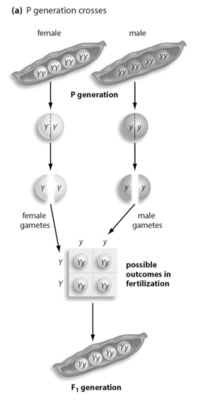
In his basic experiments, Mendel began with true-breeding parental (P) plants. What results did he see when he cross-fertilized P generation plants that had different traits?
Answer
-
The F1 plants had new traits that were a blend of P traits.
-
All F1 plants had the trait of one or the other P plant.
-
The F1 plants had an entirely new trait, not seen in either P plant.
-
The F1 plants showed a combination of the two P traits in a 1:1 ratio.
-
The F1 plants showed a combination of the two P traits, in a 3:1 ratio.
Question 62
Question
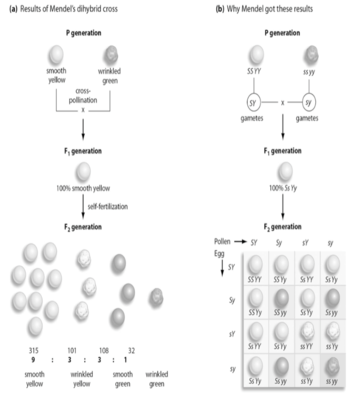
In a dihybrid cross, if heterozygotes are crossed, what fraction of the offspring is expected to have both the dominant phenotypes?
Answer
-
1/16
-
1/3
-
2/3
-
3/16
-
9/16
Want to create your own Quizzes for free with GoConqr? Learn more.