
4232616
Description

Quiz by amandeep.purewal, updated more than 1 year ago

|
Created by amandeep.purewal
about 10 years ago
|
|
Question 1
Question
Refer to the exhibit. The indicated configuration was established on the HSRP standby router RTB. However, the console message %IP-4-DUPADDR started appearing almost immediately on the RTB router. Given the output of the show standby brief command on RTA, what is the cause of the problem?
Answer
-
The command standby pre-empt should only be applied on the active router.
-
The subnet mask is missing from the standby ip 10.1.1.1 command.
-
The group number 50 is missing in the Router RTB configuration commands.
-
The priority number 150 is missing in the Router RTB configuration commands.
-
The virtual IP address should be the same as the active router.
-
The ports on the switch must be configured with the spanning-tree PortFast feature.
Question 2
Question
Which statement correctly explains the process of mitigating ARP attacks on a switch where dynamic ARP inspection (DAI) has been configured?
Answer
-
All intercepted packets that come from untrusted ports are dropped.
-
All intercepted packets that come from trusted ports are sent to untrusted ports only.
-
The intercepted packets are verified against the DHCP snooping binding table for valid IP-to-MAC bindings
-
For all intercepted packets, an ARP request is sent to the DHCP server for IP-to-MAC address resolution
Question 3
Question
Refer to the exhibit. What feature does an SNMP manager need to be able to set a parameter on ACSw1 ?

Answer
-
A manager who is using an SNMP string of K44p0uta
-
Manager who is using an Inform Request MIB
-
A manager who is using host 192.168.0.5
-
A manager who is using authPriv
Question 4
Question
Which statement is true concerning the core layer within the hierarchical design model?
Answer
-
Remote users are granted access to the network through the core.
-
Routing should be configured without traffic filtering, address translation, or other packet manipulation at the core.
-
The core, which acts as the front door to a network, is designed to prevent unauthorized users from gaining entry.
-
The core provides an optimized and reliable transport structure by using a combination of route summaries, distribution lists, and route maps.
Question 5
Question
When a port security violation occurs on a switch port, the switch sends a syslog message but does not shutdown the port. What port security mode is in effect?
Answer
-
Sticky
-
Shutdown
-
Restrict
-
protect
Question 6
Question
Which three steps are required to configure interfaces as routed ports on a multilayer Catalyst switch? (Choose three.)
Answer
-
Enable IP routing globally
-
Assign IP addresses to routed ports
-
Configure SVI for each VLAN in the network
-
Configure 802.1 Q encapsulation on routed ports
-
Disable Power over Ethernet (PoE) on the physical Layer 3 interfaces
-
Disable Layer 2 functionality on interfaces that will be configured as routed ports
Question 7
Question
A bridging loop occurs in a network and disrupts user connectivity. What action should be taken by a network administrator to restore connectivity?
Answer
-
Disable ports that should be in the blocking state
-
Disable ports that should be in the forwarding state
-
Disable and re-enable all ports on the distribution switches
-
Disable all ports on the distribution switches and replace with new switches
Question 8
Question
Which three actions can cause problems with a VTP implementation? (Choose three.)
Answer
-
using a non-trunk link to connect switches
-
using non-Cisco switches
-
configuring all switches to be in VTP server mode
-
not using any VTP passwords on any switches
-
using lowercase on one switch and uppercase on another switch for domain names
-
having a VTP transparent switch in between a VTP server switch and a VTP client switch (all switches in the same VTP domain)
Question 9
Question
Refer to the exhibit. What two conclusions can be made based on the output? (Choose two.)
Answer
-
Interfaces Fa0/1 through Fa0/6 are trunk ports.
-
Switch DLS1 is not the root bridge for VLAN 1.
-
The Cost column in the lower part of the exhibit is not the cumulative root path cost.
-
The default spanning-tree timers have been adjusted.
-
That Fa0/12 is displaying the alternate port role indicates that PVRST+ is enabled.
Question 10
Question
Which QoS requirement should be taken into account when implementing VoIP in a campus environment?
Answer
-
The QoS requirements should accommodate the best effort delivery for voice traffic.
-
The QoS requirements should accommodate the bursty nature of voice traffic
-
The QoS requirements should accommodate the intensive demand on bandwidth for voice traffic
-
The QoS requirements should accommodate the smooth demand on bandwidth, low latency, and delay for voice traffic
Question 11
Question
When troubleshooting GLBP in an environment with a VLAN that spans multiple access layer switches, a network engineer discovers that suboptimal paths are being used for upstream traffic. What is the recommended solution?
Answer
-
Use HSRP instead of GLBP
-
Adjust the GLBP timers
-
Configure spanning tree so that the spanning-tree topology adjusts with the GLBP active virtual forwarder(AVF).
-
Disable GLBP preemption on all route processors
Question 12
Question
Refer to the exhibit. What happens if interface gigabitEthernet 5/1 on SwitchA stops receiving UDLD packets?
Answer
-
UDLD stops trying to establish a connection with the neighbour.
-
UDLD changes the port state to err-disable.
-
UDLD changes the port to loop-inconsistent blocking state.
-
UDLD sends hello messages to its neighbour at a rate of one per second to attempt to recover the connection.
Question 13
Question
How should a switch port be configured for a connection to a standalone wireless access point that provides multiple VLAN-separated SSIDs?
Answer
-
as a trunk port
-
as a routed port
-
as an access port
-
as a switched virtual interface
Question 14
Question
Which two procedures should be implemented and in place when deploying VoIP in a campus network?(Choose two.)
Answer
-
Keep voice and data traffic in the same VLAN and mark the traffic for high priority treatment.
-
Create voice VLANs to keep voice traffic separate from other data to ensure special handling of the traffic.
-
Configure traffic shaping QoS policy to guarantee minimum delay for the voice traffic
-
Configure QoS policy to classify the voice traffic in the priority queue to guarantee reserved bandwidth allocation for the traffic
-
Configure the Weighted Random Early Detection (WRED) congestion avoidance mechanism to guarantee that the voice traffic will be placed in the priority queue
Question 15
Question
What are three possible misconfigurations or indicators of misconfigurations on a Layer 3 interface? (Choosethree.)
Answer
-
wrong IP address or subnet mask
-
ports in the wrong VLAN
-
mismatch between SVI and VLAN numbering
-
disabled VTP pruning
-
downed SVI
-
ACL on wrong interface
Question 16
Question
What type of queuing provides the best quality for voice applications?
Answer
-
custom queuing
-
FIFO queuing
-
priority queuing
-
weighted round robin (WRR) queuing
Question 17
Question
Refer to the exhibit. What is the problem between the connection on Switch1 and Switch2?
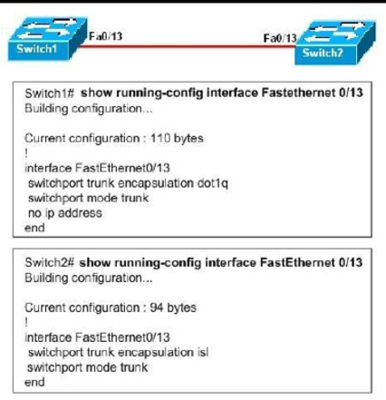
Answer
-
native VLAN mismatch
-
Encapsulation mismatch
-
switchport mode mismatch
-
VTP mismatch
-
DTP mismatch
-
hardware failure
Question 18
Question
Refer to the exhibit. The exhibit contains the configuration for a Cisco access device. How will someone dialing in be authenticated?
Answer
-
local username and password
-
TACACS+ server
-
RADIUS server and, if that fails, local username and password
-
TACACS+ server and, if that fails, local username and password
-
RADIUS server and, if that fails, TACACS+ server
Question 19
Question
Which STP enhancement should be configured in the network to prevent a nondesignated port to transition to a forwarding state when a topology change occurs?
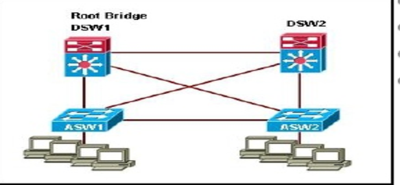
Answer
-
Root guard should be implemented on the Layer 2 ports between the distribution switches.
-
Port Fast should be implemented on the uplink ports from the access switches to the distribution switches.
-
Loop guard should be implemented on the Layer 2 ports between DSW1 and DSW2 and on the uplink ports from the access switches to the distribution switches.
-
BPDU guard should be implemented on the Layer 2 ports between DSW1 and DSW2 and on the uplink ports from the access switches to the distribution switches.
Question 20
Question
What are two actions a hacker may take in a VLAN hopping attack? (Choose two.)
Answer
-
replying to ARP requests that are intended for other recipients
-
sending malicious dynamic trunking protocol (DTP) frames
-
replying to DHCP requests that are intended for a DHCP server
-
sending a unicast flood of Ethernet frames with distinct source MAC addresses
-
sending frames with two 802.1Q headers
Question 21
Question
Refer to the exhibit. Assuming that the switch is running Multiple Spanning Tree (MST), which conclusion can be made based on the output?
Answer
-
Spanning-tree load balancing is in effect.
-
All VLANs are mapped to MST instance 2.
-
PVRST+ is still operating on switch DLS1.
-
PVST+ is still operating on switch DLS1.
-
MST will require fewer resources than PVST+ or PVRST+.
Question 22
Question
A network administrator wants to implement inter-VLAN routing in the network. Which interfaces should be configured as routed ports?
Answer
-
all interfaces on links 5 and 6
-
all interfaces on links 1, 2, 3, and 4
-
all interfaces on links 1, 2, 3, 4, 5, and 6
-
all interfaces between the distribution and the access switches
Question 23
Question
Which three actions are taken when the command
switchport host is entered on a switch port? (Choosethree.)
Answer
-
BPDU guard is enabled.
-
Cisco Discovery Protocol (CDP) is disabled.
-
VLAN trunking protocol (VTP) is disabled.
-
PortFast is enabled
-
Trunking is disabled.
-
Channel group is disabled
Question 24
Question
Which two statements are true about routed ports on a multilayer switch? (Choose two.)
Answer
-
A routed port behaves like a regular router interface and supports VLAN subinterfaces.
-
A routed port is a physical switch port with Layer 2 capability.
-
A routed port is not associated with a particular VLAN.
-
To create a routed port requires removal of Layer 2 port functionality with the no switchport interface configuration command.
-
The interface vlan global configuration command is used to create a routed port.
Question 25
Question
Refer to the exhibit. Switches DSw1 and DSw2 are configured with the HSRP virtual IP address 10.10.10.1, and standby priority is set to 100. Assume both switches finish booting at the same time and HSRP is operating as expected. On the basis of this information, which three HSRP statements are true? (Choose three.)
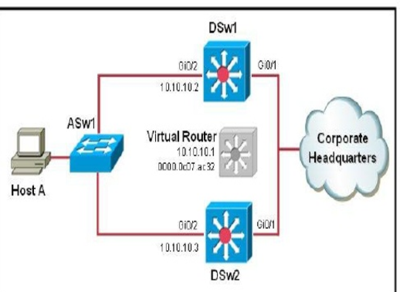
Answer
-
Applying the standby 32 timers 10 30 command on the Gi0/2 interfaces of each switch would decrease the failover time.
-
If the DSw1 and DSw2 switches have been configured to preempt, then DSw2 will be the active router.
-
If the DSw1 switch is configured with the standby pre-empt command and DSw2 is not, then DSw1 will be the active router.
-
The HSRP group number in this HSRP configuration is HSRP group number 50.
-
The standby track command is useful for tracking interfaces that are not configured for HSRP.
-
When host A sends an ARP request for 10.10.10.1, Virtual Router replies with the MAC address of the active router
Question 26
Question
What is the recommended maximum one-way jitter when implementing video over IP for real-time video applications?
Answer
-
1 ms
-
2 ms
-
5 ms
-
10 ms
Question 27
Question
Refer to the exhibit. Based on the provided
show ip dhcp snooping command, which statement is true?
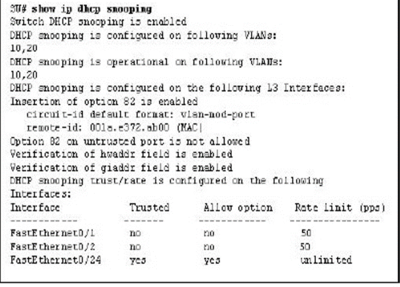
Answer
-
Only port Fa0/24 can send and receive all DHCP messages.
-
Ports Fa0/1, Fa0/2, and Fa0/24 can send and receive all DHCP messages.
-
Only ports Fa0/1 and Fa0/2 can send and receive all DHCP messages.
-
Ports Fa0/1, Fa0/2, and Fa0/24 can send and receive only DHCP requests
Question 28
Question
Which two items in the TCAM table are referenced in the process of forwarding a packet? (Choose two.)
Answer
-
VLAN ID
-
ACL information
-
destination MAC address
-
QoS information
-
source MAC address
-
hash key
Question 29
Question
Catalyst Catalyst 6500 switches support which three Supervisor Engine redundancy features? (Choose three.)
Answer
-
Route Processor Redundancy+ (RPR+)
-
distributed CEF (dCEF)
-
Stateful Switchover (SSO)
-
Resilient Packet Ring (RPR)
-
Nonstop Forwarding (NSF)
-
Per Line Card Traffic Policing
Question 30
Question
Which two statements are true about the default operation of STP in a Layer 2 switched environment that has redundant connections between switches? (Choose two.)
Answer
-
The root switch is the switch with the highest speed ports
-
Decisions on which port to block when two ports have equal cost depend on the port priority and index.
-
All trunking ports are designated and not blocked
-
Root switches have all ports set as root ports
-
Nonroot switches each have only one root port
Question 31
Question
Which benefit is provided by centralizing servers in a data center server farm?
Answer
-
It keeps client-to-server traffic local to a single subnet.
-
Servers that are located in a data center require less bandwidth.
-
It is easier to filter and prioritize traffic to and from the data center.
-
Server farms are not subject to denial of service attacks.
Question 32
Question
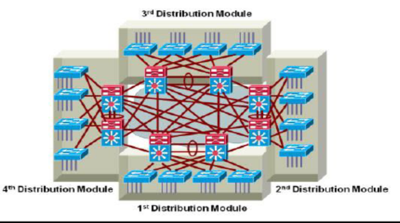
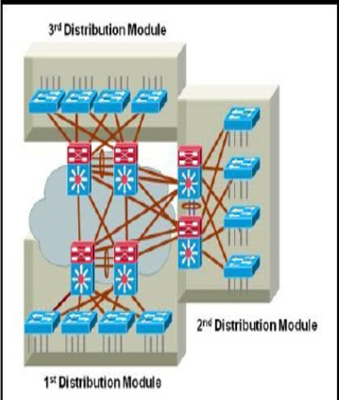
Refer to the exhibit. What restriction will be presented in a campus enterprise network that is designed with four large distribution building blocks?
Answer
-
The implementation of link aggregation will be limited.
-
The implementation of IGP routing protocols will be limited
-
The implementation of EtherChannels on redundant links will exceed the bandwidth
-
The implementation of scalability that is required during future growth will be limited
Question 33
Question
Which three issues can cause devices to become disconnected across a trunk link? (Choose three.)
Answer
-
native VLAN mismatch
-
unassigned management VLAN
-
Layer 2 interface mode incompatibilities
-
missing default VLAN
-
mismatched trunk encapsulations
-
PAgP not enabled
Question 34
Question
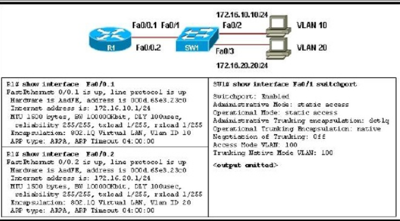
Refer to the exhibit. What additional configuration is required in order for users in VLAN 10 to communicate with the users in VLAN 20?
Answer
-
Configure interface Fa0/1 on SW1 as a trunk.
-
Remove the subinterfaces on R1 and configure interface Fa0/0 as a trunk.
-
Configure interfaces Fa0/2 and Fa0/3 on SW1 as trunk links.
-
Configure VLAN 100 as a data VLAN and VLAN 1 as the native VLAN.
Question 35
Question
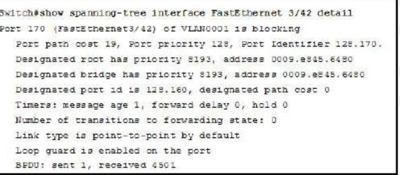
Refer to the exhibit. Given that interface Fa3/42 is an active trunk port, what two conclusions can be made based on the displayed output? (Choose two.)
Answer
-
Root guard is not enabled on interface Fa3/42
-
Interface Fa3/42 will not pass data traffic if it detects that it is part of a spanning-tree loop caused by unidirectional link failure
-
UDLD cannot be configured on interface Fa3/42
-
If a spanning-tree loop is detected on VLAN 1, data traffic will be blocked for all VLANs on interface Fa3/42
-
The difference in BPDUs sent and received indicates a loop caused by unidirectional link failure has been detected
Question 36
Question
Which architecture enables enterprises to offer important network services, such as security, new communication services, and improved application performance to every office, regardless of its size or proximity to headquarters?
Answer
-
Cisco Enterprise Campus Architecture
-
Cisco Enterprise Data Center Architecture
-
Cisco Enterprise Branch Architecture
-
Cisco Enterprise Teleworker Architecture
Question 37
Question
Which three parameters must be configured in order to enable SSH? (Choose three.)
Answer
-
Retries
-
Hostname
-
Timeouts
-
domain name
-
Keys
-
routing protocol
Question 38
Question
The TCAM defines three different match options that correlate to which three specific match regions? (Choose three.)
Answer
-
bifurcated match
-
longest match
-
second match
-
exact match
-
first match
-
third match
Question 39
Question
Which two types of attacks can be mitigated by port security? (Choose two.)
Answer
-
Dictionary
-
denial of service (DoS)
-
Replay
-
MAC-address flooding
-
password
Question 40
Question
What is a characteristic of a standalone WLAN solution?
Answer
-
has no centralized monitoring
-
has no centralized management
-
has no centralized operational control
-
has no centralized access authentication
Question 41
Question
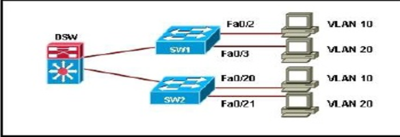
Refer to the exhibit. What configuration will be required on the DSW switch in order to perform inter-VLAN routing for all VLANs that are configured on the access switches?
Answer
-
Configure the routing protocol
-
Configure SVI for each VLAN in the network
-
Configure the links between DSW and the access switches as access links
-
Configure as routed ports the DSW interfaces that face the access switches
Question 42
Question
How do FlexLink and STP operate together?
Answer
-
If an active STP port is blocked, the active FlexLink port will take over
-
Both the active STP port and active FlexLink port can forward traffic simultaneously
-
Both the active STP port and active FlexLink port can forward traffic simultaneously but only for different VLANs
-
STP can be active in the distribution layer, but is unaware of any FlexLink updates in the access layer
Question 43
Question
Refer to the exhibit. What two effects will occur when a fourth distribution module is included in the campus enterprise network that is depicted in the exhibit? (Choose two.)
Answer
-
The inclusion of the fourth module will increase the routing complexity.
-
It will limit the traffic flow in the network
-
It will provide scalability for future growth
-
It will impact the security of the traffic between the distribution switches
-
It will increase the number of additional links that are required to provide redundant connectivity
Question 44
Question
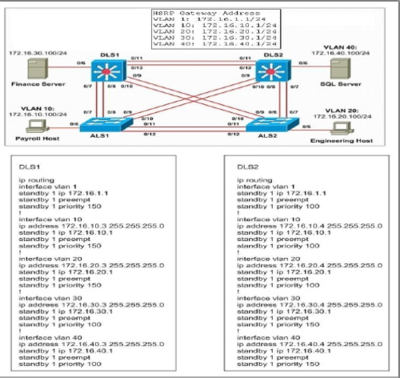
Refer to the exhibit. What statement is true about the way HSRP is configured?
Answer
-
Switch DLS1 is the standby router for VLANs 1,10, and 20.
-
Switch DLS2 is the standby router for VLANs 30 and 40.
-
Issuing the show standby command on switch DSL1 will reveal that the HSRP state for VLAN 10 is standby.
-
Issuing the show standby command on switch DSL2 will reveal that the HSRP state for VLAN 30 is standby
-
By setting different priorities on different VLANs, a type of load balancing is occurring
-
If the Ethernet cables between switch DLS2 and switch ALS1 were severed, Payroll Host would not be able to reach SQL Server
Question 45
Question
When should a proactive management be performed within the stages of the Cisco Lifecycle Services?
Answer
-
prepare phase
-
plan phase
-
design phase
-
implement phase
-
operate phase
-
optimize phase
Question 46
Question
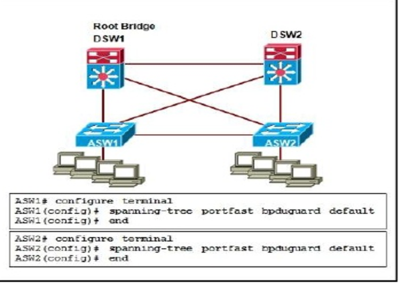
Refer to the exhibit. What is the result of the displayed configuration on switches ASW1 and ASW2?
Answer
-
BPDU guard puts an interface that is configured for STP PortFast in the err-disable state upon receipt of a BPDU.
-
BPDU guard overrides the PortFast configuration and reverts to the default spanning tree configuration on the access ports.
-
BPDU guard forces the uplink ports on ASW1 and ASW2 to become designated ports to prevent DSW2 from becoming a root switch.
-
BPDU guard places the uplink ports on a ASW1 and ASW2 into the STP loop-inconsistent blocking state when the ports stop receiving BPDUs.
Question 47
Question
Which multilayer switching forwarding method does Cisco Express Forwarding (CEF) use?
Answer
-
route caching
-
process switching
-
silicon switching
-
topology-based switching
Question 48
Question
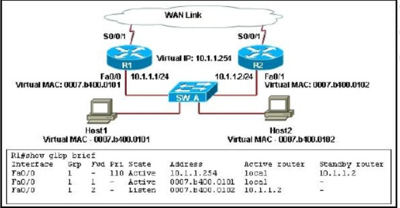
Refer to the exhibit. A network administrator wants to verify the proper operations of the packet load sharing between a group of redundant routers that are configured with GLBP. On the basis of the provided output, which router is the Active Virtual Forwarder (AVF) for Host2?
Answer
-
the router with an IP address of 10.1.1.1
-
the router with an IP address of 10.1.1.2
-
the router with the virtual IP address of 10.1.1.254
-
the router with the IP address 10.1.1.1 and the router with the IP address 10.1.1.2
Question 49
Question
What is required for SLA to capture one-way delays?
Answer
-
two IP SLA responders
-
a Round Trip Timer value
-
Network Time Protocol (NTP)
-
IP SLA source using TCP port 2020
Question 50
Question
What is the most common method of configuring inter-VLAN routing on a Layer 3 switch?
Answer
-
Configure the switch physical interface so that the router will have an interface in each VLAN.
-
For each VLAN, configure trunking between the router and the switch.
-
Configure a routing protocol on the Layer 3 switch to include each interface
-
Configure switch virtual interfaces. The result is that the router will have a virtual interface in each VLAN.
Question 51
Question
What is the purpose of the debug condition standby vlan vlan-id group-number command in troubleshooting HSRP?
Answer
-
redirect the debug standby output for the referenced HSRP group to a syslog server on the specified VLAN
-
block the debug standby output for the referenced VLAN and HSRP group
-
Display debug standby output only for HSRP traffic that is received by HSRP peers in the specified VLAN and group
-
Display debug standby output only for HSRP traffic that is sent to HSRP peers in the specified VLAN and group
-
limit the output of the debug standby command to the specific VLAN interface and HSRP group
Question 52
Question
What device can be used to support Power over Ethernet (PoE) to power the access points?
Answer
-
a host computer
-
an IP phone
-
an Ethernet switch
-
a lightweight access point
Question 53
Question
Which three statements about RSTP edge ports are true? (Choose three.)
Answer
-
Edge ports function similarly to UplinkFast ports.
-
Edge ports should never connect to another switch
-
If an edge port receives a BPDU, it becomes a normal spanning-tree port
-
Edge ports immediately transition to learning mode and then forwarding mode when enabled
-
Edge ports never generate topology change notifications (TCNs) when the port transitions to a disabled or enabled status
-
Edge ports can have another switch connected to them as long as the link is operating in full duplex
Question 54
Question
What are two benefits of local VLANs in the Enterprise Campus Network? (Choose two.)
Answer
-
wide coverage because of the fact that a VLAN can be geographically dispersed throughout the network
-
ease of management because local VLANs are typically confined to the building access submodule
-
high availability because redundant paths exist at all infrastructure levels
-
broad expansion domain because the number of devices on each VLAN can easily be added to
-
IP address conservation because address blocks can be allocated to VLANs
Question 55
Question
Which phase of the Cisco Lifecycle Services approach includes building a network according to the design and verifying that it performs according to specifications?
Answer
-
prepare phase
-
plan phase
-
design phase
-
implement phase
-
Operate phase
-
Optimize phase
Question 56
Question
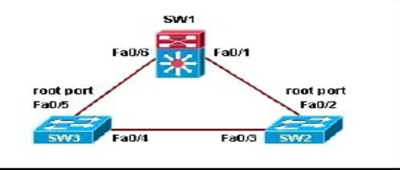
Refer to the exhibit. The link between switch SW1 and SW2 is manually configured as full duplex on SW2 and with half duplex on SW1. How could this impact the STP operations?
Answer
-
Switch SW2 can move port Fa0/3 into a forwarding state, thereby creating a Layer 2 loop
-
Switch SW1 shuts down the Fa0/1 port and thus reinforces a new spanning-tree calculation.
-
Switch SW2 negotiates the Fa0/1 port on SW1 to be in full-duplex mode which keeps SW1 as the rootbridge for the spanning tree.
-
Switch SW1 negotiates the Fa0/2 port on SW2 to be in half-duplex mode and thus forces SW2 to become the root bridge for the spanning tree.
Question 57
Question
What three features are provided by IEEE 802.1Q trunking? (Choose three.)
Answer
-
Security
-
Resilience
-
QoS support
-
multivendor support
-
relatively small frame overhead
-
multicast support
Question 58
Question
How many physical links can comprise a single PAgP EtherChannel on a Catalyst 3560 switch? (Choose three.)
Answer
-
2
-
5
-
8
-
10
-
12
-
13
-
16
Question 59
Question
What is the most fundamental form of high availability when using Catalyst modular switches?
Answer
-
Spanning Tree Protocol
-
routing protocol
-
First Hop Redundancy Protocol (FHRP)
-
Supervisor Engine redundancy
-
redundant switching modules
Question 60
Question
What is the recommended maximum one-way latency when implementing video over IP for real-time video applications?
Answer
-
Latency is not a factor for a smooth video over IP implementation.
-
Latency should be defined for voice traffic only (not for video).
-
The recommended maximum one-way latency should not be more than 150 ms.
-
When mixed video and voice packets are included in the video stream, the latency should be 300 ms.
Want to create your own Quizzes for free with GoConqr? Learn more.