
Quiz
PHYSICS M2 (1)
This quiz has question types that open in the usual player.
Questions in this quiz (21)
1The density of a substance depends on two quantities associated with the material m[blank_start]ass[blank_end] and v[blank_start]olume[blank_end].
- Aass
- Bolume
2Density = mass / [blank_start]volume[blank_end]
units in kg/m3 or g/[blank_start]cm[blank_end]3- Avolume
- Bgrams
- Cheight
- Dweight
- Ecm
- Fm
- Gkm
- Hkg
3A material always has the same density.
- ATrue
- BFalse
4volume is measured using a [blank_start]ruler[blank_end] in [blank_start]cm3[blank_end].
Mass is measured using a [blank_start]top-pan-balance[blank_end] in [blank_start]grams[blank_end].
Density is found by d[blank_start]ividing[blank_end] the [blank_start]mass[blank_end] by the [blank_start]volume[blank_end], and is measured in [blank_start]g/cm3[blank_end]- Aruler
- Bcm3
- Ctop-pan-balance
- Dgrams
- Emass
- Fvolume
- Gividing
- Hg/cm3
5Any object displaces its own volume of [blank_start]liquid[blank_end]. The displacement method can either be done using:
~ a measuring cylinder (if the cylinder is small enough and the measuring cylinder is big enough. THE [blank_start]INCREASE[blank_end] IN VOLUME = VOLUME OF THE [blank_start]OBJECT[blank_end].
~ a [blank_start]eureka[blank_end] can; for larger objects (collect the volume of water displaced from the can when the object is lowered into the can using a measuring cylinder. VOLUME OF WATER DISPLACED = VOLUME OF OBJECT.- Aliquid
- Bsolid
- Csand
- Dacid
- EINCREASE
- FDECREASE
- GOBJECT
- HCYLINDER
- IWATER
- JTEST TUBE
- Keureka
- Ltin
- Mround
- Nplastic
61) The [blank_start]eureka[blank_end] can is filled with [blank_start]water[blank_end] above the spout and excess water is allowed to f[blank_start]low out[blank_end].
2) The stone is placed carefully into the can, so that is completely s[blank_start]ubmerged[blank_end].
3) The volume of the water displaced is measured using a m[blank_start]easuring[blank_end] c[blank_start]ylinder[blank_end].
4) The volume of water displaced equals the v[blank_start]olume[blank_end] of the s[blank_start]tone[blank_end]- Aeureka
- Bwater
- Clow out
- Dubmerged
- Eeasuring
- Fylinder
- Golume
- Htone
7What is a planet?
- AA planet is an object that gives out its own light and is orbited by stars.
- BA planet is an object that orbits a star but does not give out its own light.
- CA planet is an object with living life forms.
8There are [blank_start]8[blank_end] planets in our solar system and they all orbit the [blank_start]sun[blank_end]
- A8
- B7
- C9
- D6
- E10
- Fmoon
- Gsun
- Hstars
9The shape of the planet's orbit is circular.
- ATrue
- BFalse
10The shape of the planet's orbit is elliptical (oval). The planets in our solar system are:
m[blank_start]ercury[blank_end] / v[blank_start]enus[blank_end] / e[blank_start]arth[blank_end] / m[blank_start]ars[blank_end] / J[blank_start]upiter[blank_end] / S[blank_start]aturn[blank_end] / U[blank_start]ranus[blank_end] / n[blank_start]eptune[blank_end]- Aercury
- Benus
- Carth
- Dars
- Eupiter
- Faturn
- Granus
- Heptune
11The earth takes a year ([blank_start]365 1/4 days[blank_end]) to orbit the sun. The closer the planet is to the sun the shorter its year. Mercury is [blank_start]closest[blank_end] to the sun; its year is approximately 88 days. The earth orbits the sun approximately every [blank_start]365.25[blank_end] days. so the calendar was adjusted as it would be impossible to add [blank_start]1/4 day[blank_end] on once a year and hence every 4th year one extra [blank_start]day[blank_end] is added on ([blank_start]29/02[blank_end]); this is a [blank_start]leap[blank_end] year.
- A365 1/4 days
- B365.25
- Cclosest
- D1/4 day
- Eday
- F29/02
- Gleap
12The [blank_start]four[blank_end] smaller planets closest to the sun are "small [blank_start]rocky[blank_end] planets" they have the [blank_start]shortest[blank_end] years and are generally [blank_start]warmer[blank_end]. the next four are the "gas giants" which are much cooler and have [blank_start]longer[blank_end] years.
- Afour
- Brocky
- Cshortest
- Dwarmer
- Ecolder
- Flonger
13What are asteroids?
- AAsteroids are lumps of rock, ranging in size.
- BAsteroids are small planets
- CAsteroids are moons from other planets
- DAsteroids are parts of the sun
14Most Asteroids orbit the sun in a 'belt' between Mars and Jupiter.
- ATrue
- BFalse
15A satellite is any body that orbits a [blank_start]planet[blank_end].
- Aplanet
- Bmoon
- Csun
- Dperson
- Etelephone line
16What are the uses of man made satellites?
- Aphone signals
- Bcookers
- Cweather mapping
- Dsnapchat
- Ecomputer programming
- Freconscence (spying/observing)
17Our moon orbits the earth every 27.4 days
- ATrue
- BFalse
18Comets are made of [blank_start]ice[blank_end] and [blank_start]dust[blank_end]
- Aice
- Bsand
- Cwater
- Ddust
- Erock
- Fmud
- Gasteroids
19How do comets travel around the sun?
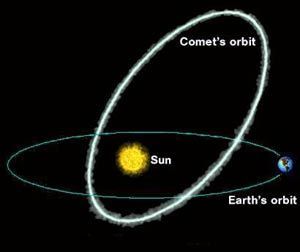
- Ain and elongaed eliptical orbit
20early astronomers thought the earth was at the centre (geocentric) of the solar system. With the sun, planets and moon orbiting around it.
- ATrue
- BFalse
21The [blank_start]geocentric[blank_end] method was first challenged by a polish [blank_start]monk[blank_end] called [blank_start]Copernicus[blank_end] who proposed the [blank_start]heliocentric[blank_end] system; with the sun at the centre; on the evidence of:
1) the retrograde (planets seeming to move backwards in the sky at times) motion of mars; and other planets.
2) the varying brightness of the planets when viewed in the night sky.
this was viewed badly by the [blank_start]church[blank_end]. When [blank_start]Galileo[blank_end] built a telescope and was able to observe moons orbiting Jupiter; he backed up [blank_start]Copernicus'[blank_end] ideas.- Amonk
- Bheliocentric
- Cgeocentric
- Dchurch
- Ecommunity
- FGalileo
- GCopernicus
- HCopernicus'
Information
- Description
- quiz on Force
- Author
- ailbhe17
- Language
- English
- Views
- 17
- Tags
- Rating
- No ratings yet Rate this quiz