
5660267
Description

Created by jlgale2016
|
|
Created by jlgale2016
over 10 years ago
|
|
Question 1
Question
A mixture is made up of lots of substances that are chemically joined together.
Answer
- True
- False
Question 2
Question
In a mixture, the substances [blank_start]are not[blank_end] chemically joined together, it [blank_start]is[blank_end] easy to separate, you [blank_start]can[blank_end] change the amounts of each substance and the substances in a mixture [blank_start]keep[blank_end] their own properties.
In a compound, the substances [blank_start]are[blank_end] chemically joined together, it [blank_start]is not[blank_end] easy to separate, you [blank_start]cannot[blank_end] change the amounts of each substance and the substances in a mixture [blank_start]do not keep[blank_end] their own properties.
Answer
-
are not
-
are
-
are
-
are not
-
is
-
is not
-
is not
-
is
-
can
-
cannot
-
cannot
-
can
-
keep
-
do not keep
-
do not keep
-
keep
Question 3
Question
How can you tell whether a substance is pure or impure?
Answer
-
Pure substances have sharp melting points.
-
Pure substances do not have sharp melting points.
-
Impure substances have sharp melting points.
-
Impure substances do not have sharp melting points.
Question 4
Question
A solution is a mixture of a liquid with a solid or a gas. The liquid is called is called the solvent. The solid or gas is called the solute.
Answer
- True
- False
Question 5
Question
In a coffee solution, the coffee beans dissolve into water. This makes the coffee beans the [blank_start]solute[blank_end] and the water the [blank_start]solvent[blank_end].
Answer
-
solute
-
solvent
Question 6
Question
Which of these is particles in a solid, which is particles in a liquid, and which is particles in a solution?
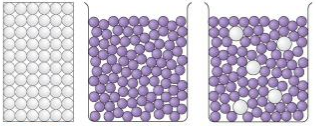
Answer
-
Solid
-
Liquid
-
Solution
-
Solid
-
Liquid
-
Solution
-
Solid
-
Liquid
-
Solution
Question 7
Question
When you dissolve sugar in water, eventually the water cannot dissolve any more sugar. At that point, the water is a [blank_start]saturated solution[blank_end].
Answer
-
saturated solution
Question 8
Question
If in 100g of water at 20 degrees Celsius, the solubility of sugar was 202 and the solubility of salt was 36, then the [blank_start]sugar[blank_end] is more soluble than the [blank_start]salt[blank_end] in 100g of water at 20 degrees Celsius.
Answer
-
sugar
-
salt
Want to create your own Quizzes for free with GoConqr? Learn more.