
Quiz
Geography Quiz Plate Tectonics GW2
This quiz has a time limit, so it opens in the usual player.
Questions in this quiz (30)
1Which of the following is true about a fold in geographical term.
May choose more than one.- AA fold is a bend
- BA syncline is a down fold
- CAn anticline is an up fold
- DFolding refers to the bending of rock layers
- EFolding is about force
2What causes folding to occur?
- ATensional force
- BCompressional force
3Where are fold mountains located?
- AThe Circum-Pacific belt in zones of colliding plates
- BThe Mediterranean-north Indian belt in zones of colliding plates
- CAlong the Atlantic Ocean
4Young fold mountain is [blank_start]higher[blank_end] with [blank_start]more[blank_end] jagged edges, peaks and [blank_start]less[blank_end] exposed to erosions. An example of young fold mountains is The Himalayas.
However, Old fold mountain is [blank_start]lower[blank_end], [blank_start]more[blank_end] rounded with [blank_start]fewer[blank_end] peaks/rounded tops and [blank_start]more[blank_end] exposed to erosion. An example is The Appalachians in North America and The Ural Mountains in Russia.- Amore
- Bless/fewer
- Cless
- Dmore
- Ehigher
- Flower
- Glower
- Hhigher
- Imore
- Jless
- Kfewer/lesser
- Lmore
- Mmore
- Nless
5What are the types of faults?
- ANormal
- BReverse
- CTransform
- DTransverse
- EAbnormal
6Faults are cracks and fractures
- ATrue
- BFalse
7[blank_start]Tensional force[blank_end] is [blank_start]exerted[blank_end] on the crust pulling the crust apart.
Tensional forces cause parts of the crust to be [blank_start]fractured[blank_end], forming [blank_start]fault lines.[blank_end]
The central block [blank_start]subsides[blank_end] between two faults. The [blank_start]depression[blank_end] created subsiding central block known as [blank_start]rift valley[blank_end]- ATensional force
- Bexerted
- Cfractured
- Dfault lines
- Esubsides
- Fdepression
- Grift valley
8The diagram below shows a structure of a volcano. Fill in the missing field. Any spelling or phrasing mistakes may lead to deduction of marks. It is followed by the notes given in our file @ Study group 1.0 members only.
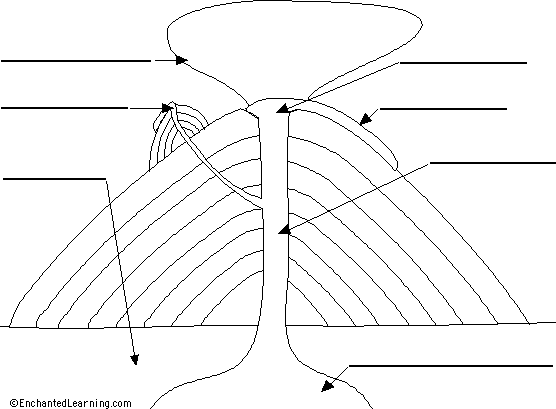
- AAsh cloud
- BCrust
- CMagma Chamber
- DMain pipe
- ELava flow
- FSecondary cone
- GSecondary pipe
- HCrater
- IVent
- JLayers of ash, lava and cinders
9What is a Volcano?
[blank_start]Landform[blank_end] that is formed when [blank_start]magma[blank_end] is [blank_start]ejected[blank_end] from the [blank_start]mantle[blank_end] onto the Earth’s surface- ALandform
- BPhenomena
- Cmagma
- Dlava
- EPyroclastic materials
- Fejected
- Greleased
- Hmantle
- Icore
10What is a crater?
A [blank_start]bowl-shaped[blank_end] depression at the [blank_start]top[blank_end] of the volcano where volcanic materials like Ash, lava and other [blank_start]pyroclastic materials[blank_end] are released- Abowl-shaped
- Btop
- Cpyroclastic materials
11At the [blank_start]convergent[blank_end] plate boundaries where 2 plates meet, the [blank_start]thinner[blank_end] and [blank_start]denser[blank_end] [blank_start]oceanic[blank_end] plate [blank_start]subducts[blank_end] beneath the [blank_start]lighter[blank_end] [blank_start]continental[blank_end] plate.
The subducted plate melts to form [blank_start]magma[blank_end].
Magma contains [blank_start]gases[blank_end] such as carbon dioxide and sulfur dioxide.
[blank_start]Pressure[blank_end] builds up the magma rises through [blank_start]cracks and fractures[blank_end] on the [blank_start]lithosphere[blank_end].
Lava (and other pyroclastic materials) [blank_start]cools[blank_end] and hardens around the [blank_start]vent[blank_end] to build up a conical-shaped or dome-shaped volcano.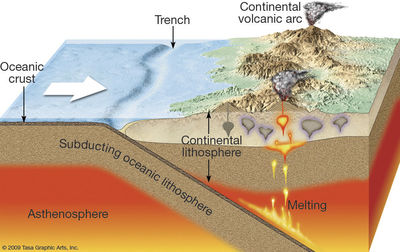
- Aconvergent
- Bthinner
- Cdenser
- Doceanic
- Esubducts
- Flighter
- Gcontinental
- Hgases
- Imagma
- JPressure
- Kcracks and fractures
- Llithosphere
- Mvent
- Ncools
12High viscosity (sticky):
1) [blank_start]Acidic[blank_end]
2) [blank_start]High[blank_end] silica content
3) [blank_start]800[blank_end] degrees celsius - cools and solidifies [blank_start]quickly[blank_end]
4) Flow [blank_start]slowly[blank_end]
5) Spread over [blank_start]small[blank_end] areas
6) Gas is trapped and pressure is built up
7) [blank_start]Loud & violent[blank_end] explosions which produce [blank_start]steep-sided[blank_end] volcano
Low Viscosity (Fluid):
1) [blank_start]Basic[blank_end]
2) [blank_start]Low[blank_end] silica content
3) [blank_start]1200[blank_end] degrees celsius - Cools and solidifies [blank_start]slowly[blank_end]
4) Flow more [blank_start]rapidly[blank_end]
5) Spread over [blank_start]bigger[blank_end] areas
6) Allow air to escape
7) [blank_start]Quiet[blank_end] eruption which produce [blank_start]gently-sloping[blank_end] volcano- AAcidic
- BBasic
- CHigh
- DLow
- E800
- F1200
- Gquickly
- Hslowly
- Islowly
- Jquickly
- Ksmall
- Lbig
- MLoud & violent
- NQuiet
- Osteep-sided
- Pgently-sloping
- QBasic
- RAcidic
- SLow
- THigh
- U1200
- V800
- Wslowly
- Xquickly
- Yrapidly
- Zslowly
- AAbigger
- ABsmaller
- ACQuiet
- ADLoud & violent
- AEgently-sloping
- AFsteep-sided
13Which of the following is a risk of living near volcano
- ADestruction from volcanic materials
- BAir pollution
- CChange in climate
- DFertile land
- ELost of lives
- FDestruction of habitats
- GWaste pollution
- HWater pollution
14If a volcano is considered dormant, it would never erupt again
- ATrue
- BFalse
15If a volcano is considered extinct, it will not erupt again.
- ATrue
- BFalse
16Where do earthquakes occur?
- ADivergent plate boundary
- BConvergent plate boundary
- CTransform plate boundary
- DAll of the above/below
17Which of the following is true about earthquakes distribution?
- AMost of the earthquakes occur at the circum-pacific belt of convergence
- BIt occurs at the Meditterranean North Indian belt
- CIt occurs in the mid-Atlantic ridges
- DIt can occur in hot spots
18[blank_start]Rocks[blank_end] on each side of the fault are forced to move, but the movement is [blank_start]not smooth[blank_end]
The rocks at the fault are “[blank_start]locked[blank_end]” together
Because rocks are [blank_start]locked[blank_end] together, they [blank_start]bend[blank_end] and [blank_start]store[blank_end] energy like a coiled spring
This cause [blank_start]stress[blank_end] to the rocks.
The [blank_start]stress[blank_end] in the rocks becomes so great that it finally causes the rocks to [blank_start]break free[blank_end] into [blank_start]new[blank_end] positions along the fault.
This results in the release of the [blank_start]stored[blank_end] energy in the form of [blank_start]seismic waves[blank_end] which makes the ground [blank_start]vibrate[blank_end]- ARocks
- Blocked
- Cnot smooth
- Dstress
- Elocked
- Fbend
- Gstore
- Hstress
- Istored
- Jbreak free
- Knew
- Lvibrate
- Mseismic waves
19The following are the terms of earthquakes:
1) [blank_start]Focus[blank_end] is a place where Earthquake Begins
2) [blank_start]Epicentre[blank_end] is a point directly above the focus on the earth’s surface
3) Seismic waves are waves of energy that [blank_start]travels[blank_end] through the earth which cause the ground to vibrate
4) [blank_start]Foreshocks[blank_end] are energy release before the mainshock
5) [blank_start]Aftershock[blank_end] is usually a smaller earthquake that follows the main shock of a large earthquake- AFocus
- BEpicentre
- CEpicentre
- DFocus
- Etravels
- Fpasses
- GForeshocks
- HAftershocks
- IMainshocks
- JAftershock
- KMainshock
- LForeshock
20A siesmometer is used to measure earthquakes
- ATrue
- BFalse
21Magnitude of the earthquake is represented in a ricther scale
- ATrue
- BFalse
22The smaller the magnitude, the lesser death there are in an earthquake
- ATrue
- BFalse
23[blank_start]Earthquake[blank_end] takes place under the sea
[blank_start]Seabed[blank_end] is displaced by the earthquake
[blank_start]Seismic energy[blank_end] from an undersea earthquake [blank_start]forces[blank_end] out a mass of seawater resulting in [blank_start]large volume of water[blank_end] being lifted
In the deep ocean, tsunami waves may travel at the speed of [blank_start]800[blank_end] km/h. It has [blank_start]long[blank_end] wave length but [blank_start]short[blank_end] wave height.
As it approaches the shore, it is slowed and water behind catches up.
Wave height increase dramatically
When it hits the shore, the tsunami waves could be traveling [blank_start]30-50[blank_end] km/h and may reach heights of around 15 m.- AEarthquake
- BSeabed
- CSeismic energy
- Dforces
- Elarge volume of water
- Fsmall volume of water
- G800
- H80
- Ilong
- Jshort
- K30-50
- L300-500
24Which of the following is a hazard of living near earthquake zone?
- Alost of life
- Btsunami
- CDestruction to infrastructure
- DLandslides
25What is the main reason people still wants to live near earthquakes zone
- AThey are confident that it would not happen
- BCannot afford to move
- CStay there to watch earthquakes
26What do not affects the extent of damage in an earthquakes
- ATime of occurrence
- BWhere it happens
- CType of soil
- DPreparedness
- EDeep or shallow focus
- FTypes of waves
- GEconomic development
- HDistance from the sea
27The shallower the earthquake the lesser the damage it has
- ATrue
- BFalse
28The extent of damage may depend on the type of waves
- ATrue
- BFalse
29Bonus: How many types of earthquakes waves are there?
- A1
- B2
- C3
- D4
30Bonus: What are the main cause(s) that result in the large number of deaths during the 1995 Great Hanshin earthquake?
- AIt triggers a tsunami
- BIt happens in early morning where many were still asleep, some were already cooking
- CTheir emergency preparedness was low
- DIt was partially from reclaimed land which results in liquefaction
- EIt was very near the epicentre
- FThere was high population density
- G18000 homes were blown off/destructed
Information
- Description
- The following quiz will only be set on the relevant topics
- Author
- Koh Swee Hong
- Language
- English
- Views
- 9
- Tags
- Rating
- No ratings yet Rate this quiz