
Quiz
1 FLIG. PER. EXAM PREP
Questions in this quiz (25)
11 Which speed gives the greatest altitude gain in a given horizontal distance during climb after take off?
- AO 'Vx
- BO 'VA.
- CO 'Vy.
- DO None of the above.
22 Which speed gives the greatest altitude gain in a given time during climb after take off?
- AO 'VY.
- BO 'VA.
- CO VX.
- DO None of the above.
33 In case of an engine failure the longest gliding distance can be achieved:
- AO When L/D ratio is maximum
- BO If we extend one notch of flaps.
- CO When L/D ratio is minimum.
- DO When we fly at a speed just above the stalling speed.
44 In case of an engine failure, of aeroplanes of the same type, which aeroplane will achieve the greatest gliding distance?
- AO Gliding distance does not depend on weight.
- BO The heavier aeroplane
- CO The lighter aeroplane.
55 What is absolute ceiling?
- AO The density altitude at which the rate of climb equals to zero.
- BO The maximum altitude at which an aeroplane can execute a given flight.]
- CO The altitude at which the maximum rate of climb becomes less than 100ft/min.
- DO The altitude above which the aeroplane stalls.
66 What is service ceiling?
- AO The density altitude at which the maximum rate of climb becomes less than 100ft/min.
- BO The altitude at which the rate of climb becomes equal to zero.
- CO The maximum altitude at which an aeroplane can execute a given flight.
- DO The altitude above which the aeroplane stalls.
77 Which speed is V2?
- AO The minimum safe climb out speed with one engine inoperative.
- BO The speed at which the aeroplane requires the minimum power for straight and level flight.
- CO the minimum stalling speed.
- DO The speed at which the aeroplane requires the maximum power for straight and level flight.
88 The rate of climb of an aircraft depends on:
- AO Both b and c are correct.
- BO the excess thrust.
- CO the weight.
- DO the angle of climb.
99 The best gliding angle in the event of an engine failure depends on:
- AO The aerodynamic characteristics of the aeroplane.
- BO The air density.
- CO The aircraft weight.
1010 Which speed is V1?
- AO The decision speed during take off.
- BO The speed at which L/D ratio is maximum.
- CO The speed at which L/D ratio is equal to zero.]
- DO None of the above.
1111 In order for a propeller driven aircraft to achieve maximum range it should be flown at a speed:
- AO which gives the max L/D ratio.
- BO equal to V2.
- CO slightly higher than stalling speed.
- DO equal to V1.
1212 In order for a propeller driven aircraft to achieve maximum endurance it should be flown at a speed:
- AO slightly higher than stalling speed.
- BO equal to V2.
- CO equal to V1.
- DO slightly higher than stalling speed and equal to V1, both are correct.
1313 The theoretical range of a propeller driven aircraft
- AO does not depend on the altitude
- BO increases at higher altitudes.
- CO decreases at higher altitudes.
- DO none of the above.
1414 The theoretical endurance of a propeller driven aircraft
- AO decreases at higher altitudes.
- BO increases at higher altitudes.
- CO does not depend on the altitude.
- DO none of the above.
1515 When take off weight increases:
- AO the required runway length for take off increases.
- BO the required runway length for take off decreases.
- CO the required runway length for take off is not affected.
1616 When aircraft weight increases what adjustment is required to the approach speed?
- AO An increase.
- BO A decrease.
- CO Approach speed remains the same.
1717 How does a high pressure altitude affect aircraft performance.
- AO It decreases the rate of climb.
- BO It improves piston engine performance.
- CO It decreases the required runway length for take off.
- DO It increases lift because thinner air creates less drag.
1818 Which factor increases the density altitude of an airport?
- AO An increase in temperature.
- BO An increase in barometric pressure.
- CO A decrease in relative humidity.
- DO A decrease in temperature.
1919 Why do we need to know the density altitude?
- AO In order to calculate aircraft performance.
- BO In order to calculate the pressure altitude.
- CO In order to calculate the flight level when the aircraft flies at a high altitude.
- DO in order to have safe altimeter readings over mountainous areas.]
2020 How will the density altitude change by an increase in temperature from -4C to +10C if the pressure altitude remains the same.(Fig. FPP01)
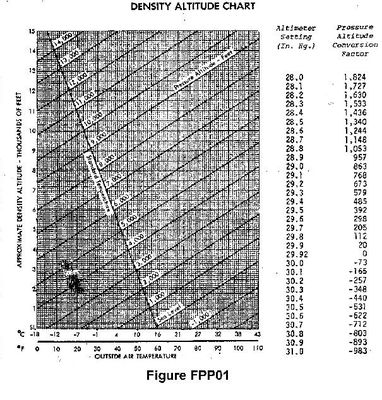
- AO It will increase by 1.650 ft.]
- BO it will increase by 1.400 ft.]
- CO It will increase by 1.200 ft.]
- DO It will decrease by 1.000 ft.]
2121 What will the density altitude be if the airport elevation is 5.250 ft ,temperature 27C and altimeter setting 29.25 inHg? (Fig FPP01)
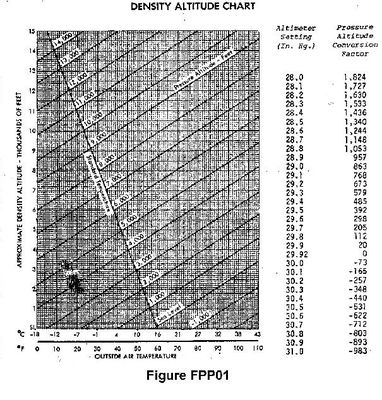
- AO '8.500 ft.
- BO '5.850 ft.
- CO '4.900 ft.
- DO '7.700 ft.
2222 How does high relative humidity affect aircraft performance?]
- AO It decreases performance.
- BO It improves performance.
- CO Changes in relative humidity do not affect aircraft performance.]
- DO It decreases performance at low altitudes and improves performance at high altitudes.
2323 Which of the following factors causes the greater increase in density altitude?
- AO An increase in outside air temperature (OAT)?
- BO An increase in barometric pressure?
- CO A decrease in relative humidity?
- DO An increase in wind speed.
2424 Which combination atmospheric conditions causes the greater decrease in aircraft performance during take off and landing?]
- AO High temperature,high relative humidity,high pressure altitude.
- BO Low temperature low relative humidity, low pressure altitud
- CO High temperature ,high relative humidity, low pressure altitude.
- DO Low temperature.high relative humidity,high pressure altitude.
2525 How does high density altitude affect propeller efficiency?
- AO It decreases propeller efficiency.]
- BO It improves propeller efficiency.
- CO It does not affect propeller efficiency.
Information
- Description
- 1 FLIG. PER. EXAM PREP
- Author
- tsampikos pompou
- Language
- English
- Views
- 856
- Tags
- Rating
- 5.0 out of 5 · 2 ratings Rate this quiz