
Quiz
Untitled
This quiz has question types that open in the usual player.
Questions in this quiz (32)
1Which metal is the best conductor?
- AIron
- BCopper
- CBrass
2Which metal is the worst conductor?
- AIron
- BBrass
- CCopper
3There are three ways that heat energy is transferred: [blank_start]conduction[blank_end] , [blank_start]convection[blank_end] and [blank_start]radiation[blank_end] .
- Aradiation
- Bconvection
- Cconduction
4Conduction is the [blank_start]heat transfer in solids[blank_end] caused by [blank_start]vibrating[blank_end] and [blank_start]passing energy[blank_end] from one to the next. Metals also have ' [blank_start]free electrons[blank_end] ' that [blank_start]diffuse[blank_end] through the structure carrying [blank_start]heat[blank_end] with them. Bad conductors are called [blank_start]insulators[blank_end] (they usually contain air because the particles are [blank_start]far apart[blank_end] )
- Aheat transfer in solids
- Bvibrating
- Cpassing energy
- Dfree electrons
- Ediffuse
- Fheat
- Ginsulators
- Hfar apart
5Convection happens in f[blank_start]luids[blank_end], [blank_start]liquids[blank_end] or [blank_start]gas[blank_end]. When they are heated the [blank_start]hot fluid expands[blank_end] - it does not change [blank_start]weight[blank_end], so effectively becomes lighter, [blank_start]less dense[blank_end] .
- Aluids
- Bliquids
- Cgas
- Dhot fluid expands
- Eless dense
- Fweight
6In both conduction and convection [blank_start]particles[blank_end] are needed so they do not happen in [blank_start]space[blank_end] because it is a [blank_start]vacuum[blank_end].
- Avacuum
- Bspace
- Cparticles
7Label this diagram of convection -
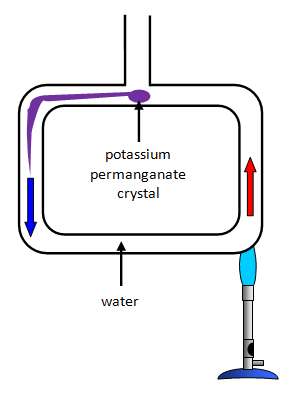
- ACool, more dense, sinks
- BHot, less dense, rises
8Black [blank_start]absorbs[blank_end] well
Silver [blank_start]radiates[blank_end] well- Aabsorbs
- Bradiates
9Radiation is an [blank_start]energy wave[blank_end], also called ' [blank_start]infra red[blank_end] '. It is a set wave length in the [blank_start]electromagnetic spectrum[blank_end] which also contains [blank_start]UV[blank_end], r[blank_start]adio[blank_end], [blank_start]microwaves[blank_end], [blank_start]light[blank_end], x and g[blank_start]amma[blank_end].
Anything [blank_start]hotter[blank_end] than its surroundings [blank_start]radiates[blank_end] - [blank_start]black[blank_end] radiates better than white, which [blank_start]reflects[blank_end].- Aenergy wave
- Binfra red
- Celectromagnetic spectrum
- DUV
- Eadio
- Fmicrowaves
- Glight
- Hamma
- Ihotter
- Jradiates
- Kblack
- Lreflects
10Use efficiency = [blank_start]total input[blank_end] / [blank_start]useful energy[blank_end]
- Auseful energy
- Btotal input
11Heating a substance involves t[blank_start]ransferring[blank_end] e[blank_start]nergy[blank_end] after all heat is a form of energy. Specific heat capacity is the [blank_start]amount of energy[blank_end] required to [blank_start]raise the temperature[blank_end] of 1Kg of the substance to 1 degree Celsius.
- Aransferring
- Bnergy
- Camount of energy
- Draise the temperature
12The greater [blank_start]mass of the substance[blank_end], the great amount of [blank_start]energy[blank_end] needed to raise the temperature
- Amass of the substance
- Benergy
13E = [blank_start]Mass[blank_end] x [blank_start]SHC[blank_end] x [blank_start]Temp[blank_end]
- ATemp
- BSHC
- CMass
14[blank_start]Weight[blank_end] is a force caused by gravity and is measured in [blank_start]newtons[blank_end].
- Anewtons
- BWeight
15Weight on earth is [blank_start]10[blank_end].
- A10
16Mass is amount of [blank_start]matter or molecules[blank_end] in an object, measured [blank_start]Kg[blank_end].
- Amatter or molecules
- BKg
17weight = [blank_start]mass[blank_end] x [blank_start]gravity[blank_end]
- Amass
- Bgravity
18Energy is measured in [blank_start]joules[blank_end]
- Ajoules
19Energy needed = [blank_start]weight[blank_end] or [blank_start]force[blank_end] x [blank_start]distance[blank_end]
- Adistance
- Bweight
- Cforce
20Potenial energy = [blank_start]mass[blank_end] (kg) x [blank_start]gravity[blank_end] (10) x [blank_start]height[blank_end] (m)
- Amass
- Bgravity
- Cheight
21Potential energy = [blank_start]weight[blank_end] x [blank_start]distance[blank_end]
- Adistance
- Bweight
22Kinetic energy = 1/2 x [blank_start]mass[blank_end] x [blank_start]velocity[blank_end]([blank_start]2[blank_end])
- Amass
- Bvelocity
- C2
23PE = [blank_start]KE[blank_end]
[blank_start]m[blank_end] x g x h = [blank_start]0.5[blank_end] x m x v(2)- AKE
- Bm
- C0.5
24Power = e[blank_start]nergy[blank_end] / [blank_start]time[blank_end]
- Atime
- Bnergy
25Hydroelectricity is the process of [blank_start]damns blocking a river[blank_end] to make a reservoir or collecting water that is pumped there and when the water is released the pressure from behind the damn forces [blank_start]water down pipes[blank_end] which then leads to a [blank_start]turbine[blank_end].
Advantage - no [blank_start]pollution[blank_end] , states don't need to be reliant on [blank_start]international fuel sources[blank_end]
Disadvantage - harm to [blank_start]habitats[blank_end] and fish being unable to [blank_start]migrate upstream[blank_end] , water [blank_start]droughts[blank_end]- Adamns blocking a river
- Bwater down pipes
- Cturbine
- Dpollution
- Einternational fuel sources
- Fhabitats
- Gmigrate upstream
- Hdroughts
26Nuclear power stations use the same process as fossil fuel power stations. The fuel produces [blank_start]heat[blank_end] and heat is then used to [blank_start]boil water[blank_end] and [blank_start]turn into steam[blank_end]. The steam is then used to [blank_start]power a turbine[blank_end], which turns to generate and [blank_start]make electricity[blank_end].
Advantages - produces huge amounts from small amounts of fuel, does not contribute to the treehouse effect, small amount of [blank_start]waste[blank_end]
Disadvantages - can be dangerous and has to be sealed up for thousands of years to allow [blank_start]radioactivity to die[blank_end] away, [blank_start]nuclear[blank_end] accidents can be major disasters- Aheat
- Bboil water
- Cturn into steam
- Dpower a turbine
- Emake electricity
- Fwaste
- Gradioactivity to die
- Hnuclear
27Wind power is where the [blank_start]wind blows a propellor[blank_end] around which turns a generator and produces electricity.
Advantages - wind is [blank_start]free[blank_end], need [blank_start]no fuel[blank_end], land can still be [blank_start]used for farming[blank_end]
Disadvantages - wind is [blank_start]not predictable[blank_end], suitable areas (the coast) are [blank_start]often expensive[blank_end]- Awind blows a propellor
- Bfree
- Cno fuel
- Dused for farming
- Eoften expensive
- Fnot predictable
28Solar energy is the conversion of [blank_start]sunlight into electricity[blank_end] either using [blank_start]PV[blank_end] or indirectly using c[blank_start]oncentrated[blank_end] s[blank_start]olar[blank_end] p[blank_start]ower[blank_end]. Concentrated solar power systems use [blank_start]lenses or mirrors[blank_end] and tracking systems to focus a [blank_start]large area[blank_end] of sunlight into a small beam.
Advantages - r[blank_start]enewable[blank_end], no [blank_start]fuel costs[blank_end], no p[blank_start]ollution[blank_end]
Disadvantages - expensive and [blank_start]inefficient[blank_end] , may need a [blank_start]conventional boiler[blank_end] , does not work at [blank_start]night[blank_end]- Asunlight into electricity
- BPV
- Concentrated
- Dolar
- Eower
- Flenses or mirrors
- Glarge area
- Henewable
- Ifuel costs
- Jollution
- Kinefficient
- Lconventional boiler
- Mnight
29forces can change the s[blank_start]hape[blank_end], s[blank_start]peed[blank_end] and [blank_start]direction[blank_end] of an object
- Ahape
- Bpeed
- Cdirection
30Ribosome - make [blank_start]protein[blank_end] for the cell
- Aprotein
31Mitochondria - [blank_start]respiration[blank_end] happens here to [blank_start]release energy[blank_end] from food molecules
Cytoplasm - [blank_start]chemical reactions[blank_end] happen here that [blank_start]keep the cell alive[blank_end]
Nucleus - [blank_start]controls what the cell does[blank_end] and contains [blank_start]instructions[blank_end] to make a [blank_start]new[blank_end] cell
Cell membrane - gives cell its [blank_start]shape[blank_end] and controls what [blank_start]goes in and out[blank_end]- Arespiration
- Brelease energy
- Cchemical reactions
- Dkeep the cell alive
- Econtrols what the cell does
- Finstructions
- Gnew
- Hshape
- Igoes in and out
32Plant Cells:
Cytoplasm - [blank_start]controls starch grains[blank_end]
Chloroplasts - carry out [blank_start]photosynthesis[blank_end], contain [blank_start]chlorophyll[blank_end] to trap [blank_start]light energy[blank_end]
Vacuole - has a large permanent vacuole filled with liquid called [blank_start]cell sap[blank_end]
Cell wall - covers thin. [blank_start]cell membrane[blank_end], made of tough [blank_start]cellulose[blank_end] which [blank_start]toughens[blank_end] the cell- Acontrols starch grains
- Bphotosynthesis
- Cchlorophyll
- Dlight energy
- Ecell sap
- Fcell membrane
- Gcellulose
- Htoughens
Information
- Description
- Physics Quiz on Untitled, created by romia manley on 08/01/2017.
- Author
- romia manley
- Language
- English
- Views
- 0
- Tags
- Rating
- No ratings yet Rate this quiz