
Quiz
AS101 Final
Create a free account to finish this quiz
Save your progress and see your final score.
Already have an account? Sign in
Questions in this quiz (52)
1Which one of the following statements best describes the Sun?
- Agenerates energy by nuclear fusion
- Blocated 10 AU from earth
- Corbiting the Solar System
- Dlocated in the centre of the Milky Way
2Which of the following sequences objects is in the correct order of decreasing distance
- AMoon, Venus, Saturn, Polaris, Andromeda galaxy
- BVenus, Saturn, Moon, Andromeda galaxy, Polaris
- CPolaris, Andromeda galaxy, Moon, Saturn, Venus
- DAndromeda galaxy, Saturn, Venus, Polaris, Moon
3The nearest star to our solar system is alpha Centauri at 4.0x10^16 m (4.3 ly away). The diameter if the sun is 1.4x10^9 m. How many suns would it take to line up adjacent to each other in order to reach alpha Centauri?
- A2.8x10^7
- B5.6x10^6
- C2.8x10^25
4There approximately 100 billion stars in our galaxy. If there 100 billion observable galaxies in our universe, what is a reasonable estimate for the total number ion the universe?
- A1.0X10^22
- B2.0x10^20
- C1.5x10^15
- D1.0x10^24
5The distance to a super cluster galaxy might be
- A100 Mpc
- B10 Kpc
- C120 ly
- D10 AU
6Approximately 100 Earths would fit inside Jupiter. This Jupiter’s radius must be __________ times larger that Earth’s radius
- A100
- B12
- C10
- D1000
7A spherical particle in the ring of Saturn has radius of about 1m. The surface area of the particle in the area of radiation flow is
- A125 m^2
- B3.14 ^2
- C12.6 m^2
- D14 m^2
8If the landing lights in Denver airport were switched on, then in one second these photons travel to:
- ANew York (1580 km)
- BAlpha Centauri (40,000,000,000 000 km)
- CThe Sun(150,000,000 km)
- DMoon (384,000 km)
9Sirius the brightest star in the sky is about 9 ly away. If the speed of light became half of its present value, how far would Sirius be?
- A9 ly
- B18 ly
- C4.5 ly
- D32 ly
10The Andromeda galaxy is about 2,000,000 ly away. Therefore light started its travel
- A1,000,000 y
- B2,000,000 y
- CJust a second ago
- DCan’t be determined
11In the diagram, what is the diameter of Mercury?
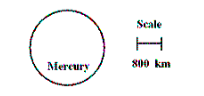
- Aabout 240 km
- Babout 2400 km
- Cabout 24,000 km
- Dabout 240,000 km
12What is 5.7×10⁷ the same as?
- A5.7 million
- B57 thousand
- C570 thousand
- D57 million
13If the distance from the Sun to the Earth is represented by roughly 15 metres, then what would the distance from the Earth to the Moon on the same scale be?
- Aabout 30 metres
- Babout 10 metres
- Cabout 1 metre
- Dsmaller than the width of your hand
14Approximately how many times larger than the diameter of a typical planet (the Earth) is the diameter of a typical star (the Sun)?
- A10 times
- B100 times
- C1000 times
- D10,000 times
15What does the Solar System contain?
- Athe Sun, its planets, and some smaller bodies
- Bthe Sun, galaxies, planets, and stars
- Cthe Sun, planets, moons, and stars
- Dthe Sun, planets, asteroids, and galaxies
16What is the approximate diameter of the Earth?
- A1 AU
- B13,000 light-years
- C13,000 kilometres
- D1,000,000 kilometres
17Which of the following is no longer considered a major planet?
- AMercury
- BUranus
- CPluto
- DSaturn
18Today the age of the universe is estimated in 13,700,000,000 years
- A1.37x10^6 y
- B1.37x10^7 y
- C1.37x10^8 y
- D1.37x10^9 y
19Which statement best describes the Milky Way Galaxy?
- AIt is a spiral galaxy
- BIt is comprised of several smaller galaxies
- CIt is about 1,000 light-years in diameter
- DIt is type of supercluster
20What is the implication if the distance to the nearest star is 4.2 light-years?
- AThe star is 4.2 million AU away
- BThe light we see left the star 4.2 years ago
- CThe star must be very old
- DThe star must be very young
21If we say that an object is 1,000 light-years away, how does that affect how we see it?
- AWe see it as it looked 1,000 years ago
- BWe see it as it would appear to our ancestors 1,000 years ago
- CWe see it as it looked 1,000 light-years ago
- DWe see it as it is right now, but it appears 1,000 times dimmer
22What is the average distance from Earth to the Sun?
- A1 ly
- B1 AU
- C1 million km
- D1 billion km
23How is a planet different from a star?
- APlanets are larger than stars.
- BPlanets reflect light, while stars produce their own light.
- CStars move faster in the sky than planets.
- DPlanets are brighter than stars.
24
Which of the following is the smallest?- Asize of a typical planet
- B1 AU
- C1 light-year
- Dsize of a typical galaxy
25In the diagram, what is the diameter of Jupiter?
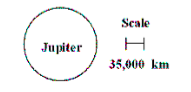
- Aabout 7.0 × 10^4 km
- Babout 7.0 × 10^5 km
- Cabout 1.4 × 10^4 km
- Dabout 1.4 × 10^5 km
26It takes light 1.3 seconds to travel from the Moon to Earth and 8 minutes for light to travel from the Sun to Earth. Which of the following statements is true?
- AThe Sun is 6.2 times farther from Earth than the Moon
- BThe Sun is 10 times farther from Earth than the Moon
- CThe Sun is 370 times farther from Earth than the Moon
- DThe Sun is 0.10 times farther from Earth than the Moon
27How long does it take for light to travel from the Sun to Neptune?
- Aseveral seconds
- Bseveral minutes
- Cseveral hours
- Dseveral weeks
28The speed of light is 3.0×10⁵ km/s, and it takes 1.3 seconds for light to travel from the Moon to Earth. Based on this information, what is the distance from the Earth to the Moon?
- A390,000 km
- B230,000 km
- C3.9 km
- D2.3 km
29Which of the following definitions best describes a constellation?
- Aa group of very bright stars
- Bthe dividing line between the north and south celestial hemispheres
- Ca region of the sky containing a certain star pattern
- Da group of very faint stars
30Which of the following best describes the Big Dipper?
- Aa faint star near Polaris
- Ba constellation
- Can asterism
- Dthe North Star
31What do stars in the same constellation have in common?
- AThey must have been discovered at about the same time.
- BThey are in the same part of the sky as seen from the Earth.
- CThey probably formed at the same time
- DThey must be part of the same cluster of stars in space.
32Which of the following best describes Ursa Major (the Great Bear)?
- Aan asterism
- Ba constellation
- Canother name for the Big Dipper
- Danother name for the Seven Sisters
33Which of the following statements correctly describes the relationship between stars and constellations?
- AOnly the brighter stars are in constellations.
- BOnly stars close to the ecliptic (the Earth's orbital plane) are located in constellations.
- COnly those stars that were visible to the ancient Greeks are located in constellations.
- DEvery star is located in a constellation.
34If the apparent visual magnitude of a star is 7.3, what does this tell us about the brightness of the star?
- AIt is bright enough that it would be visible even during the day.
- BIt is not visible with the unaided eye.
- CIt is one of the brighter stars in the sky.
- DIt appears faint because of its great distance from the Earth.
35Which of the following describes the magnitude scale?
- AIt can be used to indicate the apparent intensity of a celestial object.
- BIt was used to determine the rate of precession.
- CIt originated just after the telescope was invented.
- DIt is no longer used today.
36If the apparent visual magnitude of star A is 3.1, and the apparent visual magnitude of star B is 0.5, how do star A and star B compare in terms of apparent brightness as seen from Earth?
- AStar A is only slightly brighter than star B.
- BStar A is much brighter than star B.
- CStar A is fainter than star B.
- DStar A is about the same brightness as star B.
37Which star in the table would be invisible to the unaided eye of an observer on Earth?
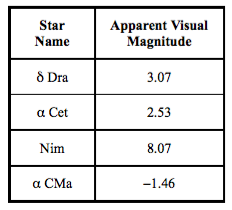
- Aδ Dra
- Bα CMa
- CNim
- Dα Cet
38What aspect of an object depends on both the size of the object and the distance to the object?
- Aangular diameter
- Bapparent magnitude
- Cproper motion
- Dapparent brightness
39What is the term for the point on the celestial sphere directly above an observer, no matter where on the Earth the observer is located?
- Asouth celestial pole
- Bnorth celestial pole
- Cnadir
- Dzenith
40
Where is the zenith for an observer standing at a point on the Earth’s equator?- Anear the horizon and towards the south
- Bnear the horizon and towards the west
- Cthe position depends on the time of day
- Ddirectly overhead
41An observer in the northern hemisphere watches the sky for several hours. Due to the motion of the Earth, this observer notices that the stars near the north celestial pole appear to move. What pattern does this apparent movement follow?
- Afrom right to left
- Bfrom left to right
- Ccounter-clockwise around the celestial pole
- Dclockwise around the celestial pole
42The Moon has an angular diameter of 0.5°. What is the Moon's angular diameter in minutes of arc?
- A0.5
- B1800
- C50
- D30
43You point your finger toward the zenith right now, and then point there again six hours later. At both times, your finger was pointing in the same direction relative to one of the options below. Which one?
- Ayour horizon
- Bthe Sun
- Cthe ecliptic
- Dthe north celestial pole
44For an observer in Valdivia, Chile, at a latitude of 39° South, what is the angle between the southern horizon and the south celestial pole?
- A39°
- B51°
- C23.5°
- D45°
45For an observer in Waterloo, at a latitude of 43° North, what is the angle between the northern horizon and the north celestial pole?
- A36°
- B23.5°
- C74°
- D43°
46What languages do the standard constellation names come from?
- AGreek and Latin
- BGreek and Arabic
- CArabic and Sanskrit
- DLatin and Arabic
47What causes the precession of the Earth’s rotation axis?
- Athe impacts of asteroids
- Bthe force of gravity from the Sun and Jupiter on the Earth–Moon system
- Cthe magnetic field of the Earth
- Dthe force of gravity from the Sun and Moon on the Earth's equatorial bulge
48A star is on the north point of the horizon. Where will the star be in 6 and 12 hours later
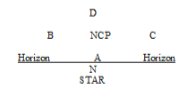
- AA
- BB
- CC
- DD
49The Earth revolves in a counter clockwise direction around the sun at about 1 deg/day (360 deg and 365 days). Then this motion makes the sun to appear moving
- A15 deg per day eastward
- B1 deg per day eastward
- Cnot at all-the sun does not appear to move
- D1 deg per day westward
- E15 deg per day westward
50Which of the following diagrams represent the area of the sky where an ancient Greek astronomer could observe the planets? (Ancient Greeks knew the 5 planets, in fact the word planet comes from the Greek word “planetes” = wanderer.)
- A
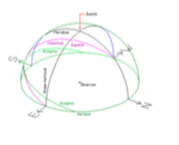
- B
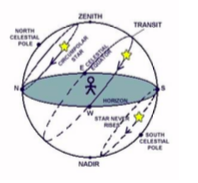
- C
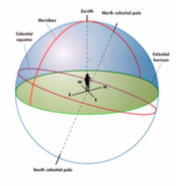
- A
51A person in Nashville , TN observes Venus in the western part of the horizon. Six hours later Venus will be
- Ahigh in the south
- Blow in the south
- Cnearly overhead
- Dnot visible
52A person in Denver Colorado observes Jupiter in the eastern horizon right after the sunset. Where would the planet be after six hours?
- Alow in the south
- Blow in the west
- Cnearly overhead
- Dhigh in the south
- Enot visible
Information
- Description
- Astronomy Quiz on AS101 Final, created by Jennifer Rayner on 08/04/2017.
- Author
- Jennifer Rayner
- Language
- English
- Views
- 92
- Tags
- Rating
- 5.0 out of 5 · 1 rating Rate this quiz