
9287170
Description

Quiz by Ella Middlemiss, updated more than 1 year ago

|
Created by Ella Middlemiss
over 8 years ago
|
|
Question 1
Question
When someone is infected by a disease-causing organism, several mechanisms in their body act to destroy the invading pathogen. This task is performed by the immune system and is known as the immune response. [blank_start]Non-specific[blank_end] responses help to destroy any invading pathogen, whereas [blank_start]specific[blank_end] immunity is always directed at a specific pathogen.
Answer
-
Non-specific
-
Specific
-
specific
-
Non-specific
Question 2
Question
A stream of tears helps to wash out foreign materials and attacks any [blank_start]bacteria[blank_end] on the surface of the eye. Tears contain an enzyme called [blank_start]lysosyme[blank_end] that kills bacteria by breaking down their [blank_start]cell walls[blank_end]. The same enzyme is found in saliva and nasal secretions, protecting the body from harmful bacteria in the air we breathe or the food we eat.
Answer
-
bacteria
-
lysosyme
-
cell walls
Question 3
Question
An injury, cut or graze enables [blank_start]microbes[blank_end] and other foreign material to enter the body. A [blank_start]blood clot[blank_end] will rapidly seal the wound. But inflammation at the site, known as the inflammatory [blank_start]response[blank_end], helps to destroy invading microbes. Damaged white blood cells and [blank_start]mast cells[blank_end], found in the connective tissue below the skin and around blood vessels, release special chemicals, such as [blank_start]histamine[blank_end]. These chemicals cause the arterioles in the area to [blank_start]dilute[blank_end], increasing blood [blank_start]flow[blank_end] in the capillaries at the infected site. Histamines also increase the permeability of the [blank_start]capillaries[blank_end]: cells in the capillary walls [blank_start]separate[blank_end] slightly, so the vessels leak. Plasma fluid, white blood cells and antibodies leak from the blood into the tissue causing oedema ([blank_start]swelling[blank_end]). The infecting microbes can now be attacked by these intact white blood cells.
Answer
-
microbes
-
crumbs
-
blood clot
-
plug
-
response
-
party
-
mast cells
-
platelets
-
histamine
-
antihistamine
-
dilute
-
constrict
-
capillaries
-
arteries
-
flow
-
pressure
-
separate
-
come together
-
swelling
-
pain
Question 4
Question
What are phagocytes?
Answer
-
white blood cells that engulf bacteria and other foreign matter in the blood and tissues
-
white blood cells that produce antibodies
Question 5
Question
Only macrophages are phagocytes
Answer
- True
- False
Question 6
Question
Two types occur: B and T cells. Involved in the immune response including antibody production and immunity. Some cells only last a few days; others can survive for years.
Answer
-
Neutrophils
-
Lymphocytes
-
Monocytes
-
Other white cells
Question 7
Question
Circulate in the blood for a day or 2 before they move into the tissue by squeezing between the cells of capillary walls. Here they become macrophages and engulf bacteria, foreign matter and cell debris. Numerous in the lungs, liver, kidneys, spleen and lymph nodes.
Answer
-
neutrophils
-
monocytes
-
lymphocytes
-
other white cells
Question 8
Question
Leave blood capillaries by squeezing between the cells of capillary walls. Ingest and destroy bacteria. 80 million produced every minute (more during infection). Last only a few days.
Answer
-
monocytes
-
neutrophils
-
lymphocytes
-
other white cells
Question 9
Question
Produce the chemical histamine involved in the inflammatory response
Answer
-
other white cells
-
monocytes
-
neutrophils
-
lymphocytes
Question 10
Question
Red blood cells contain a nucleus
Answer
- True
- False
Question 11
Question
White blood cells contain a nucleus
Answer
- True
- False
Question 12
Question
Action at the infected site: Chemicals released by [blank_start]bacteria[blank_end] and the cells damaged at the site of infection attract phagocytic white cells. [blank_start]Neutrophils[blank_end] are the first to arrive; they engulf between 5 and 20 bacteria before they become [blank_start]inactive[blank_end] and die. The neutrophils are then followed by [blank_start]macrophages[blank_end]. These larger, longer-lived cells can each destroy around 100 bacteria. They will also ingest debris from damaged cells, and foreign matter such as particles of [blank_start]carbon[blank_end] and dust in the lungs. The ingested material is enclosed within a [blank_start]vacuole[blank_end]. [blank_start]Lysosomes[blank_end] containing digestive enzymes fuse with the vacuole, the enzymes are released, and they destroy the bacteria or other foreign material. The large numbers of phagocytic cells that collect at the site of infection can engulf huge numbers of bacteria. After a few days the area is full of dead cells, mainly neutrophils, which form a thick fluid called [blank_start]pus[blank_end]. The pus may break through the surface of the skin, but usually it gradually gets broken down and absorbed into the surrounding tissue.
Answer
-
bacteria
-
Neutrophils
-
inactive
-
macrophages
-
carbon
-
vacuole
-
Lysosomes
-
pus
Question 13
Question
Action to prevent the spread of infection: In spite of intense [blank_start]phagocytic[blank_end] activity at the infected site, some live [blank_start]bacteria[blank_end] usually get carried away either by the blood or in the [blank_start]lymph[blank_end]. The spread of these bacteria is hindered by the action of [blank_start]macrophages[blank_end] in the lymph nodes, [blank_start]spleen[blank_end] and liver. Only occasionally does the system fail, leading to widespread infection known as [blank_start]septic shock[blank_end] or 'blood poisoning'.
Answer
-
phagocytic
-
bacteria
-
lymph
-
macrophages
-
spleen
-
septic shock
Question 14
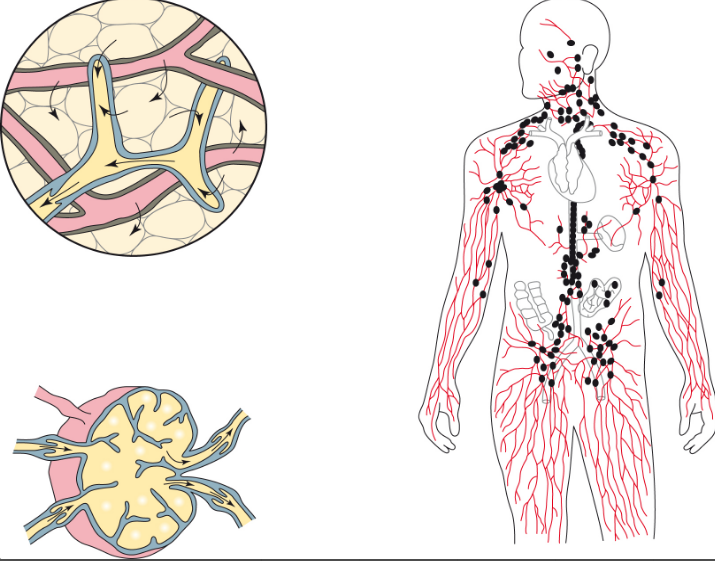
Answer
-
tissue cell
-
plasma from capillary to tissue fluid
-
blood capillary
-
tissue fluid enters lymph capillary
-
lymph capillary
-
mass of lymphocytes & macrophages
-
lymph nodes
Question 15
Question
Tissue fluid drains into the [blank_start]lymphatic[blank_end] vessels. The fluid, called lymph, flows along the lymph vessels. It passes through lymph nodes and eventually returns to the blood via the lymphatic and [blank_start]thoracic[blank_end] ducts. As lymph passes through the lymph nodes any pathogens present activate [blank_start]lymphocytes[blank_end] and macrophages, which can then destroy the microbes.
Answer
-
lymphatic
-
thoracic
-
lymphocytes
Question 16
Question
[blank_start]Interferon[blank_end] provides non-specific defence against [blank_start]viruses[blank_end], and some bacteria and protozoa. [blank_start]Microbe-infected[blank_end] cells produce this [blank_start]protein[blank_end]; it [blank_start]diffuses[blank_end] to the surrounding cells where it prevents microbes from multiplying. It inhibits microbial [blank_start]protein synthesis[blank_end] and in this way limits the formation of new microbe particles.
Answer
-
Interferon
-
viruses
-
Microbe-infected
-
diffuses
-
protein synthesis
-
protein
Want to create your own Quizzes for free with GoConqr? Learn more.