
Quiz
NM1 Exam 1
This quiz has question types that open in the usual player.
Questions in this quiz (61)
1You are preparing for an initial eval with a new patient. You know he had a CVA, but you can't find in the chart which cerebral artery was involved. During the eval you note the following deficits: Left-sided hemiparesis and sensory loss with mostly LE involvement and mental confusion.
Based solely upon these findings, which artery was most likely involved?- AR ACA
- BR MCA
- CR PCA
- DL MCA
- EL PCA
- FL ACA
2You are preparing for an initial eval with a new patient. You know he had a CVA, but you can't find in the chart which cerebral artery was involved. During the eval you note the following deficits: left-side hemiparesis and sensory loss with mostly UE involvement, Homonymous Hemianopsia, and left-side neglect.
Based solely upon these findings, which artery was most likely involved?- AR MCA
- BL MCA
- CR ACA
- DL ACA
- ER PCA
- FL PCA
3You are preparing for an initial eval with a new patient. You know he had a CVA, but you can't find in the chart which cerebral artery was involved. During the eval you note the following deficits: Right-sided hemiparesis and sensory loss with mostly UE involvement, homonymous hemianopsia, apraxia, and aphasia.
Based solely upon these findings, which artery was most likely involved?- AL MCA
- BR MCA
- CL ACA
- DR ACA
- EL PCA
- FR PCA
4You are preparing for an initial eval with a new patient. You know she had a CVA, but you can't find in the chart which cerebral artery was involved. During the eval you note the following deficits: Transient left-sided hemiparesis and sensory loss and left-sided homonymous hemianopsia
Based solely upon these findings, which artery was most likely involved?- AR PCA
- BL PCA
- CR MCA
- DL MCA
- ER ACA
- FL ACA
5Which of the following are typical effects of RIGHT-SIDED Brain Damage?
- AUnilateral Left-Sided Neglect
- BAgnosia
- CQuick and Impulsive Behavior
- DPoor Judgement
- EUnawareness of Deficits
- FEmotional Lability (in appropriate laughing/crying)
- GAphasia
- HApraxia
- IAwareness of Deficits
- JDepressed and Negative Attitude
6Which of the following are typical effects of LEFT-SIDED Brain Damage?
- AAphasia
- BApraxia
- CSlow, cautious, and hesitant behavior
- DAwareness of Deficits
- EDepressed and Negative Attitude
- FUnilateral Left-Sided Neglect
- GAgnosia
- HPoor Judgement
- IUnawareness of Deficits
- JEmotional lability (inappropriate laughing/crying)
7[blank_start]Ideomotor apraxia[blank_end]: understand what to do but are unable to perform task. Habitual tasks can be done automatically but inability to perform on command.
[blank_start]Ideational apraxia[blank_end]: have lost the idea of what to do. Unable to conceptualize a task and cannot perform purposeful motor act either on command or automatically.- AIdeomotor apraxia
- BIdeational apraxia
- CIdeational apraxia
- DIdeomotor apraxia
8[blank_start]Coup-contrecoup injury[blank_end] - When the brain “bounces” due to the force of impact and make contact with the skull at the opposite side of local damage.
[blank_start]Polar brain injury[blank_end] - Occurs in response to acceleration-deceleration and rotational forces (such as in a head on collision). The moving body and head suddenly stop with impact but the brain continues to accelerate forward until it slams into the skull.
[blank_start]Diffuse Axonal Injury (DAI)[blank_end] - Rapid movement of the brain within the skull causes widespread stretching and tearing of the neuronal axons within their myelin sheaths (subcortical white matter shearing).- ACoup-contrecoup injury
- BPolar Brain Injury
- CDiffuse Axonal Injury (DAI)
- DPolar brain injury
- ECoup-contrecoup Injury
- FDiffuse Axonal Injury (DAI)
- GDiffuse Axonal Injury (DAI)
- HCoup-contrecoup Injury
- IPolar Brain Injury
9Which type of Hematoma is associated with Medial Meningeal Artery Damage?
- AEpidural
- BSubdural
- CIntracerebral
10Which type of Hematoma is particularly common in the elderly?
- AEpidural
- BSubdural
- CIntracerebral
11In the Disablement Frameworks, what is defined as "interruption or interference with normal processes, and effort of the organism to regain normal state."
- ANagi - Active Pathology
- BNagi - Impairment
- CNagi Functional Limitation
- DICF - Health Condition
- EICF - Activity Limitation
- FICF - Participation Restriction
12In the Disablement Frameworks, what is defined as "anatomical, physiological, mental or emotional abnormalities"?
- ANagi - Impairment
- BICF - Impairment
- CNagi - Functional Limitation
- DICF - Health Condition
- ENagi - Disability
13In the Disablement Frameworks, what is defined as "limitation in performance at the level of the whole organism or person"?
- ANagi - Functional Limitation
- BNagi - Disability
- CNagi - Impairment
- DICF - Participation Restriction
- EICF - Impairment
14In the Disablement Frameworks, what is defined as "problems an individual may experience in involvement in life situations"?
- AICF - Participation Restriction
- BICF - Activity Limitation
- CICF - Impairment
- DNagi - Functional Limitation
- ENagi - Impairment
15Which disablement model accounts for personal and environmental factors?
- AICF
- BNagi
16Which of the following correspond to Spasticity?
- AOccurs during Fast, Passive Elongation
- BCaused by stimulation of the muscle spindle and hyperexcitability of the stretch reflex
- CRelated to a lesion of the UML of Corticospinal Tract
- DOccurs during Fast and Slow, Passive Elongation
- ECommonly associated with lesions of the Basal Ganglia
- FAffects both Agonist and Antagonist muscles
17Which of the following correspond to Rigidity?
- AAffects both Agonist and Antagonist muscles
- BCommonly associated with lesions of the Basal Ganglia
- COccurs during Fast and Slow, Passive Elongation
- DCaused by stimulation of the muscle spindle and hyperexcitability of the stretch reflex
- ECaused by lesion of the UML of Corticospinal Tract
- FOccurs during Fast, Passive Elongation
18At which Brunnstrom Level is Spasticity at its worst?
- AStage 1
- BStage 2
- CStage 3
- DStage 4
- EStage 5
- FStage 6
19During which Brunnstrom Stages does the patient have Spasticity?
- AStage 1
- BStage 2
- CStage 3
- DStage 4
- EStage 5
- FStage 6
20Once your patient reaches Brunnstrom Stage 1, most of his symptoms have disappeared (spasticity, flaccidity, etc.).
- ATrue
- BFalse
21One aspect of Wernicke's Aphasia is that the patient becomes frustrated with their inability to communicate.
- ATrue
- BFalse
22[blank_start]Visual Object Agnosia[blank_end] - Failure to recognize visually-presented objects, despite normal vision.
[blank_start]Simultagnosia[blank_end] - Inability to perceive multiple sensations at once when trying to perceive a stimulus as a whole.
[blank_start]Prosopagnosia[blank_end] - Inability to identify a known person by their face.
[blank_start]Auditory Agnosia[blank_end] - Inability to recognize non-speech sounds or discriminate between them.
[blank_start]Astereognosis[blank_end] - Inability to recognize objects by handling or touching them.- AVisual Object Agnosia
- BSimultagnosia
- CProsopagnosia
- DAuditory Agnosia
- EAstereognosis
23Put the Motor Control Theories in Chronological Order:
[blank_start]Reflex Theory[blank_end] - Late 1800s - Early 1900s
[blank_start]Hierarchical Theory[blank_end] - Mid 1900s
[blank_start]Contemporary Systems Theory[blank_end] - Late 1900s- AReflex Theory
- BHierarchical Theory
- CContemporary Systems Theory
24Which Motor Control Theory states : "Reflexes are modified to adapt to the task via central commands."
- AHierarchical Theory
- BContemporary Systems Theory
- CReflex Theory
25Which Motor Control Theory can be described as "an integrated theory of motor control that allows for flexibility of motor patterns (versus stereotyped movements) that can adapt to the task and the environmental constraints."
- AContemporary Systems Theory
- BHierarchical Theory
- CReflex Theory
26Which Motor Control Theory states that "Reflexes are the building blocks of complex behavior."
- AReflex Theory
- BHierarchical Theory
- CContemporary Systems Theory
27Label this image
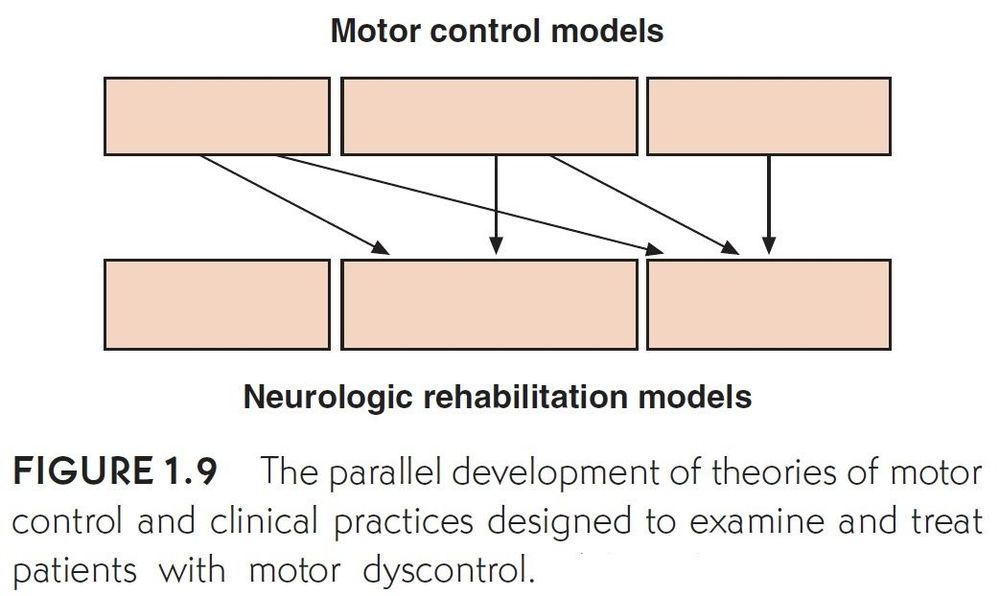
- AReflex
- BHierarchical
- CSystems
- DMuscle ReEducation
- ENeurotherapeutic Facilitation
- FContemporary Task-Oriented
28Which of the following are limitations of the Reflex Theory of Motor Control?
- AIt does not explain novel movements
- BMany coordinated movements (i.e. locomotion) can be performed in the absence of sensory input
- CThe reflex is the basic unit of behavior
- DInhibition of primitive reflexes does not release normal movements
- EVery cognitive (requires active problem solving)
29Which of the following are limitations of the Hierarchical Theory of Motor Control?
- AIt does not explain the normal presence of primitive reflexes in neurologically healthy adults
- BInhibition of primitive reflexes does not release normal movements
- CIt does not explain novel movements
- DReflex chaining does not explain the fact that a single stimuli can result in variable response
- EVery cognitive (requires active problem solving)
30If your patient has a balance deficit, which type of impairment is it?
- AComposite
- BDirect
- CIndirect
31The coordination test we learned in lab which involves the patient rapidly alternating both hands between supination and pronation is testing for which of the following conditions?
- ADysdiadochokinesia
- BDysmetria
- CIntention Tremor
- DResting Tremor
32An action tremor (aka intention tremor) may be caused by a lesion to which of the following areas of the CNS?
- ACerebellum
- BBasal Ganglia
- CSpinal Cord
33Lesion to the Basal Ganglia results in which sort of tremor?
- AResting Tremor
- BAction Tremor
34A lesion of the cerebellum may result in which of the following coordination problems?
- ADysdiadochokinesia
- BAction Tremor
- CDysmetria
- DAkinesia
- EBradykinesia
- FRigidity
- GResting Tremor
- HChorea
- IAthetosis
35A lesion of the basal ganglia may result in which of the following coordination problems?
- AAkinesia
- BBradykinesia
- CRigidity
- DResting Tremor
- EChorea
- FAthetosis
- GDysdiadochokinesia
- HHypermetria
36Spascticity is velocity dependent.
- ATrue
- BFalse
37[blank_start]Obtunded[blank_end]: Patient has a decreased interest in their surroundings, slowed response to stimuli, and sleepiness.
[blank_start]Stupor[blank_end]: Patient has an even lower level of consciousness; only responds by grimacing or drawing away from painful stimuli.
[blank_start]Coma[blank_end]: Patient cannot be aroused; no response to stimuli.- AObtunded
- BStupor
- CComa
38[blank_start]Expressive Aphasia[blank_end]: Characterized by awkward articulation, restricted vocabulary and a preservation of auditory comprehension
[blank_start]Receptive Aphasia[blank_end]: An impairment in auditory comprehension. Speech remains fluent, but is marked by word substitutions.
[blank_start]Dysarthria[blank_end]: “Slurred speech”; may occur after an UMN lesion when there is damage to the motor system controlling the muscles and movements associated with speech production (right and left sided lesions).
[blank_start]Dysphagia[blank_end]: Impaired swallowing ability. It occurs in 30-40% of individuals with stroke and is common in patients with Parkinsons’s discase, MS, and cerebral palsy.- AExpressive Aphasia
- BReceptive Aphasia
- CDysarthria
- DDysphagia
39Which type of Hematoma is considered the most deadly?
- AEpidural
- BSubdural
- CIntracerebral
40Which of the following represents the correct cascade of events following oxygen deprivation in the brain secondary to a stroke?
- ANeurons release excessive Glutamate;
Altered Ca Ion channels cause influx of Ca into neurons;
High-levels of intracellular Ca activates destructive Ca-sensitive enzymes;
Enzymes cause further neuronal cell death;
Intracellular fluid floods into brain causing edema. - BAltered Ca Ion channels cause influx of Ca into neurons;
High-levels of intracellular Ca activates destructive Ca-sensitive enzymes;
Enzymes cause further neuronal cell death;
Neurons release excessive Glutamate;
Intracellular fluid floods into brain causing edema. - CIntracellular fluid floods into brain causing edema;
Altered Ca Ion channels cause influx of Ca into neurons;
High-levels of intracellular Ca activates destructive Ca-sensitive enzymes;
Enzymes cause further neuronal cell death;
Neurons release excessive Glutamate;
- ANeurons release excessive Glutamate;
41Which of the following values are indicative of normal ICP?
- A4 mmHg
- B15 mmHg
- C12 mmHg
- D2 mmHg
- E20 mmHg
- F40 mmHg
42At which of the following levels of ICP is it necessary to notify the patient's nurse and doctor, but it's ok to continue therapy?
- A10 mmHg
- B25 mmHg
- C15 mmHg
- D5 mmHg
- E30 mmHg
43At which of the following levels of ICP should you immediately stop therapy and notify the patient's nurse and doctor?
- A5 mmHg
- B15 mmHg
- C20 mmHg
- D30 mmHg
44Brain edema begins within [blank_start]minutes[blank_end] of stroke onset, peaks around [blank_start]3 - 4 days[blank_end], and disappears within [blank_start]3 weeks[blank_end].
- Aa few minutes
- B60 minutes
- C4 hours
- D3 - 4 days
- E7 - 10 days
- F10 - 14 days
- G3 weeks
- H2 months
- I6 months
45Typical onset of Multiple Sclerosis begins during which of the following age brackets?
- A20 and 40 years of age
- B50 and 70 years of age
- C5 and 10 years of age
- D65 and 70 years of age
46Typical onset of Parkinson's Disease begins during which of the following age brackets?
- A50 - 60 years of age
- B20 - 40 years of age
- C5 - 10 years of age
- D70 - 80 years of age
47Which type of Multiple Sclerosis is described below?
• Characterized by discrete attacks of neurological deficits with either full or partial recovery in subsequent weeks to months.
• The periods between relapses are characterized by lack of disease progression.- ARelapsing-Remitting MS (RRMS)
- BSecondary-Progressive MS (SPMS)
- CPrimary-Progressive MS (PPMS)
- DProgressive-Relapsing MS (PRMS)
48Which type of Multiple Sclerosis is described below?
• Characterized by an initial relapsing-remitting course, followed by a change in clinical course with progression to steady and irreversible decline with or without continued acute attacks.
• May be the result of progressive axonal loss rather than new lesions.- ARelapsing-Remitting MS (RRMS)
- BSecondary-Progressive MS (SPMS)
- CPrimary-Progressive MS (PPMS)
- DProgressive-Relapsing MS (PRMS)
49Which type of Multiple Sclerosis is described below?
• Characterized by disease progression and steady functional decline from onset; patients may experience modest fluctuations in neurological disability but discrete attacks do not occur.- ARelapsing-Remitting MS (RRMS)
- BSecondary-Progressive MS (SPMS)
- CPrimary-Progressive MS (PPMS)
- DProgressive-Relapsing MS (PRMS)
50Which type of Multiple Sclerosis is described below?
• Characterized by a steady deterioration in disease from onset but with occasional acute attacks.
• Intervals between attacks are characterized by continuing disease progression.- ARelapsing-Remitting MS (RRMS)
- BSecondary-Progressive MS (SPMS)
- CPrimary-Progressive MS (PPMS)
- DProgressive-Relapsing MS (PRMS)
51Which of the following is the Abnormal Flexion Synergy Pattern for UE?
- AScapular – Retraction/Elevation
Shoulder – AB-D, ER
Elbow – Flexion
Forearm – Supination
Wrist – Flexion
Fingers - Flexion - BScapular – Retraction/Elevation
Shoulder – AB-D, IR
Elbow – Flexion
Forearm – Pronation
Wrist – Flexion
Fingers - Extension - CScapular – Retraction/Elevation
Shoulder – AD-D, ER
Elbow – Flexion
Forearm – Pronation
Wrist – Flexion
Fingers - Extension - DScapular – Retraction/Elevation
Shoulder – AD-D, ER
Elbow – Flexion
Forearm – Pronation
Wrist – Flexion
Fingers - Flexion
- AScapular – Retraction/Elevation
52Which of the following is the Abnormal Extension Synergy Pattern for UE?
- AScapular – Protraction
Shoulder – AD-D, IR
Elbow – Extension
Forearm – Pronation
Wrist – Extension
Fingers - Flexion - BScapular – Retraction
Shoulder – AD-D, IR
Elbow – Extension
Forearm – Pronation
Wrist – Extension
Fingers - Extension - CScapular – Retraction
Shoulder – AB-D, IR
Elbow – Extension
Forearm – Pronation
Wrist – Extension
Fingers - Extension - DScapular – Retraction
Shoulder – AB-D, IR
Elbow – Extension
Forearm – Supination
Wrist – Extension
Fingers - Flexion
- AScapular – Protraction
53Select the proper components for the Abnormal Flexion Synergy Pattern for LE?
- AHip - Flexion, AB-D, ER
- BKnee - Flexion
- CAnkle - DF, Inversion
- DToe DF
- EHip - Flexion, AB-D, IR
- FHip - Flexion, AD-D, IR
- GAnkle - PF, Inversion
- HAnkle - PF, Eversion
- IToe - PF
54Select the proper components for the Abnormal Extension Synergy Pattern for LE?
- AHip - Extension, AD-D, IR
- BKnee Extension
- CAnkle - PF, Inversion
- DToe - PF
- EToe - DF
- FAnkle - DF, Inversion
- GAnkle - DF, Eversion
- HHip - Extension, AB-D, IR
55You are working with a patient with a known abnormal synergy pattern.
Assuming cerebral shock has resolved, what happens when you resist Flexion at a joint of the UnInvolved UE?- AFlexion synergy of the Involved UE
- BExtension synergy of the Involved UE
- CFlexion synergy of the Involved LE
- DExtension synergy of the Involved LE
56You are working with a patient with a known abnormal synergy pattern.
Assuming cerebral shock has resolved, what happens when you resist Extension at a joint of the UnInvolved UE?- AExtension synergy of the Involved UE
- BFlexion synergy of the Involved UE
- CExtension synergy of the Involved LE
- DFlexion synergy of the Involved LE
57You are working with a patient with a known abnormal synergy pattern.
Assuming cerebral shock has resolved, what happens when you resist Flexion at a joint of the UnInvolved LE?- AExtension Synergy of the Involved LE
- BExtension Synergy of the Involved UE
- CFlexion Synergy of the Involved LE
- DFlexion Synergy of the Involved UE
58You are working with a patient with a known abnormal synergy pattern.
Assuming cerebral shock has resolved, what happens when you resist Extension at a joint of the UnInvolved LE?- AFlexion synergy of the involved LE
- BExtension synergy of the involved LE
- CFlexion synergy of the involved UE
- DExtension synergy of the involved UE
59You are working with a patient with a known abnormal synergy pattern.
Assuming cerebral shock has resolved, what happens when you resist Flexion at a joint of the Involved UE?- AFlexion synergy of the involved LE
- BExtension synergy of the involved LE
- CFlexion synergy of the Uninvolved LE
- DExtension synergy of the Uninvolved LE
60You are working with a patient with a known abnormal synergy pattern.
Assuming cerebral shock has resolved, what happens when you resist Extension at a joint of the Involved LE?- AExtension synergy of the Involved UE
- BFlexion synergy of the Involved UE
- CExtension synergy of the UnInvolved LE
- DFlexion synergy of the UnInvolved LE
61[blank_start]Homonymous Hemianopsia[blank_end]: a visual field cut that reduces part or all of the contra-lesional visual field.
[blank_start]Diploplia[blank_end]: double vision, which can be the result of a decrease in oculomotor control or range of motion.
[blank_start]Strabismus[blank_end]: an eye alignment problem that leads to difficulty with depth perception.
[blank_start]Nystagmus[blank_end]: involuntary, cyclic movement of the eye (side to side/horizontal, up-down, or rotatory/torsional).- AHomonymous Hemianopsia
- BDiploplia
- CStrabismus
- DNystagmus
Information
- Description
- USA - NM1 Quiz on NM1 Exam 1, created by Ben Williams on 13/06/2017.
- Author
- Ben Williams
- Language
- English
- Views
- 81
- Tags
- Rating
- No ratings yet Rate this quiz