
Quiz
Mec1201 Multiple Choice Quiz
Create a free account to finish this quiz
Save your progress and see your final score.
Already have an account? Sign in
Questions in this quiz (27)
1Cold working process changes the mechanical properties of the metals in which
- Aincrease the cold working rate reduces the ductility of metals
- Bincrease the cold working rate reduces the strength of metals
- Cincreases the cold working rate reduces the hardness of metals
- Dincreases the cold working rate reduces the strength , the hardness and the ductility of metals
2In equilibrium phase diagrams, which one of the following statements is correct?
- AThe amount of phases presented cannot be determined.
- BThe microstructure of the alloys can be determined
- CThe microstructure of the alloys can be determined when only equilibrium cooling rate takes place.
- DThe morphology of the phases can be determined
3Some polymers may be strengthened considerably by a mechanism called ‘crystallisation’. This mechanism can be described as:
- AThe arrangement of the long chain molecules randomly to each other and there is no pattern in the structure of the polymer.
- BWhen the long chain molecules are heavily cross linked thus forming a regular arrayed within the structure.
- CWhere individual mers are drawn into an ordered arrayed in a regular lattice structure within the polymer.
- DWhere linear long chain molecules are drawn into close alignment with each other in regions of ordered structure.
4The function of adding chlorine gas into the addition polymerisation process is to:
- AControl the rate of reaction by attaching themselves to each end of the mers prior to addition process.
- BAct as a catalyst by speeding up the polymerisation process.
- CBy adding radicals to the side of the giant long chains in isotactic array to increase the polymerisation process.
- DTo react with the hydrogen atoms bonded to the carbon atoms to form a HCl compound as a side reaction.
5A ceramic material can be defined as:
- AA group of organic crystalline materials whose atoms are bonded together by strong covalent bonds only.
- BA group of inorganic non-metallic materials whose atoms are bonded together by a combination of ionic and covalent bonds.
- CA group of inorganic non-metallic materials whose atoms are bonded together by ionic bonds only.
- DOrganic non-metallic materials made up of long chain molecules with an amorphous structure held together by strong covalent bonds.
6Silica has the chemical equation of:
- ASiO2
- BSiO4
- C(SiO4)-4
- DKAlSi3O
7Dry corrosion can be defined as:
- AOxidation at the cathode of an electrolytic cell due to the chemical reaction of gases such as oxygen, sulphur, halogens, hydrogen and nitrogen directly in the absence of a liquid
- BChemical reduction of a metal in the absence of liquid
- COxidation at the anode of an electrolytic cell in the presence of oxygen in a liquid.
- DOxidation of the surface of a metal due to the chemical reaction of gases such as oxygen, sulphur, halogens, hydrogen and nitrogen directly in the absence of a liquid.
8The rate of corrosion in a galvanic cell can be reduced by:
- AReducing the surface area of the anode in comparison to the cathode.
- BReducing the surface area of the cathode in comparison to anode
- CIncreasing the ion concentration in the electrolyte.
- DIncreasing the temperature of the galvanic cell.
9In general, the conductivity of a metal can be increased by:
- AIncreasing the number of dislocations within the crystal lattice
- BIncreasing its temperature.
- CDecreasing its temperature
- DIncreasing impurity atoms within the crystal lattice.
10The hydration reaction of cement is:
- AAn exothermic chemical reaction between the calcium silicates and water to produce a hydrated calcium silicate known as tobermorite gel
- BAn endothermic chemical reaction between the calcium silicates and water to produce a hydrated calcium silicate known as tobermorite gel.
- CAn exothermic reaction between calcium silicates and water to form a glass like vitrified bond between cement particles.
- DAn endothermic reaction between calcium silicates and water to form a glass like vitrified bond between cement particles.
11At different environmental temperatures, impact testing is performed to determine one of the following:
- AUltimate strength
- BEndurance limit.
- CFlexural
- DDuctile-brittle transition
12 When a sample is subjected to bending load
- ATensile and compressive stresses are generated only.
- BTensile and shear stresses are generated only
- CCompressive and shear stress are generated only
- DCompressive, tensile and shear stresses are generated.
13The main difference between dynamic and hardness testing is that
- Adynamic testing is used for brittle materials only while hardness can be used for ductile and brittle
- Bhardness testing evaluates the surface characteristics only while dynamic testing can evaluate the bulk of the materials under fluctuating loading.
- Cdynamic testing evaluates only the surface properties of the materials while hardness can evaluate the bulk of the materials.
- DDynamic testing causes plastic deformation on the materials while hardness causes elastic deformation only
14In engineering applications, the brittle materials are not preferable compared to ductile materials. One of the main reason is that
- Athe failure in ductile materials occurs on planes of minimum shear stress
- Bthe failure in ductile materials occurs before yielding
- Cthe failure in ductile materials is predictable and occurs after yielding
- Dthe fracture in ductile failure is generally normal to the axis of the applied load
15 The main difference between compressive and hardness testing is that
- Acompressive testing is used for ductile materials only while hardness can be used for ductile and brittle.
- Bcompressive testing evaluates only the surface properties of the materials while hardness can evaluate the bulk of the materials
- Chardness testing evaluates the surface characteristics only while compressive testing can evaluate the bulk of the materials
- Dcompressive causes plastic deformation on the materials while hardness causes elastic deformation only.
16The atoms in the crystal lattice of metals are in constant state of motion, vibrating about a fixed point in the lattice. Due to that, the atoms exchange their places and move through the lattice. This is known as
- Adiffusion
- Binterstitial defect
- Csubstitutional defect
- Ddislocation
17The main reason why methane cannot be used as the primary feedstock to form a long chain polymer is
- AThe methane molecule cannot form side-chains so cannot link together to form long chain molecules
- BThe methane molecule cannot contain carbon to carbon unsaturated double bonds necessary for the polymerisation process
- CTo form carbon to carbon saturated bonds, the methane molecule must first lose two of its hydrogen atoms. This can only be done at high temperatures in a catalytic converter
- DPolymerisation of methane can only occur by first irradiating it to form an isotope.
18With respect to electron energy bands in insulators, conductors and semi-conductors, a ‘Conductor’ can be defined as
- AA material where the highest average energy level of electrons in the full valence band is well below the lowest average energy level in the conduction band.
- BA material where there is a small energy gap between the lowest average energy level in the conduction band and the highest average energy level of electrons in the valence band.
- CA material where the next available energy level of electrons is below the lowest level of the conduction band
- DA material where there is an overlap between the average highest energy level of electrons in the valence band and the lowest average energy level of the conduction band.
19At different environmental temperatures, impact testing is performed to determine one of the following:
- AUltimate strength.
- BEndurance limit.
- CFlexural
- DDuctile-brittle transition
20Cold working process can be define as
- Aa manufacturing process in which the metal plastically deformed above the recrystallisation temperature
- Ba manufacturing process in which the metal elastically deformed above the recrystallisation temperature
- Ca deformation process by external loading at room temperature.
- Da process to release the residual stresses in metals.
21In relation to the arrowed regions in which of the load-elongation curves is the region in which plastic deformation most accurately depicted?
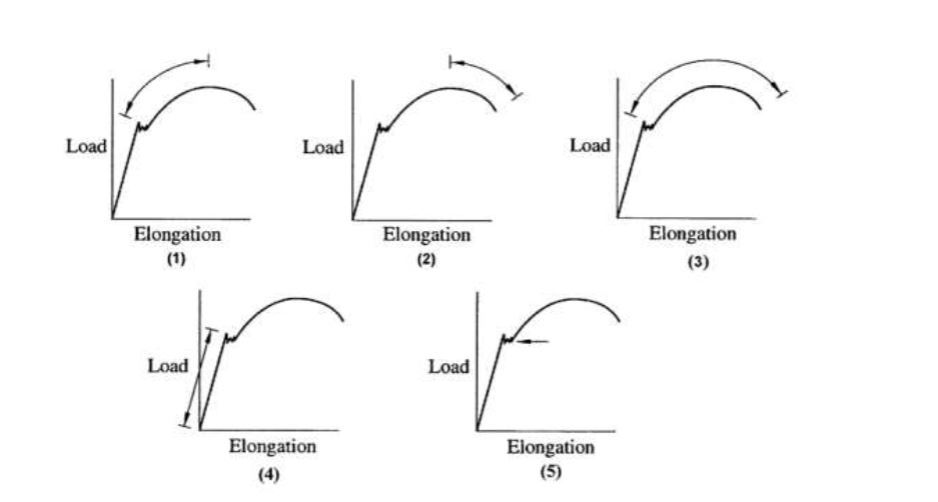
- A1
- B2
- C3
- D4
- E5
- Fnone
22In relation to the arrowed regions in which of the load-elongation curves above is the region in which elastic deformation takes place, most accurately?
- A1
- B2
- C3
- D4
- E5
- Fnone
23In relation to the arrowed regions in which of the load-elongation curves is the region where yielding process takes place most accurately?
- A1
- B2
- C3
- D4
- E5
- Fnone
24In relation to the arrowed regions in which of the load-elongation curves is the region where modulus of elasticity can be determined most accurately?
- A1
- B2
- C3
- D4
- E5
- Fnone
25Brittle failure is encouraged by many factors except:
- Adynamic (impact) loads
- Blow temperatures
- Cthe presence of stress concentrations
- DCompressive stress
26Fatigue test performs to evaluate the mechanical properties of materials which are subjected to
- ADynamic loads
- BStatic loads
- CHigh impact loads
- DStatic load for long time
27Brinell hardness can be calculated by one of the following equations
- ALoad/area of impression.
- BLoad/diameter of impression.
- CLoad/area of the ball.
- DLoad/ area of the specimen.
Information
- Description
- Quiz for mec1201
- Author
- Saxon Onions
- Language
- English
- Views
- 78
- Rating
- No ratings yet Rate this quiz