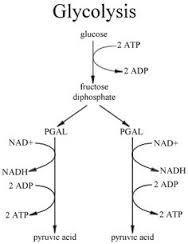
ATP attaches to glucose (6C).
2 x ATP needed to convert glucose into glucose phosphate via phosphorylation.
Glucose phosphate is unstable, so it splits into 2 x triose phosphate (3C).
Triose phosphate oxidises to pyruvate, resulting in NADH.
Total = 4 x ATP and a net gain of 2 x ATP for each glucose molecule.
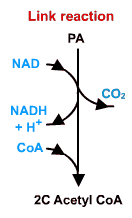
Caption: : Occurs in the matrix of the mitochondria.
Slide 3
Kreb Cycle
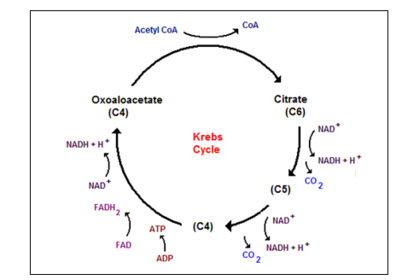
AcetylCoA combines with 4C to make Citric Acid (6C).
2 x decarboxylation reactions = 4C.
Oxidation reactions produce 3 x NADH, 1 x FADH and ATP.
ATP is formed from substrate level phosphorylation.This forms 4C Oxaloacetic, which can join to another AcetlyCoA to continue the reaction.
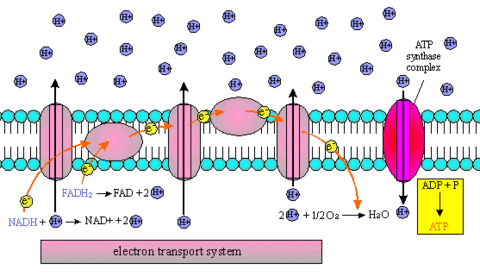
e- = picked up by carrier 1 = C1 reduced. Oxidised NAD goes back to Krebs cycle.C1 = oxidised, so C2 is reduced as e- passes to it = releases energy for ATP.
Oxidised FAD goes back to Krebs cycle.
Proton gradient = H+ is pumped into intermembrane space using e- energy.
e- + H + O2 = H2O - acts as a final e- acceptor.
H+ diffuses through ATPase. ADP + Pi = ATP = Oxidative Phosphorylation.
Caption: : This occurs in the Cristae of the mitochondria.