
Notizen
Unit C Midterm Study Notes
Inhalt der Notizen (3)
Seite 1
Unit C
Early Light Theories
Pythagoras: Light beams from the eyes (scans).
Euclid: Light reflects at equal angles. Light travels in straight lines.
Ptolemy: Light bends from air to glass to water.
Al - Haytham: Light travels to your eyes.
Isaac Newton: White light made of many colours.
Ole Romer: Discovered 1st speed of light.
Albert A. Michelson: Discovered accurate speed of light.
Optical Devices
An optical device is any technology that uses light.
Telescope: used for viewing distant objects
Microscope: used for viewing very small objects
Binoculars: used to view distant objects (2 refracting telescopes fitted together
*Mirrors and lenses are also optical devices because they use light.*
Need to Know:
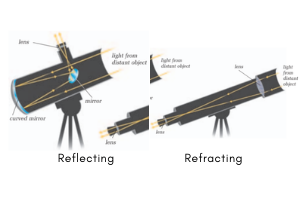
There are 2 types of telescopes = reflecting & refracting.
Reflecting: uses a curved mirror and a lens to form an enlarged image.
Refracting: uses two lenses to form an enlarged image.
How do telescopes work?
Telescopes both magnify and collect light.
They use lenses & mirrors/a combo. of both to collect light from distant objects & bring it to your eyes.
The telescope was invented for astronomy.
Seite 2
How do microscopes work?
You can great detail by combining at least 2 lenses.
When a light source shines through the specimen, a large image is produced that you can see by looking through the eyepiece.
How do binoculars work?
They are 2 short refracting telescopes fitted together.
They are like telescopes, except easier to move around.
They are not at powerful as telescopes, but e convenient.
Ray Diagrams
Ray diagrams are used to show how light travels.
Light travelling from a source is shown as straight lines = rays.
Light rays travel in every direction.
Fewer light rays reach your eyes the farther you are from a light source.
Light Bulbs
There are 2 types of bulbs:
Incandescent: electricity heats up the filament inside, so it glows.
Fluorescent: electricity causes the mercury to glow UV light. Uv light causes the phosphor to glow white.
Law of Reflection
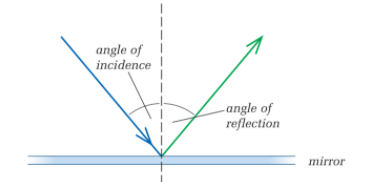
When a ray of light hits a plane mirror at an angle, it bounces off the mirror surface at exactly the same angle.
The line perpendicular to the mirror at the point of reflection is called the normal.
Angle between incident ray and the normal = angle of incidence
Angle between reflected ray and the normal = angle of reflection
Summary: the law of reflection is the angle of incidence is equal to the angle of reflection.
Seite 3
Types of Reflection
Regular reflection: happens when parallel rays hit a smooth surface; all rays reflect at the same angle.
Diffuse reflection: happens when parallel rays hit a rough surface; all rays reflect at different angles.
Properties of Light
Light travels in straight lines
Light can be reflected
Light can bend
Light is a form of energy
Mirrors & Lenses
Mirrors:
Concave mirrors: a reflecting surface that is curved inward like the inside of a bowl or spoon; light rays reflected from it converge (come together). All rays meet at a focal point.
Convex mirrors: a reflecting surface that bulges out like the back of a spoon; light rays reflected from it diverge (spread out). It spreads out light rays.
Lenses:
Concave lenses: is thinner in the middle, than at the edges. Light rays passing through it diverge or spread out.
Convex lenses: thicker in the middle than at the edges. Light rays passing through it converge/come together.
Refraction
Refraction is the bending of light as it travels from one material to another material. Refraction is due to the changes in the speed of light. Ex. a student trying to move from class to class when the hallways are full, it’s impossible to move at top speed when particles (students) get in the way. What happens when light suddenly slows down as it hits a medium? If it strikes a medium of different density at an angle, it refracts. When part of a beam of light slows down and the rest keeps going, the beam of light will bend.