
Light, Optics and Lenses
1,511 resources created by 1,169 users
This Light, Optics and Lenses page on GoConqr gathers community-made quizzes, mind maps, flashcards and notes, from reflection and refraction to lenses, colour and the eye. It's built for school students revising a topic and teachers after ready-made material. There are over 1,400 resources here, including more than 90 quizzes, over 800 mind maps and more than 300 flashcards, mostly at secondary level. Pick a quiz to find your gaps, then open a mind map to fill them.
Top Light, Optics and Lenses resources
-
18 questions0654 Reflection & Refraction of Light Quiz The diagram shows a ray of light in air incident on a glass block. Some of the light is refracted, and some...
-
30 questions0654 Light Quiz The diagram shows light travelling from air into glass. Four angles v, w, x and y are shown. Which formula ...
-
53 cardsGrade 10 Optics Test Review
-
19 questionsEP Quiz 5 is parker cute?
-
28 questionsColor Unit Evaluation The color of an object we see is determined by the
-
20 questionsLight Quiz Which of these statements is true?
-
41 cardsLight Ready for the test!!!
-
15 cardsQuantum optics Set 4
Quizzes
See all 131 quizzes-
18 questions0654 Reflection & Refraction of Light Quiz The diagram shows a ray of light in air incident on a glass block. Some of the light is refracted, and some...
-
30 questions0654 Light Quiz The diagram shows light travelling from air into glass. Four angles v, w, x and y are shown. Which formula ...
-
19 questionsEP Quiz 5 is parker cute?
-
28 questionsColor Unit Evaluation The color of an object we see is determined by the
-
20 questionsLight Quiz Which of these statements is true?
-
10 questions8K Light What are objects that create light called?
-
12 questionsColours of light and filters What happens when you look through a filter?
-
10 questionsMCAT Physics - Optics Light is propagating is a direction directly away from you, with an electric field that appears to be rotat...
Mind maps
See all 897 mind maps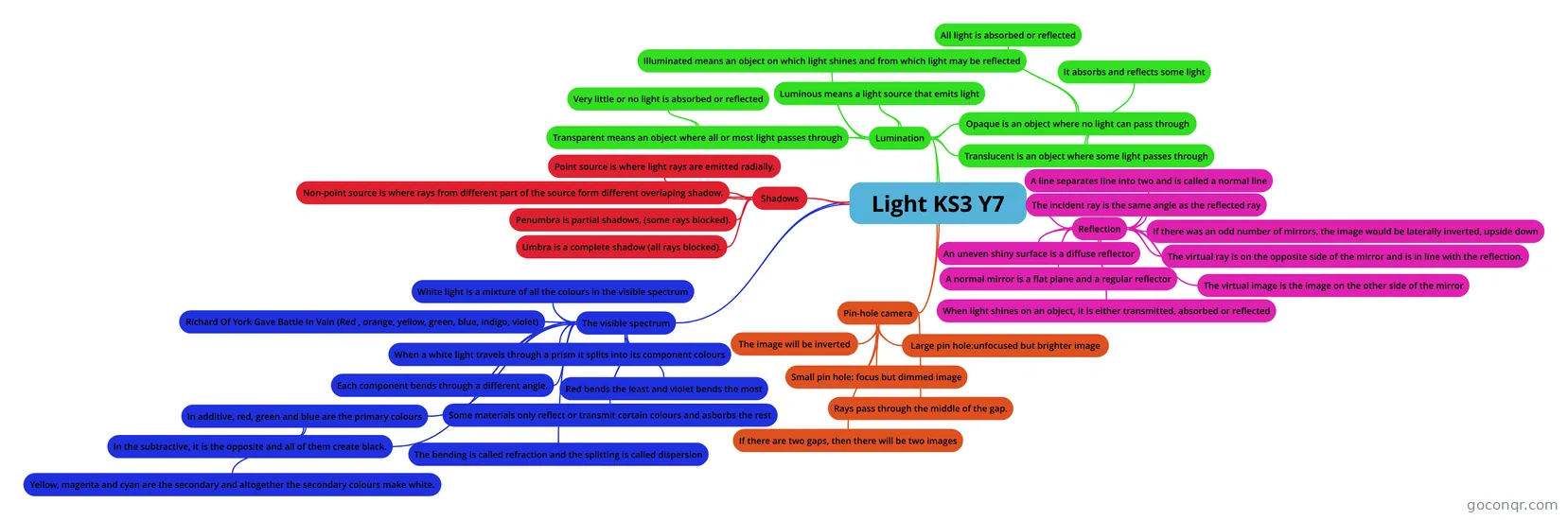
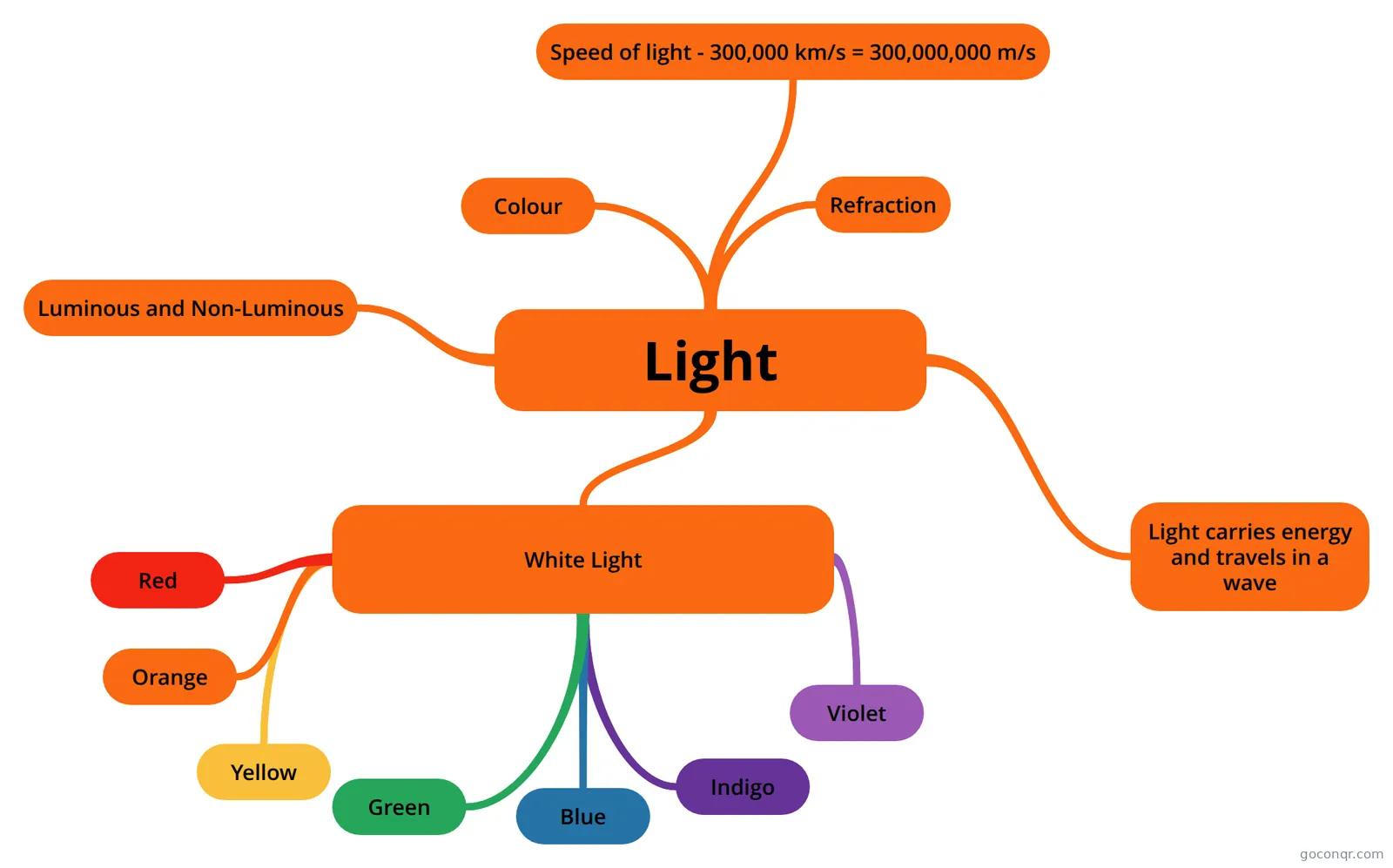
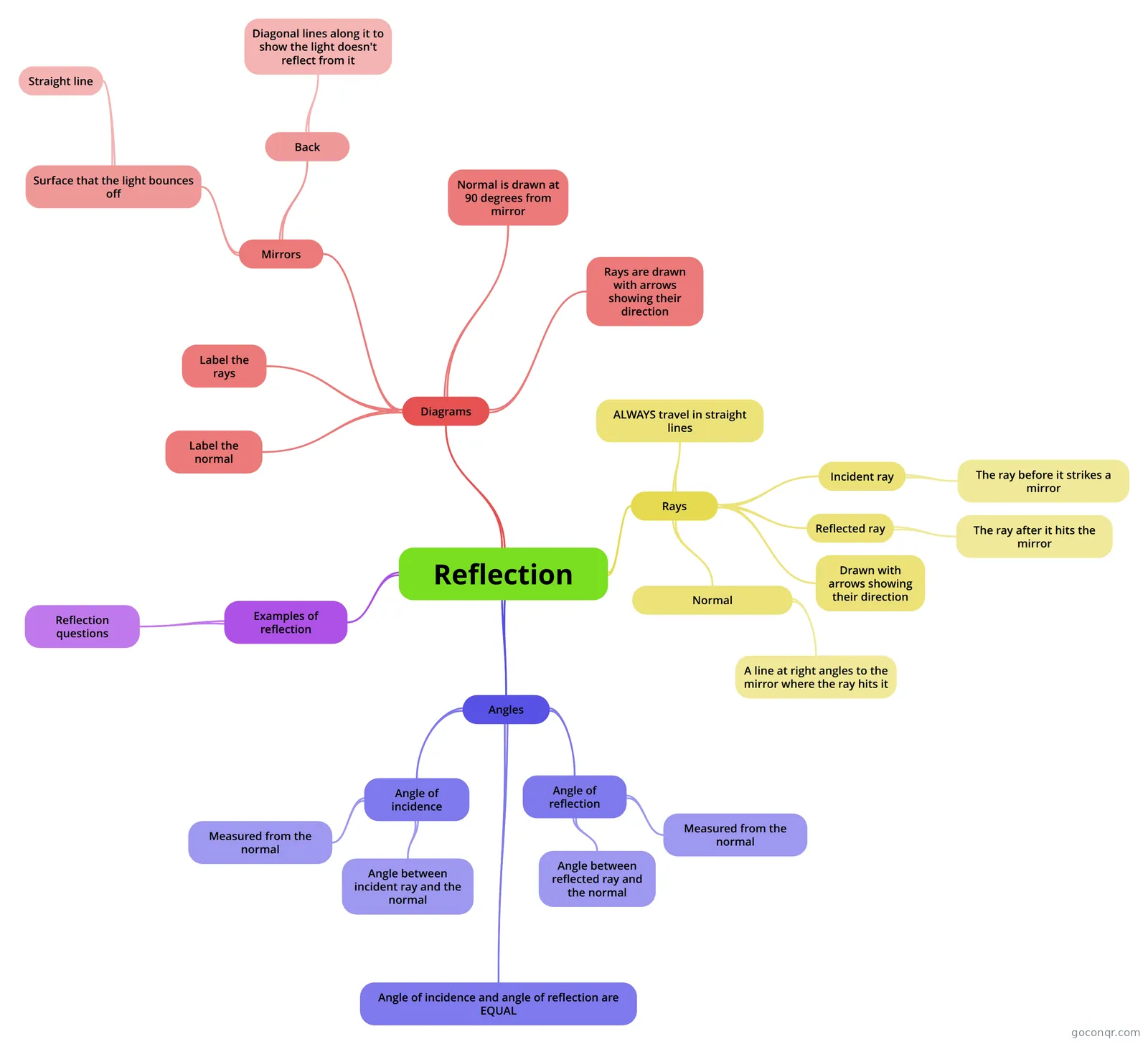
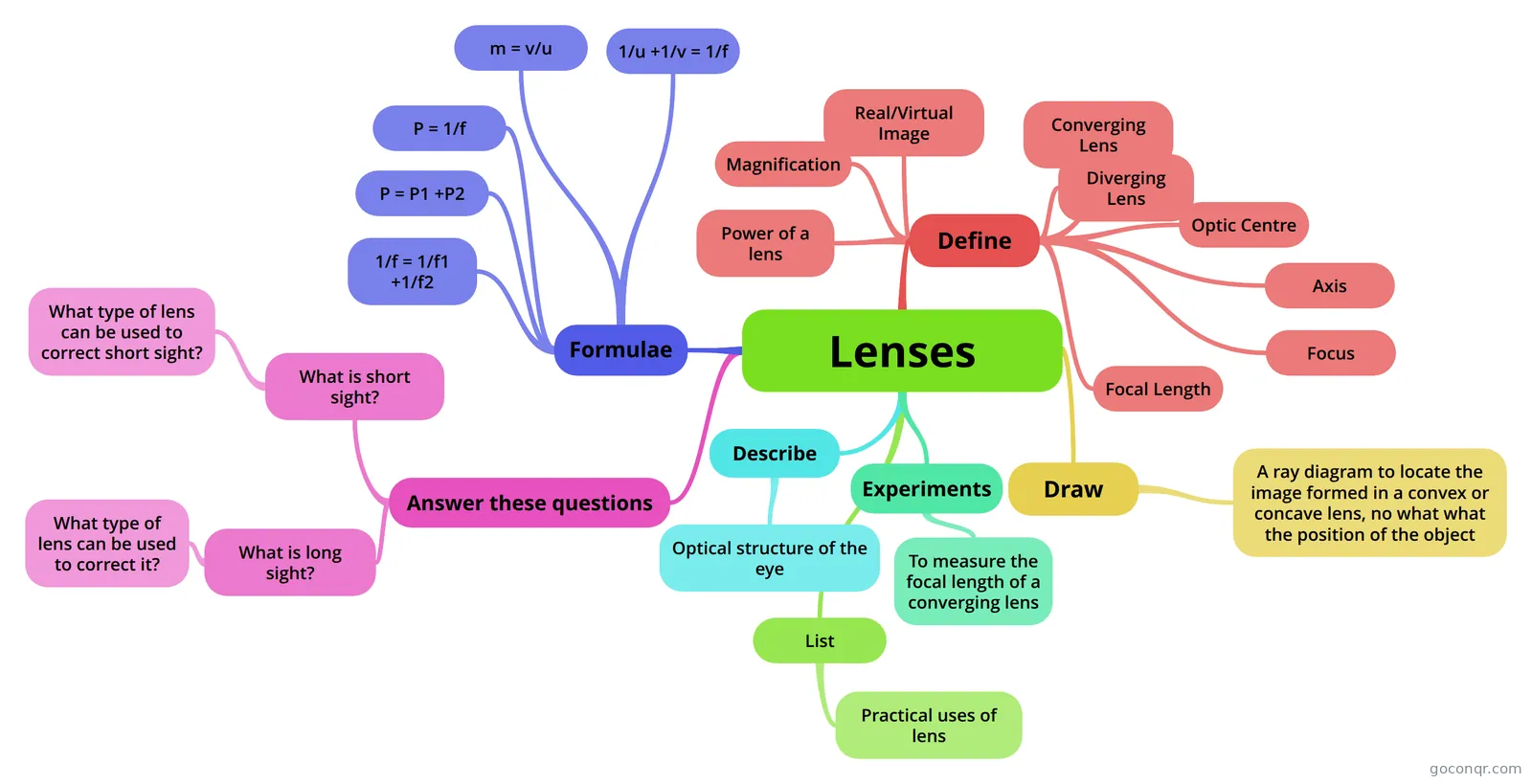
Flashcards
See all 385 flashcards-
53 cardsGrade 10 Optics Test Review
-
41 cardsLight Ready for the test!!!
-
15 cardsQuantum optics Set 4
-
17 cards9 – LIGHT PROJECTION Chapter 9: Light Projection
-
25 cardsModule 5.4 Light energy Module 5.4 Light Energy
-
16 cardsLight KS3 How does light travel?
-
4 cardsAngles What is the relationship between the angle of incidence and the angle of reflection? A. The angle of incide...
-
12 cards8K ~ light What is refraction?
Flowcharts
Notes
See all 70 notes-
Prisms-- refraction and dispersion Refraction in glass prism - Angle of incidence and angle of emergence aren't equal as both rays aren't parallel as both rectangular surfaces aren't parallel in a prism - Angle of incidence (1) is formed be...
-
Light Spectrum and Vision In the spectrum of light, there are seven colours: red orange yellow green blue indigo violet As can be seen from the image, the colours nearer the red side have longer wavelengths. (All waves on t...
-
Unit C Midterm Study Notes Unit C Early Light Theories Pythagoras: Light beams from the eyes (scans). Euclid: Light reflects at equal angles. Light travels in straight lines. Ptolemy: Light bends from air to glass to water. Al - ...
-
P8: Light How an optical image is formed in a plane mirror:The image appears to be the same distance behind the mirror as the real object is in front of the mirrorThis is the reason why: The brain thinks the light travels in st...
-
Physics Grade 10 Topic 1-5 Sources of light Light is a spectrum- meaning some light is visible There are countless sources of light, but they can all be categorized under either of the two following categories- Natural sources Objects that emit...
-
refraction and dispersion notes refraction is when light rays bend/ change direction as they go through a medium. For example, when light goes through a glass prism, the rays bend. dispersion is when White light goes through a transparent object and...
-
DISPERSION OF LIGHT AND COLOURS - created from Mind Map The dispersion of white light is the splitting up of white light into its component colours. Why does it occur? When does it occur? SPECTRUM - Ordered arrangement of colours that appears after the white light passes t...
-
Refraction Refraction -Refraction is the bending or change in direction of light when it travels from one medium into another. REFRACTION:
Slides
See all 21 slidesMore Physics topics
About Light, Optics and Lenses
GoConqr OriginalWhat this unit covers
The resources follow the usual path through light. Early ones deal with how light travels, luminous and non-luminous objects, shadows and colour filters. Later ones move on to reflection, refraction, total internal reflection, prisms, lenses and the eye.
Where to start
Begin with the basics. The Light KS3 flashcards ask how light travels and what a luminous object is. Then try the Light Quiz, which checks ideas such as why we see things and how shadows form. The Colours of light and filters quiz is a good next step if colour is still shaky.
Reflection, refraction and lenses
Once the basics feel secure, move to the 0654 Reflection & Refraction of Light Quiz. It uses a ray diagram of light meeting a glass block and asks you to read the angles. The 0654 Light Quiz goes on to the refractive index of glass and a converging lens. The mind map Lenses covers converging and diverging lenses, focal length, real and virtual images, magnification and the power of a lens.
Using quizzes and maps together
- Take a quiz without notes and see which questions you miss.
- Open a mind map on that idea, such as Refraction or Light, and read the branches.
- Go back to the flashcards to fix key terms.
- Retake the quiz a few days later.
Exam-minded students will find resources that mention GCSE Physics, IGCSE Physics, A-level Physics and IB Physics. Teachers can pick out ready-made quizzes and slide sets for a class.
Where it fits
This unit sits in the Waves, Sound and Light strand of Physics, so it pairs naturally with other wave topics. Choose one resource that matches what you are studying today and work through it.
Frequently asked questions
Which resource should I open first?
If light is new to you, start with the Light KS3 flashcards, then try the Light Quiz. They cover how light travels, shadows and why we see things. When those feel comfortable, move on to the reflection and refraction quiz and the Lenses mind map.
What do the mind maps cover?
The mind maps range across the unit. Some cover light itself, including speed, white light, luminous objects and colour. Others cover the law of reflection, refraction, lenses, the eye and fibre optics. The Lenses map includes ray diagrams, focal length and magnification.
Are the resources free to use?
Yes. Every resource listed here is free to open, study and take, with no account needed. They were made by GoConqr users, not by GoConqr itself, so styles and depth vary. Try a couple on the same topic and keep the ones that suit you.
Which exams and levels do these resources suit?
Most resources are at secondary level. Those that name exams mention GCSE Physics, IGCSE Physics, A-level Physics, IB Physics and KS3 Science. Teachers can use the quizzes and slide sets as ready-made material, while students can use them for revision.
Can I save my quiz scores or make my own resources?
A free account saves your quiz scores and lets you make your own quizzes, mind maps, flashcards and notes. That is useful if the page lacks a specific topic. You can build it yourself, for example a mind map of your own ray diagram rules.
What if I can't find the topic I need?
Look for related titles first. Prisms, total internal reflection, the eye, colour and fibre optics each have their own notes, maps or flashcards. Refraction and critical angle also appear in several notes. If nothing fits, make your own resource.