
Quiz
7th Grade Science Quiz: Life's Basic Structure
Dieses Quiz enthält Fragetypen, die sich im gewohnten Player öffnen.
Fragen in diesem Quiz (33)
1Which of these scientists is credited with naming cells?
- ARobert Hooke
- BCarl Sagan
- CAnton von Leeuwenhoek
- DRudolf Virchow
2All living things are made up of [blank_start]cells[blank_end].
- Acells
- Banimals
- Cmicroorganisms
- Dplants
3[blank_start]Cells[blank_end] are the [blank_start]smallest[blank_end] unit of all living things that can perform functions necessary for life.
- ACells
- Bsmallest
4Living cells come only from other dead cells.
- ARichtig
- BFalsch
5Which of the following are the three concepts of the cell theory?
- AEvery living thing is made of one or more cells.
- BCells carry out the functions needed to support life.
- CCells come only from other living cells.
- DCells are the largest units of living matter.
- ECells are non-living entities that cannot divide
6This scientist was one of the first people to describe living cells. He was also the first to describe bacteria.
- ARobert Hooke
- BFrancesco Redit
- CAnton van Leeuwenhoek
- DRobert Brown
- ETheodor Schwann
7A [blank_start]microscope[blank_end] is an instrument which makes an object appear bigger than it is.
- Amicroscope
- Btelescope
- Ckaleidoscope
- Dthermometer
8This scientist was born in 1626, settled in Florence and published "Experiments on the Generation of Insects"
- ARobert Hooke
- BFrancesco Redit
- CAnton van Leeuwenhoek
- DMatthias Schleiden
9This scientist was born 12/21/1773. He discovered the nucleus of the plant cell.
- ARobert Brown
- BRudolph Virchow
- CRobert Hooke
- DLazzzaro Spainzani
10Which of the following are characteristics of any living thing?
- ANeeds energy, materials from the environment and living space
- BGrows, develops, responds to environment and reproduces
- CIs made up of one or more cells
- DDirt, rocks and water are living things
- EHas no reproduction capabilities
- FIs not made up of cells
11These two scientists determined that both plants and animals were made up of cells.
- AMatthias Schleiden and Theodor Schwann
- BRobert Hooke and Robert Brown
- CAnton van Leeuwenhoek and Rudolph Virchow
- DLazzaro Spainzani and Francesco Redit
12This scientist determined that all cells come from other cells.
- ARudolph Virchow
- BRobert Brown
- CRobert Hooke
- DTheodor Schwann
13[blank_start]Prokaryotic[blank_end] cells are smaller, simpler cells that are older and the first to evolve. [blank_start]Eukaryotic[blank_end] cells are more complex cells that evolve later.
- AProkaryotic
- BEukaryotic
- CPartikaryotic
- DAwesomikaryotic
- EEukaryotic
- FProkaryotic
- GAwesomkaryotic
- HPartikaryotic
14The following are characteristics of prokaryotic cells
- AHas no organized nucleus
- BDoes contains genetic material (DNA)
- CHas an organized nucleus that controls activity
- DOrganisms in Kingdom Monera and Archaea
- EMembers of Kingdoms Protista, Fungi, Plantae and Animalia
15Which are the characteristics of eukaryotic cells?
- AMembers of Kingdoms Protista, Fungi, Plantae and Animalia
- BHas an organized nucleus that contains DNA and controls activity
- CHas no organized nucleus
- DOrganisms in Kingdom Monera and Archaea
16Which of the following are basic cells?
- APlant Cells
- BAnimal Cells
- CRock Cells
- DDirt Cells
17The plant and animal cells are eukaryotic cells because they both have a nucleus which is surrounded by a membrane.
- ARichtig
- BFalsch
18Select which of the following is NOT found in animal cells
- Achloroplast
- Bcentral vacuole
- Ccell wall
- Dlysosome
- Enucleus
- Fcell membrane
19A [blank_start]cell membrane[blank_end] is a protective covering that encloses the entire cell. [blank_start]Cytoplasm[blank_end] is the gelatin-like material inside of the cell. A [blank_start]nucleus[blank_end] is a structure enclosed by its own membrane. An [blank_start]organelle[blank_end] is any part of the cell that is enclosed by a membrane.
- Acell membrane
- Bcytoplasm
- Ceukaryotic cell
- Dnucleus
- ECytoplasm
- FCell membrane
- GOrganelle
- HNucleus
- Inucleus
- Jcell membrane
- Kcell wall
- Lcytoplasm
- Morganelle
- Nnucleus
- Ocytoplasm
- Pprokaryotic
20The cell membrane never surrounds the cytoplasm.
- ARichtig
- BFalsch
21Plant and animal cells have prokaryotic cells.
- ARichtig
- BFalsch
22Which of the following is only found in animal cells, not plant cells?
- Alysosome
- Bnucleus
- Cendoplasmic reticulum
- DGoldi apparatus
23This is a tough outer covering that lies just outside the cell membrane.
- Acell wall
- Bcell membrane
- Ccell chloroplasts
- Dcell mitochondria
24Is this a animal cell or plant cell?
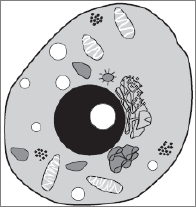
- AAnimal Cell
- BPlant Cell
25If a microscope has a 10X eyepiece and a 4X objective lens, what would the total magnification be?
- A14X
- B40X
- C28X
- D10X
- E4X
26The scientific enterprise is organized around several concepts which make up what is called “[blank_start]the nature of science[blank_end]” (NOS). These concepts serve to standardize and guide scientific inquiry around the globe. Understanding the nature of science helps to understand how science applies to our every day lives and promotes scientific literacy.
- Athe nature of science
- Bthe nowledge of science
- Cthe nature of superfluous
- Dthe nature of signs
27Select each of the following below that are part of "The Nature of Science"
- AThe natural world is understandable
- BScience demands evidence
- CScience is a blend of logic and imagination
- DScience knowledge is durable
- EScience is based on guesses
- FScience knowledge is tangible
- GScience never includes imagination
- HScientific knowledge is subject to change
- IScientists attempt to avoid bias
- JScience is a complex social activity
28[blank_start]Theories[blank_end] are generally used to explain complex natural processes not easily measurable. [blank_start]Laws[blank_end] often use mathematical formulas to show relationships and make predictions about the natural world.
- ATheories
- BLaws
- CLaws
- DTheories
29What is a single living thing and the highest level of organization is called what?
- AAtoms
- BMolecules
- COrganism
- DCells
30The result of reproduction is called [blank_start]offspring[blank_end]. Newly reproduced cells resemble their [blank_start]parents[blank_end].
- Aoffspring
- Bancestor
- Creproductivity
- Dcell regeneration
- Eparents
- Fchildren
- Gkids
- Hgrandparents
31[blank_start]Evolution[blank_end] is when a group of organisms change over a period of time in order to survive changing environments.
- ARevolution
- BEvolution
- CCreationism
- DSolution
32[blank_start]Adaptation[blank_end] is the characteristics that help an organism to survive in its environment
- AAdaptation
- BEvolution
- CCreationism
- DOrganism
33A [blank_start]stimulus[blank_end] is a change in the environment. How you react is called a [blank_start]response[blank_end].
- Astimulus
- Bresponse
- Cevolution
- Dimplementation
Informationen
- Beschreibung
- 7th grade Science Quiz am 7th Grade Science Quiz: Life's Basic Structure, erstellt von Todd Haley am 17/02/2019.
- Autor
- Todd Haley
- Sprache
- English
- Aufrufe
- 18
- Schlagwörter
- Bewertung
- Noch keine Bewertungen Bewerte dieses Quiz