
Quiz
Chemistry Review
Dieses Quiz hat ein Zeitlimit und öffnet sich deshalb im gewohnten Player.
Fragen in diesem Quiz (18)
1Please open this link in another tab fro quick reference.
http://sciencenotes.org/wp-content/uploads/2015/01/PeriodicTableMuted.png
What are valence electrons?- AElectrons in the outermost shell
- BElectrons closest to the nucleus
- CElectrons that are exchanged with other atoms to form bonds
- DElectrons that have a negative charge
- EElectrons that repel from positive protons
2What does the number 18.998 represent?
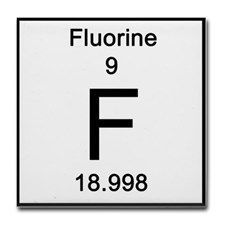
- AAverage Atomic Mass
- BNumber of Protons
- CNumber of Neutrons in an ion
- DAtomic Number
3An [blank_start]ion[blank_end] is when there is an atom with more or less electrons that the usual. Usually, in a stable atom, there are the same number of protons as electrons.
[blank_start]Cation[blank_end] - more protons, less electrons >> [blank_start]positive[blank_end]
[blank_start]Anion[blank_end] - less protons, more electrons >> [blank_start]negative[blank_end]- Aion
- BCation
- CAnion
- Dpositive
- Enegative
4Ionic Bonds - [blank_start]Metal[blank_end] (loses electrons) and [blank_start]Nonmetal[blank_end] (gains electrons)
Covalent Bonds - 2 [blank_start]nonmetal[blank_end] atoms
Polar Covalent Bond - 2 [blank_start]different[blank_end] atoms, [blank_start]Unequal[blank_end] Sharing
Non Polar Covalent Bond - 2 [blank_start]same[blank_end] atoms, [blank_start]Equal[blank_end] Sharing- AMetal
- BNonmetal
- Cdifferent
- DUnequal
- EEqual
- Fnonmetal
- Gsame
5It might be helpful to copy this table on to a piece of paper and fill it out.
All isotopes will be written in this format >> (Element)-(Number)
A - [blank_start]Pb[blank_end]
B - [blank_start]207[blank_end]
C - [blank_start]82[blank_end]
D - [blank_start]125[blank_end]
E - [blank_start]82[blank_end]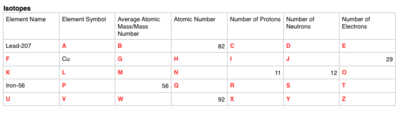
- APb
- B207
- C82
- D125
- E82
6F - [blank_start]Copper-35[blank_end]
G - [blank_start]84[blank_end]
H - [blank_start]29[blank_end]
I - [blank_start]29[blank_end]
J - [blank_start]35[blank_end]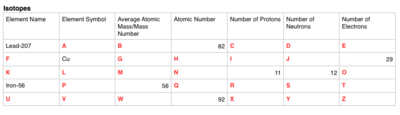
- ACopper-64
- B64
- C29
- D29
- E35
7K - [blank_start]Sodium-11[blank_end]
L - [blank_start]Na[blank_end]
M - [blank_start]23[blank_end]
N - [blank_start]11[blank_end]
O - [blank_start]11[blank_end]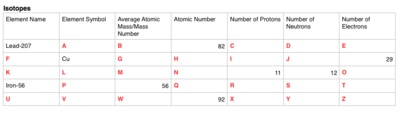
- ASodium-23
- BNa
- C23
- D11
- E11
8P - [blank_start]Fe[blank_end]
Q - [blank_start]26[blank_end]
R - [blank_start]26[blank_end]
S - [blank_start]30[blank_end]
T - [blank_start]26[blank_end]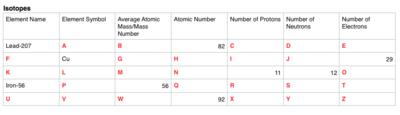
- AFe
- B26
- C26
- D30
- E26
9U - [blank_start]Uranium-146[blank_end]
V - [blank_start]U[blank_end]
W - [blank_start]238[blank_end]
X - [blank_start]92[blank_end]
Y - [blank_start]146[blank_end]
Z - [blank_start]92[blank_end]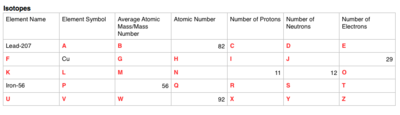
- AUranium-238
- BU
- C238
- D92
- E146
- F92
10It might be helpful to copy this table on to a piece of paper and fill it out.
Please make sure to put the charge (+/-) before the amount (1,2,3,4...).
A - [blank_start]Co[blank_end]
B - [blank_start]+2[blank_end]
C - [blank_start]27[blank_end]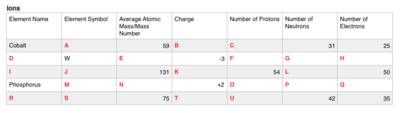
- ACo
- B+2
- C27
11D - [blank_start]Tungsten[blank_end]
E - [blank_start]184[blank_end]
F - [blank_start]74[blank_end]
G - [blank_start]110[blank_end]
H - [blank_start]77[blank_end]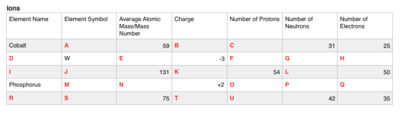
- ATungsten
- B184
- C74
- D110
- E77
12I - [blank_start]Xenon[blank_end]
J - [blank_start]Xe[blank_end]
K - [blank_start]+4[blank_end]
L - [blank_start]77[blank_end]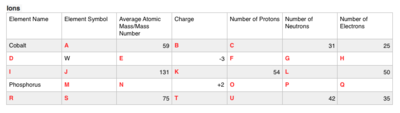
- AXenon
- BXe
- C+4
- D77
13M - [blank_start]15[blank_end]
N - [blank_start]31[blank_end]
O - [blank_start]15[blank_end]
P - [blank_start]16[blank_end]
Q - [blank_start]13[blank_end]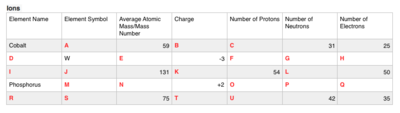
- AP
- B31
- C15
- D16
- E13
14R - [blank_start]Arsenic[blank_end]
S - [blank_start]As[blank_end]
T - [blank_start]-2[blank_end]
U -[blank_start]33[blank_end]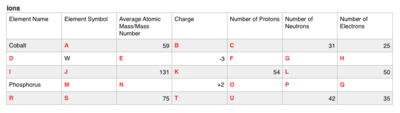
- AArsenic
- BAs
- C-2
- D33
15Describe each bond as ionic, polar covalent, or non polar covalent.
H2O - [blank_start]Polar Covalent[blank_end]
HF - [blank_start]Polar Covalent[blank_end]
NaCl - [blank_start]Ionic[blank_end]
O2 - [blank_start]Non Polar Covalent[blank_end]
LiBr - [blank_start]Ionic[blank_end]
CuO - [blank_start]Ionic[blank_end]- APolar Covalent
- BNon Polar Covalent
- CIonic
- DPolar Covalent
- ENon Polar Covalent
- FIonic
- GIonic
- HPolar Covalent
- INon Polar Covalent
- JNon Polar Covalent
- KPolar Covalent
- LIonic
- MIonic
- NNon Polar Covalent
- OPolar Covalent
- PIonic
- QNon Polar Covalent
- RPolar Covalent
16The goal of atoms (with a few exceptions is to have 8 electrons in their outermost energy shell. This is called the [blank_start]Octet[blank_end] [blank_start]Rule[blank_end].
- AOctet
- BRule
17Polar Covalent substances interact with [blank_start]Polar[blank_end] Covalent substances.
Non Polar Covalent substances interact with [blank_start]Non Polar[blank_end] Covalent.- APolar
- BNon Polar
- CNon Polar
- DPolar
18Which of these is true?
- AHydrophobic - Dislikes Water
- BHydrophobic - Water
- CHydrophilic - Dislikes Water
- DHydrophilic - Likes Water
Informationen
- Beschreibung
- A review of basic chemistry
- Autor
- Urvee ___
- Sprache
- English
- Aufrufe
- 100
- Schlagwörter
- Bewertung
- Noch keine Bewertungen Bewerte dieses Quiz