
Quiz
Chemistry Review
This quiz has a time limit, so it opens in the usual player.
Questions in this quiz (18)
1Please open this link in another tab fro quick reference.
http://sciencenotes.org/wp-content/uploads/2015/01/PeriodicTableMuted.png
What are valence electrons?- AElectrons in the outermost shell
- BElectrons closest to the nucleus
- CElectrons that are exchanged with other atoms to form bonds
- DElectrons that have a negative charge
- EElectrons that repel from positive protons
2What does the number 18.998 represent?
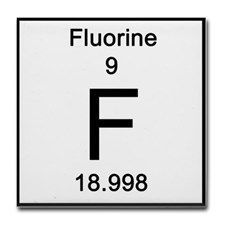
- AAverage Atomic Mass
- BNumber of Protons
- CNumber of Neutrons in an ion
- DAtomic Number
3An [blank_start]ion[blank_end] is when there is an atom with more or less electrons that the usual. Usually, in a stable atom, there are the same number of protons as electrons.
[blank_start]Cation[blank_end] - more protons, less electrons >> [blank_start]positive[blank_end]
[blank_start]Anion[blank_end] - less protons, more electrons >> [blank_start]negative[blank_end]- Aion
- BCation
- CAnion
- Dpositive
- Enegative
4Ionic Bonds - [blank_start]Metal[blank_end] (loses electrons) and [blank_start]Nonmetal[blank_end] (gains electrons)
Covalent Bonds - 2 [blank_start]nonmetal[blank_end] atoms
Polar Covalent Bond - 2 [blank_start]different[blank_end] atoms, [blank_start]Unequal[blank_end] Sharing
Non Polar Covalent Bond - 2 [blank_start]same[blank_end] atoms, [blank_start]Equal[blank_end] Sharing- AMetal
- BNonmetal
- Cdifferent
- DUnequal
- EEqual
- Fnonmetal
- Gsame
5It might be helpful to copy this table on to a piece of paper and fill it out.
All isotopes will be written in this format >> (Element)-(Number)
A - [blank_start]Pb[blank_end]
B - [blank_start]207[blank_end]
C - [blank_start]82[blank_end]
D - [blank_start]125[blank_end]
E - [blank_start]82[blank_end]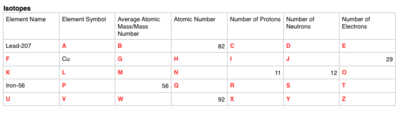
- APb
- B207
- C82
- D125
- E82
6F - [blank_start]Copper-35[blank_end]
G - [blank_start]84[blank_end]
H - [blank_start]29[blank_end]
I - [blank_start]29[blank_end]
J - [blank_start]35[blank_end]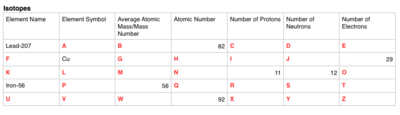
- ACopper-64
- B64
- C29
- D29
- E35
7K - [blank_start]Sodium-11[blank_end]
L - [blank_start]Na[blank_end]
M - [blank_start]23[blank_end]
N - [blank_start]11[blank_end]
O - [blank_start]11[blank_end]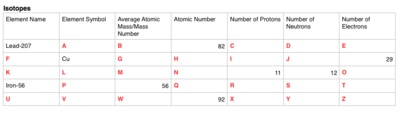
- ASodium-23
- BNa
- C23
- D11
- E11
8P - [blank_start]Fe[blank_end]
Q - [blank_start]26[blank_end]
R - [blank_start]26[blank_end]
S - [blank_start]30[blank_end]
T - [blank_start]26[blank_end]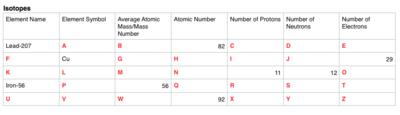
- AFe
- B26
- C26
- D30
- E26
9U - [blank_start]Uranium-146[blank_end]
V - [blank_start]U[blank_end]
W - [blank_start]238[blank_end]
X - [blank_start]92[blank_end]
Y - [blank_start]146[blank_end]
Z - [blank_start]92[blank_end]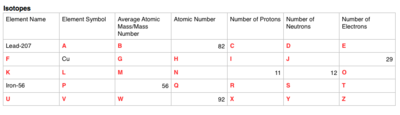
- AUranium-238
- BU
- C238
- D92
- E146
- F92
10It might be helpful to copy this table on to a piece of paper and fill it out.
Please make sure to put the charge (+/-) before the amount (1,2,3,4...).
A - [blank_start]Co[blank_end]
B - [blank_start]+2[blank_end]
C - [blank_start]27[blank_end]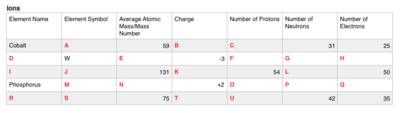
- ACo
- B+2
- C27
11D - [blank_start]Tungsten[blank_end]
E - [blank_start]184[blank_end]
F - [blank_start]74[blank_end]
G - [blank_start]110[blank_end]
H - [blank_start]77[blank_end]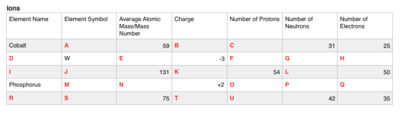
- ATungsten
- B184
- C74
- D110
- E77
12I - [blank_start]Xenon[blank_end]
J - [blank_start]Xe[blank_end]
K - [blank_start]+4[blank_end]
L - [blank_start]77[blank_end]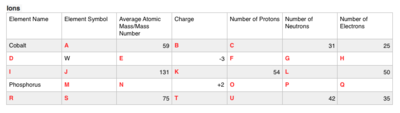
- AXenon
- BXe
- C+4
- D77
13M - [blank_start]15[blank_end]
N - [blank_start]31[blank_end]
O - [blank_start]15[blank_end]
P - [blank_start]16[blank_end]
Q - [blank_start]13[blank_end]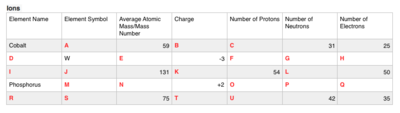
- AP
- B31
- C15
- D16
- E13
14R - [blank_start]Arsenic[blank_end]
S - [blank_start]As[blank_end]
T - [blank_start]-2[blank_end]
U -[blank_start]33[blank_end]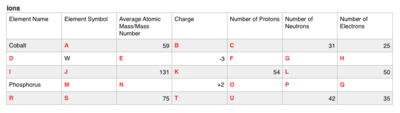
- AArsenic
- BAs
- C-2
- D33
15Describe each bond as ionic, polar covalent, or non polar covalent.
H2O - [blank_start]Polar Covalent[blank_end]
HF - [blank_start]Polar Covalent[blank_end]
NaCl - [blank_start]Ionic[blank_end]
O2 - [blank_start]Non Polar Covalent[blank_end]
LiBr - [blank_start]Ionic[blank_end]
CuO - [blank_start]Ionic[blank_end]- APolar Covalent
- BNon Polar Covalent
- CIonic
- DPolar Covalent
- ENon Polar Covalent
- FIonic
- GIonic
- HPolar Covalent
- INon Polar Covalent
- JNon Polar Covalent
- KPolar Covalent
- LIonic
- MIonic
- NNon Polar Covalent
- OPolar Covalent
- PIonic
- QNon Polar Covalent
- RPolar Covalent
16The goal of atoms (with a few exceptions is to have 8 electrons in their outermost energy shell. This is called the [blank_start]Octet[blank_end] [blank_start]Rule[blank_end].
- AOctet
- BRule
17Polar Covalent substances interact with [blank_start]Polar[blank_end] Covalent substances.
Non Polar Covalent substances interact with [blank_start]Non Polar[blank_end] Covalent.- APolar
- BNon Polar
- CNon Polar
- DPolar
18Which of these is true?
- AHydrophobic - Dislikes Water
- BHydrophobic - Water
- CHydrophilic - Dislikes Water
- DHydrophilic - Likes Water
Information
- Description
- A review of basic chemistry
- Author
- Urvee ___
- Language
- English
- Views
- 100
- Tags
- Rating
- No ratings yet Rate this quiz