
Quiz
Proteins
Dieses Quiz enthält Fragetypen, die sich im gewohnten Player öffnen.
Fragen in diesem Quiz (11)
1This molecule is...
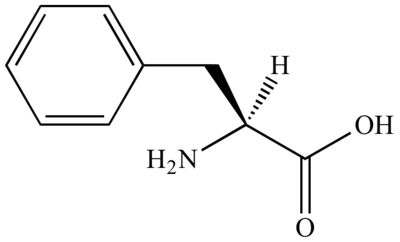
- AA triglyceride
- BAn alcohol
- CAn amino acid
- DStarch
2Which of the following statements are true about proteins? Check all that apply.
- AThey are amino acid polymers.
- BThey consist of polypeptides.
- CPeptide bonds are formed in hydrolysis reactions.
- DPrimary structure is the sequence of amino acids.
3[blank_start]Amino acid[blank_end] sequence determines the [blank_start]primary[blank_end] structure of a protein. This is determined by the codons in DNA and m[blank_start]RNA[blank_end]. [blank_start]Secondary[blank_end] structure refers to one of two shapes that a polypeptide may take: beta-[blank_start]pleated sheet[blank_end] or alpha [blank_start]helix[blank_end]. This is determined by [blank_start]hydrogen[blank_end] bonding. [blank_start]Tertiary[blank_end] structure is the further folding of the polypeptide on itself. The polypeptide begins to form a more complex, unique, three-dimensional shape. Finally, [blank_start]quaternary[blank_end] structure - which does not apply to all proteins - is the interaction between several polypeptides to form a globular protein, one common example being [blank_start]haemoglobin[blank_end], responsible for carrying oxygen.
- AAmino acid
- Bprimary
- CRNA
- DSecondary
- Epleated sheet
- Fhelix
- Ghydrogen
- HTertiary
- Iquaternary
- Jhaemoglobin
4Label the types of bonds found in the tertiary structure of proteins.
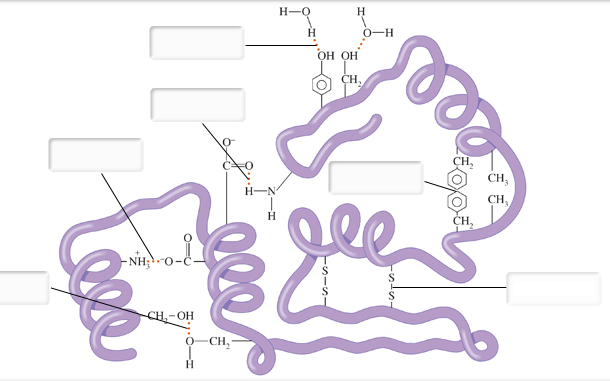
- ADisulphide bridge
- BHydrogen bond
- CIonic bond
- DHydrophobic attraction
- EHydrophilic attraction
- FHydrophobic attraction
- GHydrophilic attraction
- HIonic bond
- IHydrogen bond
- JDisulphide bridge
- KHydrophobic attraction
- LHydrophilic attraction
- MHydrogen bond
- NIonic bond
- ODisulphide bridge
- PHydrophilic attraction
- QHydrophobic attraction
- RIonic bond
- SHydrogen bond
- TDisulphide bridge
- UHydrophilic attraction
- VHydrophobic attraction
- WIonic bond
- XHydrogen bond
- YDisulphide bridge
- ZHydrophilic attraction
- AAHydrophobic attraction
- ABDisulphide bridge
- ACIonic bond
- ADHydrogen bond
5[blank_start]Fibrous[blank_end] proteins tend to have structural roles, while [blank_start]globular[blank_end] proteins usually have [blank_start]functional[blank_end] roles.
- AFibrous
- Bglobular
- Cfunctional
6Functional proteins are more soluble than structural proteins.
- ARichtig
- BFalsch
7Fibrous proteins are more resistant to changes in pH and temperature than globular proteins.
- ARichtig
- BFalsch
8Which of the following are structural proteins? Check all that apply.
- AElastin
- BKeratin
- CCollagen
- DHaemoglobin
- EInsulin
- FPepsin
9[blank_start]Haemoglobin[blank_end] is a [blank_start]functional[blank_end], [blank_start]globular[blank_end] protein with a [blank_start]quaternary[blank_end] structure consisting of [blank_start]four[blank_end] polypeptide sub-units. It also has a [blank_start]prosthetic group[blank_end], which is essential to its purpose of carrying [blank_start]oxygen[blank_end] around the body.
- AHaemoglobin
- BElastin
- CKeratin
- DCollagen
- Efunctional
- Fstructural
- Gglobular
- Hfibrous
- Iquaternary
- Jprimary
- Ksecondary
- Ltertiary
- Mfour
- Nthree
- Otwo
- Pfive
- Qprosthetic group
- Rcarboxyl group
- Sactive site
- Toxygen
- Ucells
- Vglucose
- Winsulin
10Insulin contains only alpha helices.
- ARichtig
- BFalsch
11The role of insulin is to regulate [blank_start]glucose[blank_end] concentration in the blood. It does this by binding to a [blank_start]specific[blank_end] target receptor, which triggers the [blank_start]uptake[blank_end] of [blank_start]glucose[blank_end] into cells and the metabolism of [blank_start]glucose[blank_end] in [blank_start]respiration[blank_end]. The overall effect is a [blank_start]decrease[blank_end] in blood [blank_start]glucose[blank_end] concentration.
- Aglucose
- Bcholesterol
- Cwater
- Dhydrogen ion
- Especific
- Fnonspecific
- Guptake
- Hrelease
- Isynthesis
- Jglucose
- Kcholesterol
- Lwater
- MATP
- Nglucose
- Ocholesterol
- Pglycogen
- Qtriglycerides
- Rrespiration
- Sphotosynthesis
- Tglycogenesis
- Uglucogenesis
- Vdecrease
- Wincrease
- Xglucose
- Ycholesterol
- Zwater
- AAhydrogen ions
Informationen
- Beschreibung
- Biology (Biological Molecules) Quiz am Proteins, erstellt von Daniel Brand am 14/02/2017.
- Autor
- Daniel Brand
- Sprache
- English
- Aufrufe
- 3.431
- Schlagwörter
- Bewertung
- Noch keine Bewertungen Bewerte dieses Quiz