
Geography - Rocks and Landscapes
Folien in diesem Satz (6)
-
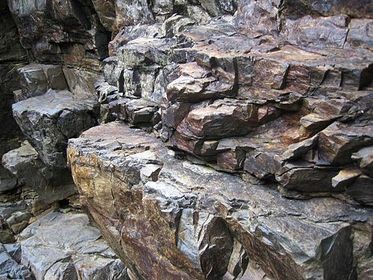
- Rocks found on the Earth's surface actually come from inside the Earth -
- so they tell us a lot about the Earth's interior.
- They are classified
- (organised) into three main groups: igneous rocks, sedimentary rocks and
- metamorphic rocks.
- Rock Types
- Igneous rock
- Sedimentary rock
- Metamorphic rock
-
- Igneous rocks are formed by magma
- from the molten interior of the Earth. When magma erupts it cools to
- form volcanic landforms. If magma cools inside the Earth it forms intrusive rock, which may later be exposed by erosion and weathering.
- Examples of igneous rocks include basalt and granite.
- https://www.youtube.com/watch?v=nHEzJQzDH80 (Einbetten)
-
- Metamorphic rocks have been subjected to tremendous heat and/or
- pressure, causing them to change into another type of rock. They are
- usually resistant to weathering and erosion and are therefore very
- hard-wearing.
- Examples of metamorphic rocks include marble, which originates from limestone, slate, which originates from clay, and schists formed from sandstone or shale (sedimentary rocks).
- https://www.youtube.com/watch?v=ckypDmkbhb8 (Einbetten)
-
- Sedimentary rocks are formed from sediments that have settled at the
- bottom of a lake, sea or ocean, and have been compressed over millions
- of years. The sediment comes from eroded rocks carried there by rivers
- or ice, and from the skeletons of sea creatures.
- Examples of sedimentary rocks include sandstone, limestone, chalk and clay.
- https://www.youtube.com/watch?v=G0ru-kLpedo (Einbetten)
-
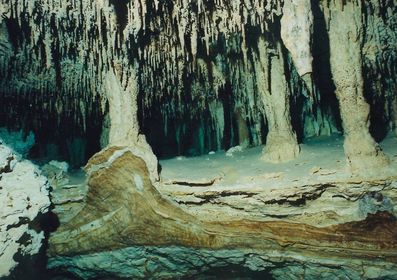
- The limestone solution process is also known as carbonation.
- Limestone is made of calcium carbonate. When carbon dioxide is dissolved in rainwater, it makes a weak acid called carbonic acid.
- When
- carbonic acid comes into contact with limestone and passes through
- joints and bedding planes, it reacts with the rock to form calcium bicarbonate.
- The calcium bicarbonate is soluble and is carried away in solution, gradually weathering the limestone.
-
- When rock is exposed to weather
- conditions it becomes subject to processes, such as freeze-thaw
- weathering, that cause it to change and break down.
- Freeze-thaw weathering
- The freeze-thaw weathering process is also known as frost shattering.
- Water - eg from rainfall or melting snow and ice - becomes trapped in a crack or joint in the rock.
- If the air temperature drops below freezing, the water will freeze and expand by 9-10 per cent putting pressure on the rock.
- The ice will melt when the temperature rises above freezing.
- If this process happens repeatedly, the rock will weaken and eventually shatter into angular fragments.
- The fragments may then be deposited as scree at the foot of a slope.
- It is most effective where the temperature fluctuates around 0°C, eg on north-facing high altitude slopes in Snowdonia.
- Igneous Processes and Products
- The Rock Cycle
- The Rock Cycle
- Types of Rock
Informationen
- Beschreibung
- Geography - Rocks and Landscapes
- Erstellt von
- Landon Valencia
- Aufrufe
- 228
- Tags
- Bewertung