
Chemical Reactions
Folien in diesem Satz (7)
-
- Oxidised: When a substance reacts with oxygen to form an oxide.
- Tarnish: When a shiny metal gets a dull coating due to its reaction wit oxygen.
- Corrode: When a substance wears away because it has reacted with other chemicals in the air or in water.
- When a metal reacts with oxygen it will form a METAL OXIDE. This is what happens when metal rusts or burns.
- METAL + OXYGEN =METAL OXIDE Mg Mg + O O = Mgo Mgo » 2mg + O₂
-
- Strontium (Sr) - Most Reactive To protect from corrosion cover
- Calcium (Ca) metal with paint since it will
- Magnesium (Mg) prevent it from corroding
- Zinc (Zn)
- Iron (Fe)
- Copper (Cu)
- Gold (Au) - Unreactive
-
- Strontium is used for making flares and fireworks for its crimson colour. It's primary use is for glass on colour television but it is also used for nuclear batteries in buoys.
- Calcium is a mineral that is essential for life, it helps to build and maintain strong bones. It can also be used to remove impurities from metals alloys.
- Magnesium is required for energy production and glycolysis,
- Zinc is a mineral that is in some foods such as oysters and beef. It is also used to make TV screens.
- Iron is an essential mineral which helps to make red blood cells.
- Copper is a reddish-brown metal and is ductile with high thermal conductivity.
- Gold is a precious yellow metal which is dense, soft, malleable and ductile which doesn't tarnish in air or in water.
-
- From Least to Most Reactive When a metal reacts with water, hydrogen is
- Lithium (Li) always given off. The other product is a metal
- Sodium (Na) metal hydroxide. sodium + water » sodium
- Potassium (K) hydroxide + hydrogen.
- Rubidium (Rb)
- Caesium (Cs)
- Francium (Fr)
-
- This is the gradual breakdown of a material by chemical action.
- Paint provides a barrier between metal and air, water and acid but is easily scratched.
- Oil protects metal when submerged but can easily wash off.
- Plastics tend to be resistant to corrosion and can protect metal parts.
- Galvanising is when a layer of zinc is coated on a less reactive metal, even if the layer is damaged the zinc will react before the metal as it is more reactive. This is an example of sacrificial protection. Aluminium can also carry out sacrificial protection.
- Plating is a layer of a less reactive metal (such as tin or nickel ) which is coated over the metal needing protection, however if the under breath is exposed to corrosion.
-
- Reactivity is the ability to take part in chemical reactions- the reactivity of an element. The more it's chemically reactive, the its nature to undergo chemical changes and form a variety or compounds.
- A displacement reaction is one where a more reactive metal will displace a less reactive metal from a compound.
- Magnesium + Copper Sulphate = Magnesium Sulphate + Copper
- Mg + CuSO₄ = MgSO₄ + Cu
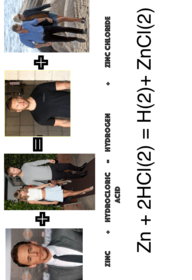
- Bildunterschrift: Tom Hiddleston + Taylor Swift and Calvin Harris » Calvin Harris + Taylor Swift and Tom Hiddleston
-
- Atoms of reactants REARRANGE to form new substances- the products
- In any reaction the total mass of the products is the same as the total mass of the reactants.
- MgO +2HO» Mg2O + OHO Magnesium oxide and hydrochloric acid
- Burning Methane
- CH₄ + O₂ = CO₂ + H₂O After balancing: CH₄ +2O₂ = CO₂ + 2H₂O
Informationen
- Beschreibung
- Year 8 KS3 Chemistry: Chemical Reactions
- Erstellt von
- Sarita Saha
- Aufrufe
- 98
- Tags
- Bewertung