
Karteikarten
Animal Parasitism: Medical, Veterinary and Ecological Aspect
Karten in diesem Stapel (73)
- 1Definition of ParasiteAn organism which lives in or on another organism (its host) and benefits by deriving nutrients at the other’s expense
- 2Defininition of HOSTAn animal or plant in which a parasitic organism lives
- 3Question TextAnswer Text
- 4Question TextAnswer Text
- 5Question TextAnswer Text
- 6Question TextAnswer Text
- 7Question TextAnswer Text
- 8Question TextAnswer Text
- 9Question TextAnswer Text
- 10Question TextAnswer Text
- 11Question TextAnswer Text
- 12Question TextAnswer Text
- 13Question TextAnswer Text
- 14Question TextAnswer Text
- 15Question TextAnswer Text
- 16Question TextAnswer Text
- 17Phylum PlatyhelminthsMost primitive metazoan group that has a well developed organ system in mesodermal layer (between the epidermal layer and gut).
Also has bilater symmetry and head development
THREE MAJOR CLASSES
1. Turbellaria
2. Trematoda
3. Cestoda - 18Cestoda1. Phylum Platyhelminthes
2. Parasitic tapeworms - 19TAENIA SOLIUM1. Pork tapeworm
2. 2-3 metres
3. Cestoda - 20Question TextAnswer Text
- 21DIPHYLLOBOTHRIUM LATUM1. Cestoda
2. Platyhelminthes
3. Fish or broad tapeworm
4. 10m - 22Trematoda1. Parasitic flukes
2. Phylum Platyhelminthes - 23SCHISTOSOMA SP.1. Trematoda
2. Platyhelminthes
3. Blood flukes - 24FASCIOLA HEPATICA1. Trematoda
2. Platyhelminthes
3. Liver fluke - 25PARAGONIMUS WESTERMANI1. Trematoda
2. Platyhelminthes
3. Lung flukes - 26Phylum Aschelminthes1. Nematodes
2. Both free living and parasitic
3. Round worms - 27Question TextAnswer Text
- 28Question TextAnswer Text
- 29Innate immunity: PhysicalPhysical barriers such as the skin and mucus secreted over the epithelial cells lining the gut or respiratory tract
- 30Innate immunity: MicrobialNatural microbial flora that lives externally on the body surface and within the intestinal and genital tract - important in preventing infection by pathogens through competition and release of anti-microbial substances
- 31Innate immunity : PhysiologicalWhen physical barriers are breached.
Defensins- soluble chemical secreted in lung tissue and gut
Leukocytes - 32Leukocytes (2 types)1. Tissue based cells (macrophages and dendritic cells)
2. Blood borne cells (neutrophils, eosinophils, natural killer cells) - 33Use of leukocytesAble to recognise invading organisms and kill them through phagocytosis or through the release of noxious chemicals - hydroxyl radicals or antibiotic peptides
- 34What is the complement system?Part of the innate system that helps or complements the ability of antibodies and phagocytic cells to clear pathogens from an organism
- 35What are the characteristics of ‘The Complement System’1. not adaptable and does not change over an individuals lifetime
2. recruited and brought into action by the adaptive immune system through
3. classical pathway, antibody mediated OR alternative pathway WHICH IS NOT ANTIBODY MEDIATED
4. Consists of a number of small proteins found in the blood synthesised by the liver - 36How does the complement system work?When stimulated by one of several triggers, proteases in the system split specific proteins to release cytokines and initiate an amplifying cascade of further splitting
- 37Response of The complement system?End result is the massive amplification if the response and activation of the cell-killing membrane attack complex.
- 38Name the three biochemical pathways that activate the complement system:1. Classical complement pathway
2. Alternative complement pathway
3. Lectin pathway - 39What is an Opsonin?Any molecule that enhances phagocytosis by marking an antigen for an immune response (opsonin is Greek for ‘to prepare for eating)
- 40Basic functions of complement:Opsonization: enhancing phagocytosis
Chemotaxis: attracting macrophages and neutrophils
Cell lysis: rupturing membranes of foreign cells (membrane attack complex)
Agglutination: clustering and bonding of pathogens together (sticking) - 41What are the two types of adaptive immunity:Passive and reactive
- 42Describe Adaptive immunity: PassiveAntibodies received from another organism e.g. passage of antibodies (Ab) from the mother to the foetus (via the placenta) it new born via milk-
Confess some protection against infections for the young while the immune system is developing. Will wear off in a few weeks/ months as these Abs decline - 43Describe Adaptive immunity: reactiveOrganism mounts its own response to a challenge by a pathogen
- 44Whether passive or reactive, what are the three classes of responses mediated by lymphocyte s?1. B lymphocytes
2. T lymphocytes
3. Natural Killer (NK) lymphocytes - 45What is B lymphocytes response to stimulation?Develop into B cells that secrete antibodies (Immunoglobulins)
- 46What is T lymphocytes response to stimulation?Regulate other immune cells or kill virus- infected cells
- 47What is Natural Killer (NK) lymphocytes response to stimulation?Kill virus-infected cells and tumour cells
- 48What is the use of the adaptive immunity?This response provides specific response to a specific antigen
Lymphocytes: May become memory cells following initial exposure to pathogen - 49What are the step of adaptive immunity?1. Memory cells are produced by initial exposure of pathogen, secondary exposure causes mass expansion of specific lymphocytes resulting in more rapid and effective immune responses THIS IS DONE BY
2. B lymphocytes produce antibodys
3. Antibodies produced become specific to a particular antigen molecule on or produced by the pathogen (parasite) - 50Antibodies produced by the adaptive immune system does not directly harm a pathogen... butBinding can tigger potent responses against the invader
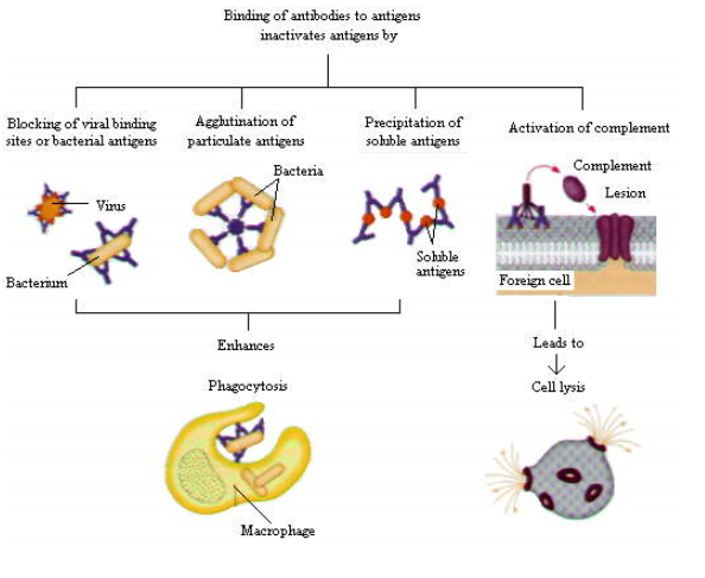
- 51What are the binding responses triggered by the adaptive immune system1. Soluble immunoglobulins attach to antigens and thereby make them recognisable to phagocytic cells as objects to be phagocytosis. Process called OPONISATION.
2. Immunoglobulins bund to antigens and ‘clump’ them to increase their size and increase the chances of phagocytosis
3. Immunoglobulins bind to certain toxins to render them non-toxic - 52Binding of antibodies to antigens inactivates antigens by:Enter text here...
- 53What is the use of cell mediated immunityControlled by T lymphocytes (T-cells) have a set of receptors on their membranes that are able to bind to other receptor molecules on host cells THESE ARE KNOWN AS MAJOR HISTOCOMPATIBILITY COMPLEX (MHC)
- 54What is MHC good for?Important mechanism for host immune system to distinguish self from on self
- 55MHC Class 1Detected by sub types of T lymphocytes, cytotoxic T cells and NK cells.
These cytotoxic cells carry surface glycoproteins CD8 therefore known as CD8 positive cells (CD8+be)
Cytotoxic T cells an natural killer cells are able to bind are able to bind MHC 1 of the infected host cell and destroy in by releasing PERFORIN - 56What does perforin do?Causes the formation of a pore on the infected cell membrane allowing the entry of factors generated by cytotoxic T cells destroying the infected cell (and the pathogen)
- 57MHC Class IIdetected by sub types of T lymphocytes known as T helper cells (CD4+ve cells).
Antigens are present mai king on the surface of B lymphocytes, macrophages and dendritic cells (antigen presenting cells) - 58What are the three sub sets of T helper lymphocytes1. T helper cell 1 (Th1)
2. T helper cell 2 (Th2)
3. T helper cell 17 (Th17) - 59T helper cells don’t directly kill pathogens but...Regulate other immune responses through the release of cytokines (such as the interleukins)
- 60How is the immune response to helminth different to Protozoa?Helminths cannot be ingested by phagotic cells such as macrophages (too large)
- 61Describe LEISHMANIA MAJOR (Protozoa) and how the immune response respondsProtozoan, single cellular parasite invades host macrophages.
Immunity based on T helper 1(Th1) response.
This activated neutrophils and macrophages stimulating the production of nitric oxide to kill the parasites - 62What parasite causes malaria disease?Plasmodium spp.
- 63Structure of malaria parasiteApicomlexan structure
- 64Four main species casing malaria in humansP. falciparum, p. ovale, p. vivax, p. malariae
- 65Immune response to malaria parasite1. inter-cellular location
2. expression of antigens on the surface of the infected erythrocyte provide a target for the hosts immune system
3. parasite counters by altering the structure of the presented surface molecules into antigentically distinct forms
4. PfEMP1 (Erythrocyte membrane protein-1) is switched structerally to evade the host immune system - 66How much antigenic switching occurs each generation of malaira parasite?2% per generation -but increases with immune pressure from the host
- 67Immunity to Malaria1. people in endemic regions develop immunity to infection
2. subjects always show symptoms of infection following initial exposure but subsequent exposure results in reduced symptoms
3. Immunity slow to develop due to parasitic antigenic variation mechanisms
4. Ab binding - may block cell invasion by the merozoite or initiate Ab cytotoxic killing of the parasite
5. no current vaccine - 68What anti-malaria drugs are there?Chloroquine - fast acting blood schizontocide (not effective against falciparium due to developed resistance)
Primaquine - effective against liver stage. mainly used to treat P. vivax or P. ovale malaria
Arteminsin - located from plant and used in Chinese traditional medicine
Severe p. falciparum treated with i.v. 'dug cocktail' - 69Malaria control strategiesChemophrophylaxis - used on people travelling to endemic areas
Mosquito nets and insecticidal sprays - 704 main classes of insecticidesOrganophosphates, cabamates, pyrethroids and DDT
- 71Malaria VaccineRTS,S - Mosquirix
protein based malaria vaccine
27 - 46% efficacy - 72Parasitic Protozoa (kineoplastids) Cutaneous and Visceral LeishmaniasisCauses by Leishmaniasis species
Located in topical and sub-tropical regions throughout the world
Transmitted by Sand fly vector (genus Phlebotomus) - 73—
Informationen
- Beschreibung
- University Level 6 Animal Parasitism Revision
- Erstellt von
- Zoë white
- Aufrufe
- 61
- Tags
- Bewertung