
Karteikarten
GCSE CHEMISTRY UNIT 2 STRUCTURE AND BONDING
Karten in diesem Stapel (18)
- 1What is a compound?A substance in which two atoms of two or more elements are chemically combined.
- 2What does chemical bonding involve?Either transferring or sharing electrons in the highest occupied energy levels (shells).
- 3What does chemical bonding achieve?The electronic structure of a noble gas
- 4When atoms form chemical bonds, what do they form?IONS
- 5What happens when an atom looses an electron?It becomes positively charged.
- 6What happens when an atom gains an electron?It becomes negatively charged
- 7What to metal atoms form?Positive ions.
- 8What do non-metal ions form?Negative ions.
- 9What is an ionic bond?The strong electrostatic forces of attraction between oppositely charged ions.
- 10How would you work out how many charges an ion should have?- When it's a metal ion the charge is equal to the group number of the metal.
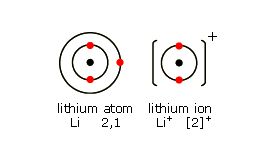
- When it's a non-metal the charge is equal to the group number minus 8. - 11Draw a lithium atom becoming positive. (Li 2,1)
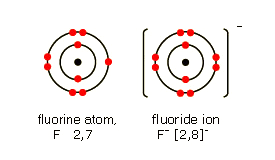
- 12Draw a fluorine atom becoming negative. (F 2,7)
- 13What is an ionic compound?When metals and non-metals share electrons forming ions. A giant structure of ions.
- 14What are the group one elements called and what do they form when reacting with non-metals?Alkali metals.
They form an ionic compound with a single positive charge. - 15What are the elements in group 7 called and what do they form when they react with metals?Hallogens.
They form ionic compounds with a single negative charge. - 16When atoms share pairs of electrons, what do they form?Covalent bonds.
- 17What do metals consist of in structure and bonding?Giant structures of atoms arranged in a regular pattern.
- 18What happen to the electrons in the highest occupied energy levels (shells) of metal atoms?They are delocalised and so move freely through the whole structure. This corresponds to a structure of positive ions with electrons between ions holding them together by strong electrostatic connections.
Informationen
- Beschreibung
- These flashcards are every thing you need to know on UNIT 2 CHEMISTRY GCSE TOPIC 1 STRUCTURE AND BONDING. It mostly follows ionic bonds but there is some other information on covalent bonds too. This would be a higher teer revision guide for GCSE's, 2014/15.
- Erstellt von
- ktmoo.poppypoo
- Aufrufe
- 1.002
- Tags
- Bewertung