
Karteikarten
Week 7 Lns

Karten in diesem Stapel (37)
- 1Can you recall the keypoints of 13
- 2Can you recall the points of lecture 14

- 3For Magnetism; State the Lorentz Define magnetisation in terms of dipoles Define hypothetical magnetic field in terms of B and external Bo What does magnetic susceptibility describe, state it in terms of M, H, uo, Bo

- 4State the relations for; magnetic dipole moment from current atomic magnetic moments Bohr Magneton energy of a dipole in B torque on a dipole in B

- 5Define Lamor precession and its frequency relation

- 6When mag susc is less than zero what happens to diamagnetsrepelled by magnetic field
- 7For Langevin Diamagnetism; What is the setup What is found?

- 8State the final form of the Langevin diamagnetic susceptibility

- 9State the relation for the susceptibility for one mole of atoms

- 10For the QM Langevin Diamagnetism, state; vector potential for magnetic field Hamiltonian

- 11For the QM Langevin Diamagnetism, state; diamagnetic energy contribution magnetic moment

- 12To summarize Diamagnetism; Describe precession of electron orbitals Chi and T dependence Langevin d susc relation normal diamagnets chi range superconductors chi range diamagnetic levitation

- 13For Paramagnetism; What is Chi, relation to applied field strength compared to diamagnetism Origin Curies Law

- 14For QM Paramagnetism; what is considered magnetic moment relation values for g energy levels in a magnetic field

- 15For 2 level system in paramagnetism; Sketch a single electron showing 2uB Sketch showing upper and lower states Net MagnetisationTwo-level systems, that is systems with essentially only two energy levels are
important kind of systems, as at low enough temperatures, only the two
lowest energy levels will be involved. Especially important are solids where
each atom has two levels with different energies depending on whether the
electron of the atom has spin up or down.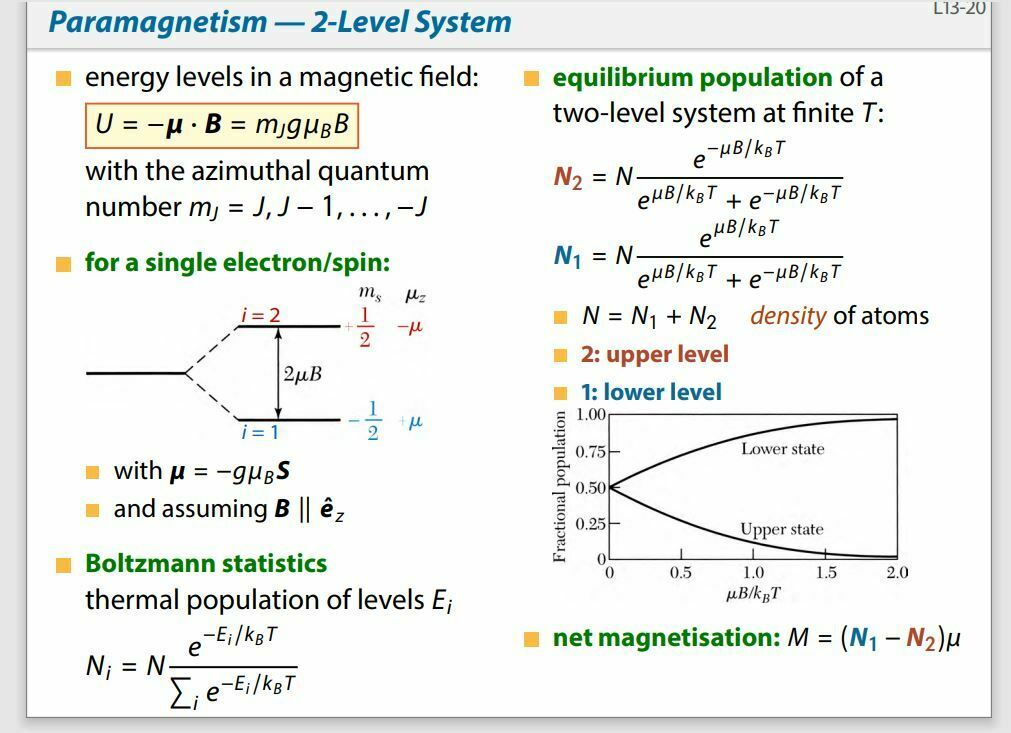
- 16For 2 level system in paramagnetism; Relation for magnetisation in terms of B and T (tanh) Sketch for tanh(1/tau) vs tauFor small values of
µB/kBT
we can use a Taylor expansion of the
hyperbolic function and get
M ≈ Nµ (µB/kBT)
In this approximation the
magnetisation is inversely proportional to
temperature. This is Curies Law
- 17Describe Langevin Paramagnetism for Multi-Level Systems; atoms Magnetisation

- 18For Langevin Paramagnetism for Multi-Level Systems, recover Curies law in the high temperature limit

- 19For Paramagnetism in metals; state M in the high t limit Fermi dirac distribution connection T contribution

- 20For Chi vs T, sketch overlapping Langevin PM Pauli PM Langevin DM

- 21For conduction of electrons in metals with paramagnetism; State M in the high t limit for a 2 level system Fermi Dirac statement DOS vs energy vs energy for 1000K and 300K

- 22For conduction in metals with paramagnetism; Sketch the four E vs DOS for the parallel to field and opposite to field shifting by 2uB

- 23For conduction in metals with paramagnetism; YB; State the magnetic susceptibility in terms of uoM and B, uoub squared and D What can be found by using the free electron gas equation for D

- 24What four ways can the DOS be expressed as What does the Pauli Susceptibility DOS need to yield

- 25State the Landau diamagnetic susceptibility in terms of the Pauli Susceptibility

- 26Can you recall the summary for Dia and Paramagnetism

- 27For magnetic orders, sketch the spin arrows for; simple ferromagnet simple antiferromagnet ferrimagnet canted antiferromagnet helical spin array ferromagnetic energy band Describe interaction between magnetic moments What is saturation magnetisation

- 28For the magnetisation of ferromagnet, sketch M as a function of H showing; Ms, Mr, Hc initial magnetisation hysteresis loop

- 29Sketch susceptibility as a function of T for; Paramagnetism Ferrromagnetism Antiferromagnetism

- 30Explain the mean field approximation by mentioning; spin spin interaction Exchange field MFA defined

- 31YB; state Currie Weiss law State; Curie law for paramagnets T and TC for paramagnetic disorder, ferromagnetic order Magnetisation for T> Tc deriving uoM Sketch Chi vs T showing complex behaviour region

- 32For the saturation magnetisation of Nickel, sketch Ms(T)/Ms(0) vs T/Tc

- 33To describe Magnons, mention; Spins in a line, Heisenberg interaction, ground state energy, energy of one spin flipped, spin waves General definitionA magnon is a quasiparticle, a collective excitation of the spin structure of an electron in a crystal lattice. In the equivalent wave picture of quantum mechanics, a magnon can be viewed as a quantized spin wave. Spin excitations are distributed over all spins like acoustic phonons.

- 34State the 1D magnon dispersion relation

- 35What can be used to measure magnon dispersion relationsInelastic neutron scattering where neutrons have a magnetic moment
- 36For Temperature Dependence of the Saturation Magnetisation, explain the lower Ms(T) at low Tdue to low-energy
spin-wave excitations - 37—
Informationen
- Beschreibung
- 13, 14
- Erstellt von
- R S C · Jul 2024
- Aktualisiert
- 19 Jul 2024
- Aufrufe
- 10
- Bewertung
Mehr zu Magnetic Materials and Magnetisation